

Wednesday 09 April 2025
Researchers have been fascinated by artificial spin systems, also known as artificial spin ices, for years. These systems consist of arrays of nanoscale magnets arranged in specific patterns, which can exhibit unique magnetic properties when cooled to very low temperatures. The study of these systems has led to a deeper understanding of the fundamental laws of physics and has potential applications in fields such as computing and data storage.
Recently, scientists have been exploring artificial spin systems based on Archimedean lattices, a family of two-dimensional patterns that are found naturally in materials like crystals and quasicrystals. These lattices are particularly interesting because they can exhibit a wide range of magnetic ordering behaviors, from simple ferromagnetism to complex frustrated states.
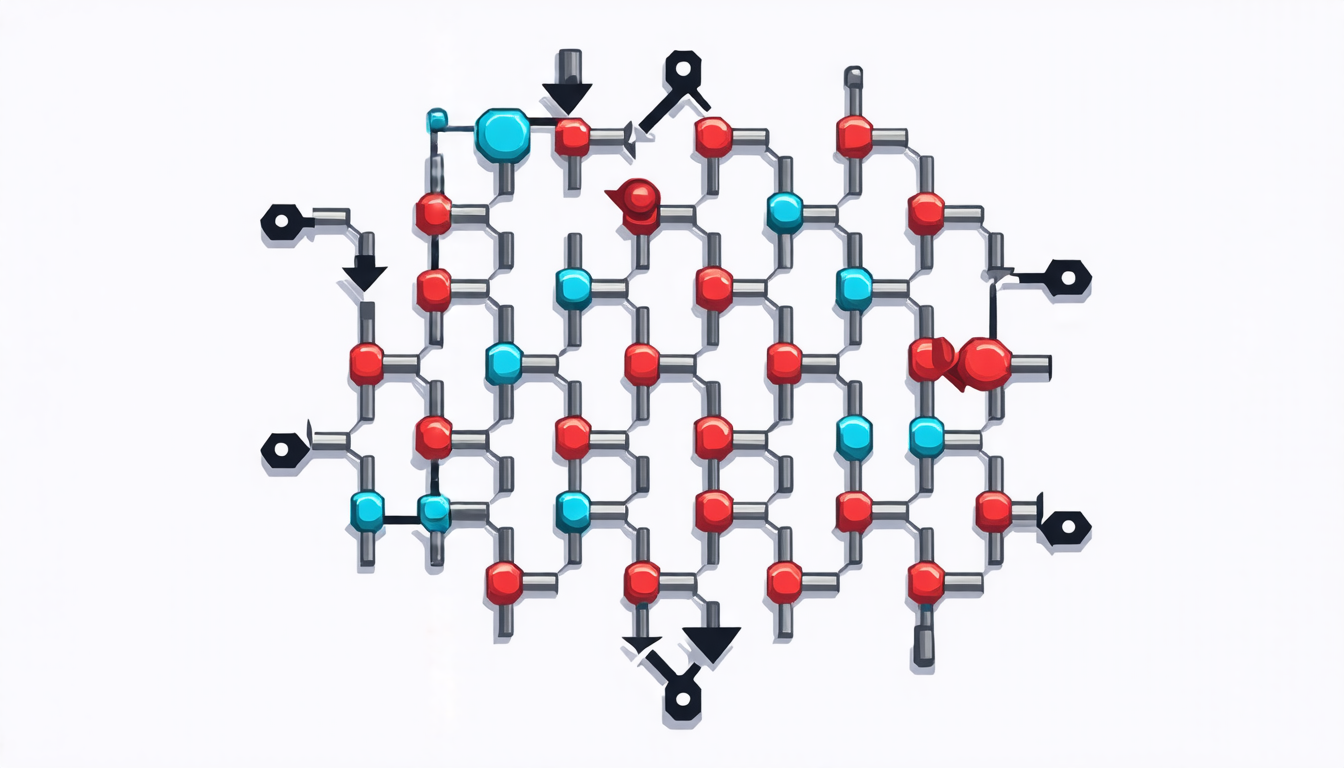
In a new study, researchers have created artificial spin systems based on 11 different Archimedean lattices, including the familiar triangular and square lattices. By carefully designing the arrays of nanomagnets and cooling them to very low temperatures, they were able to observe a variety of magnetic ordering behaviors, including ferromagnetism, antiferromagnetism, and spin liquid states.
One of the most exciting discoveries was that some of the Archimedean lattices exhibited complex frustrated states, where the magnets are unable to align in a straightforward way due to the geometry of the lattice. These states are thought to be responsible for many of the unusual properties of artificial spin systems.
The researchers used a combination of experimental techniques, including magnetic force microscopy and Monte Carlo simulations, to study the behavior of their artificial spin systems. By comparing the results of these experiments with theoretical predictions, they were able to gain a deeper understanding of the underlying physics of the systems.
This research has important implications for our understanding of complex magnetic systems and could potentially lead to new technologies for computing and data storage. Artificial spin systems are particularly interesting because they can be designed to exhibit specific properties, such as frustration or non-collinearity, which are difficult to achieve in natural materials.
The study of artificial spin systems is an active area of research, with many scientists around the world working on this topic. The development of new experimental techniques and theoretical tools will likely continue to advance our understanding of these complex magnetic systems and could potentially lead to breakthroughs in fields such as computing and data storage.
Cite this article: “Magnetic Tiling Unlocks Artificial Spin Ices Hidden Potential”, The Science Archive, 2025.
Artificial Spin Systems, Archimedean Lattices, Nanomagnets, Magnetic Ordering Behaviors, Ferromagnetism, Antiferromagnetism, Spin Liquid States, Frustrated States, Monte Carlo Simulations, Magnetic Force Microscopy.





