

Wednesday 09 April 2025
Knots are a fundamental part of our understanding of mathematics and physics, but they can also be incredibly complex and difficult to study. One of the biggest challenges is that knots come in many different forms and sizes, making it hard to develop a comprehensive theory that applies to all of them.
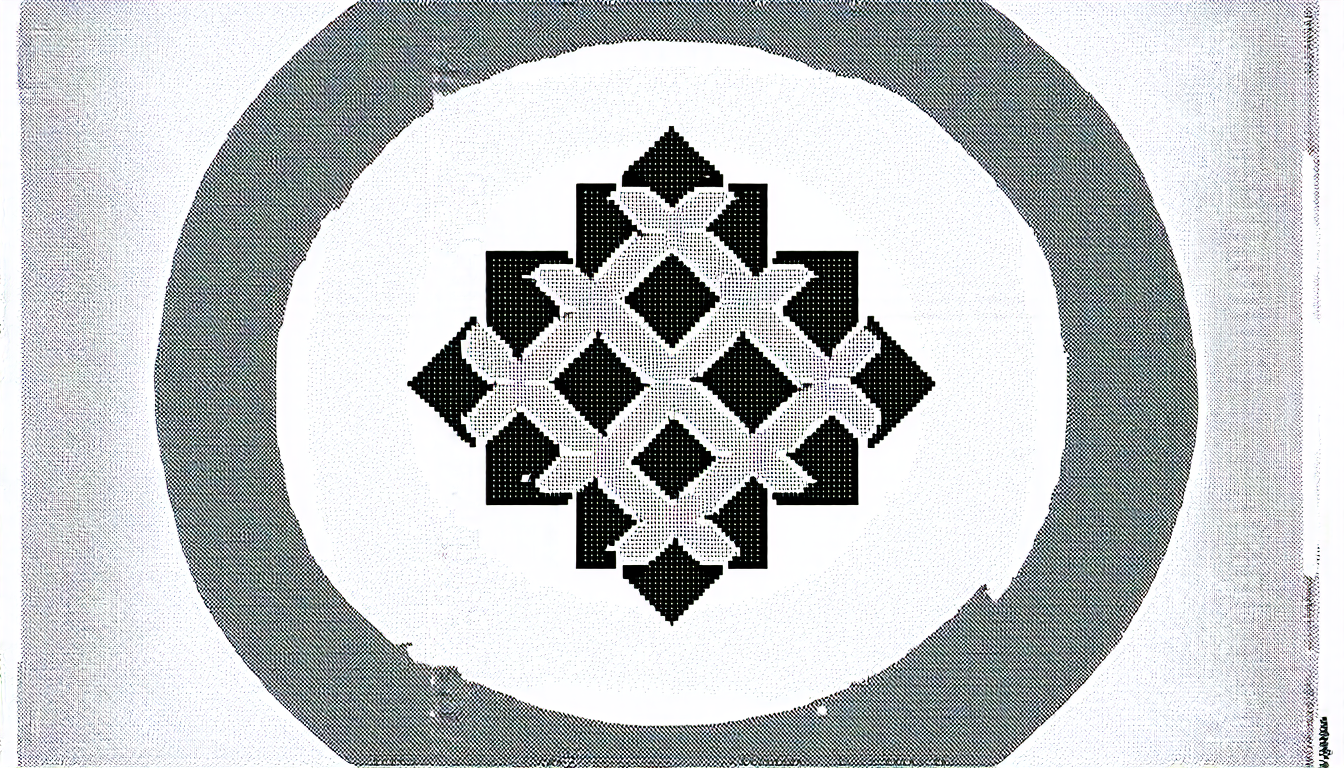
Recently, mathematicians have made significant progress in understanding one particular type of knot: the checkerboard link. These are knots that can be colored with alternating black and white squares, similar to a chessboard. This property makes them particularly interesting for study, as it allows researchers to develop new tools and techniques for analyzing their properties.
One key discovery is that the Gordon-Litherland form, a mathematical object used to describe the properties of a knot, can be applied to checkerboard links in a way that reveals new insights into their structure. This form, named after mathematicians C.M. Gordon and R.A. Litherland who first developed it, is typically used to study knots in three-dimensional space. However, by adapting it for use with checkerboard links, researchers have been able to gain a deeper understanding of these complex objects.
The implications of this discovery are far-reaching. For one, it opens up new avenues for studying the properties of knots and their behavior under different conditions. This has important applications in fields such as materials science and engineering, where understanding how materials behave under stress is crucial for designing and manufacturing new technologies.
Additionally, the study of checkerboard links can also shed light on more fundamental questions about the nature of space and time. Knots are a fundamental aspect of our universe, appearing in everything from the structure of atoms to the behavior of black holes. By better understanding how knots work, researchers may be able to gain insights into the underlying laws of physics that govern our universe.
The study of checkerboard links is also an example of the power of interdisciplinary research. Mathematicians and physicists working together have been able to develop new tools and techniques that allow them to study these complex objects in ways that would not have been possible alone. This collaboration has led to a deeper understanding of the properties of knots, and has opened up new avenues for research into their behavior.
The discovery of the Gordon-Litherland form’s application to checkerboard links is just one example of the many exciting developments happening at the intersection of mathematics and physics. As researchers continue to explore these complex and fascinating objects, we can expect even more breakthroughs and insights that will change our understanding of the world around us.
Cite this article: “Unlocking Knot Theorys Deepest Secrets: A New Gordon-Litherland Form”, The Science Archive, 2025.
Mathematics, Physics, Knots, Checkerboard Links, Gordon-Litherland Form, Interdisciplinary Research, Materials Science, Engineering, Black Holes, Space Time
Reference: Micah Chrisman, “The Gordon-Litherland pairing and its many applications” (2025).





