

Wednesday 09 April 2025
Dark matter is a mysterious substance that makes up about 27% of our universe, yet we know very little about it. It’s invisible, doesn’t interact with light, and doesn’t seem to be affected by gravity in the same way as regular matter. But despite its elusive nature, dark matter plays a crucial role in the formation and evolution of galaxies.
One of the biggest mysteries surrounding dark matter is how it interacts with normal matter. We know that dark matter must have mass because of the way it affects the motion of stars and galaxies, but we don’t know what kind of particles make up this mysterious substance.
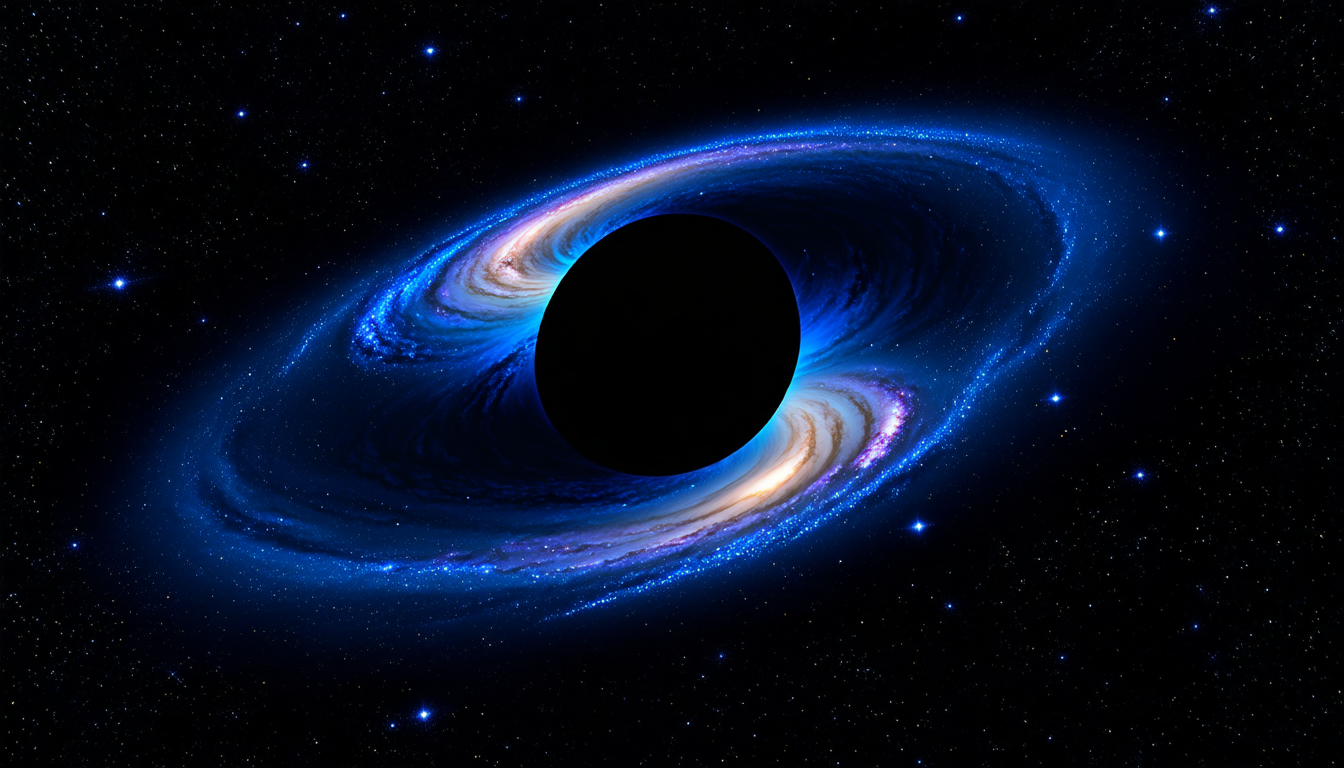
Recently, scientists have been studying the movement of stars around supermassive black holes at the centers of galaxies. These black holes are surrounded by a disk of hot, glowing gas that can be used to measure the mass of the black hole and the dark matter halo surrounding it.
By analyzing the motion of these stars, scientists have discovered that dark matter plays a crucial role in the formation of these galaxy centers. It helps to slow down the rotation of the stars, allowing them to move closer to the black hole without being torn apart by its powerful gravity.
But how does dark matter do this? The answer lies in its unique properties. Unlike regular matter, which is made up of particles that interact with each other through forces like electromagnetism and the strong and weak nuclear forces, dark matter appears to be made up of particles that only interact with normal matter through gravity.
This means that dark matter can pass right through normal matter without interacting with it in any way. But when dark matter encounters a large amount of normal matter, such as a star or a galaxy, its gravitational pull causes the normal matter to move slower and slower.
In the case of stars moving around supermassive black holes, this means that dark matter helps to slow down their rotation, allowing them to move closer to the black hole without being torn apart. This is important because it helps us understand how galaxies form and evolve over time.
The study of dark matter is an active area of research, with scientists using a variety of methods to try and detect its presence. These include searching for signs of dark matter in particle colliders, studying the way that light behaves around galaxy centers, and analyzing the motion of stars and other objects in the universe.
Despite the challenges posed by this elusive substance, scientists are making progress in understanding dark matter.
Cite this article: “Unlocking the Secrets of Dark Matter Halos in Galactic Black Holes”, The Science Archive, 2025.
Galaxies, Dark Matter, Black Holes, Stars, Gravity, Normal Matter, Particles, Rotation, Supermassive, Universe





