

Wednesday 09 April 2025
The latest findings in the field of particle physics have shed new light on the mysterious phenomenon of Light-by-Light (LbL) scattering, a process that has long been a topic of interest for scientists. In a recent study, researchers have made significant strides in understanding this complex process by incorporating previously overlooked mechanisms into their calculations.
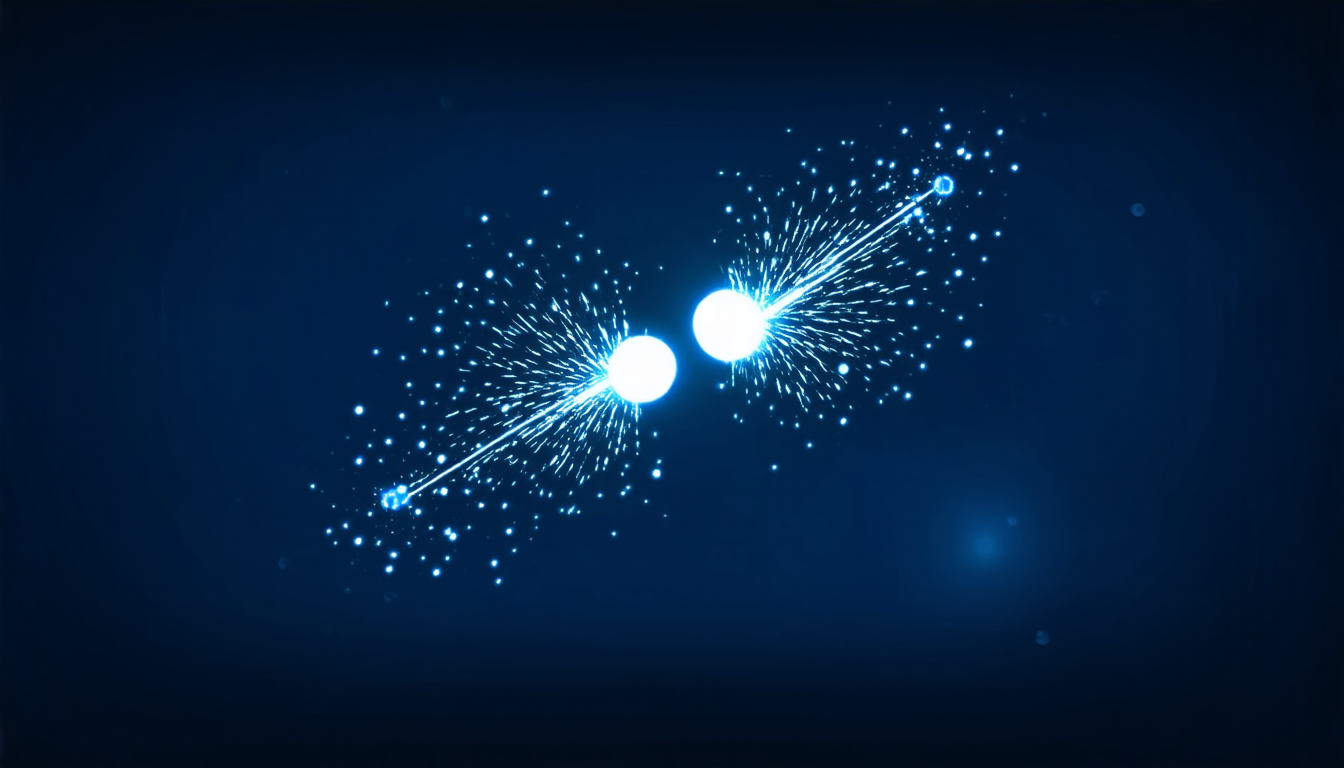
For those unfamiliar with the concept, LbL scattering is a type of interaction between photons, where two photons collide and produce another pair of photons. This process has been observed in various experiments, including those conducted at the Large Hadron Collider (LHC). However, the current understanding of this phenomenon is incomplete, as it does not take into account certain aspects of photon interactions with nucleons.
The new study aims to address this limitation by considering the contributions of semi-elastic and inelastic processes to LbL scattering. In essence, these mechanisms involve the emission of particles from an excited nucleus during the interaction, which can significantly impact the final state of the process.
To achieve this, researchers employed a novel approach that incorporates the photon distribution functions (PDFs) for protons and neutrons. These PDFs describe the probability of finding a photon within a nucleon, taking into account both elastic and inelastic interactions. By using these PDFs, the team was able to estimate the cross-section for LbL scattering, including the contributions from semi-elastic and inelastic processes.
The results indicate that these previously overlooked mechanisms play a significant role in LbL scattering, particularly at large diphoton invariant masses (Mγγ). In fact, the study found that the inclusion of these mechanisms can increase the cross-section by up to 10-15% compared to the traditional elastic-only calculation. This effect is more pronounced for larger values of Mγγ and photon rapidity differences.
The significance of this finding lies in its potential impact on our understanding of LbL scattering and its implications for particle physics as a whole. By refining our knowledge of this process, researchers may be able to better explain certain discrepancies between theoretical predictions and experimental data observed at the LHC.
Furthermore, the study’s approach highlights the importance of incorporating novel mechanisms into calculations, particularly in cases where traditional methods may not fully capture the complexity of a given phenomenon. As particle physics continues to push the boundaries of our understanding, it is essential that researchers explore new avenues and refine their methodologies to ensure the most accurate results possible.
Cite this article: “Unlocking the Secrets of Light-by-Light Scattering in Heavy Ion Collisions”, The Science Archive, 2025.
Particle Physics, Light-By-Light Scattering, Photon Distribution Functions, Protons, Neutrons, Elastic Interactions, Inelastic Interactions, Semi-Elastic Processes, Large Hadron Collider, Diphoton Invariant Masses





