

Wednesday 09 April 2025
The nuclear waste problem is a pressing concern for humanity, with millions of tons of radioactive material generated each year by power plants and medical facilities. Storing this waste safely and efficiently is a daunting task, requiring careful planning and precise execution. A team of researchers has proposed a novel approach to tackle this challenge, using a combination of artificial intelligence and mathematical optimization techniques.
The traditional method for storing nuclear waste involves packing the material into large containers and burying them deep in the earth. However, this approach has several limitations. For one, it’s difficult to ensure that the containers are packed tightly enough to minimize radiation exposure, while also leaving enough space for future storage needs. Additionally, the process of transporting and burying these containers is hazardous and costly.
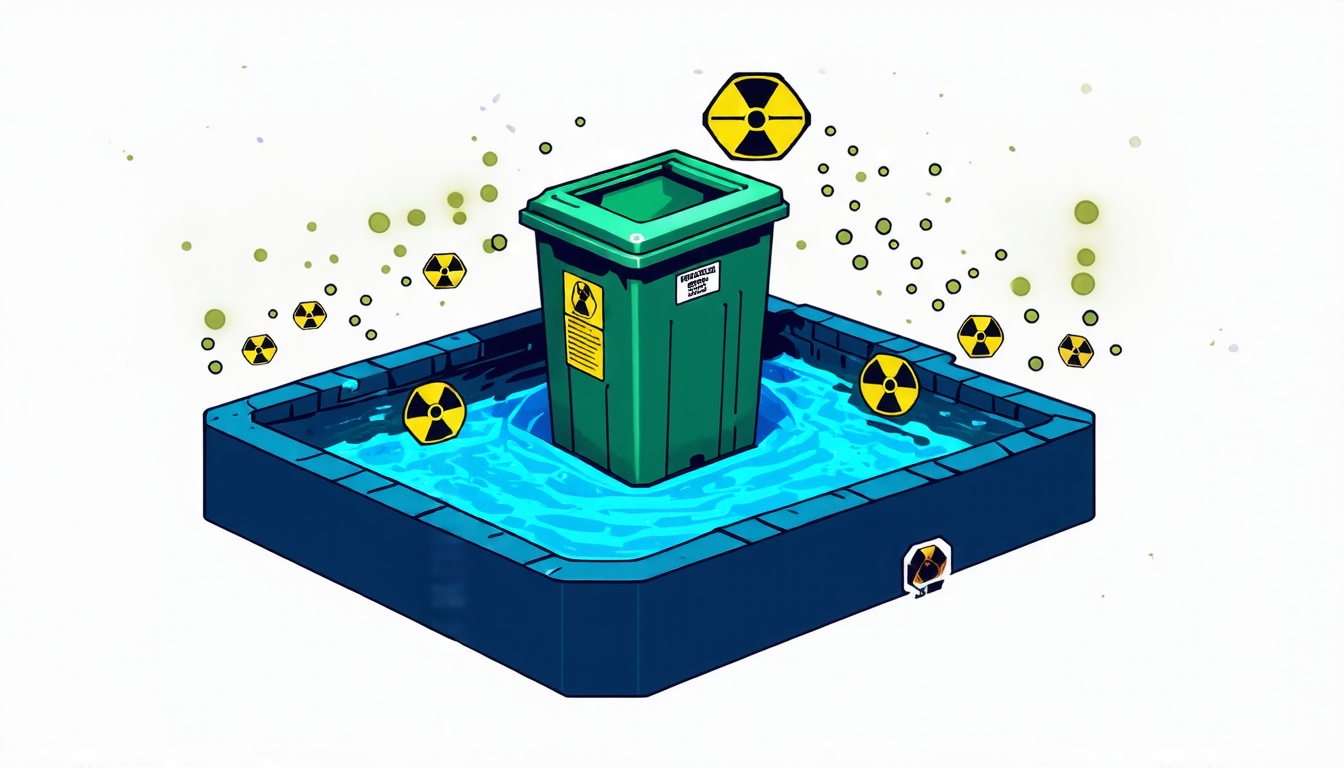
The researchers’ solution involves using a block-based heuristic algorithm to optimize the packing of nuclear waste boxes into disposal pools. The approach begins by dividing the waste boxes into smaller blocks, each with its own unique characteristics such as size, shape, and radiation level. These blocks are then arranged in a specific pattern within the disposal pool, taking into account factors like spatial utilization rate and dose rate.
The algorithm uses machine learning techniques to learn from a dataset of 1600 problem instances, simulating different scenarios and testing various packing strategies. By analyzing the results, the researchers were able to identify optimal solutions that minimize radiation exposure while maximizing storage capacity.
One key advantage of this approach is its ability to handle complex, real-world scenarios. The algorithm can account for variations in waste box size and shape, as well as irregularities in the disposal pool’s geometry. This makes it a more practical solution than traditional methods, which often rely on simplified assumptions and approximations.
The researchers’ work has significant implications for the nuclear industry, offering a more efficient and cost-effective way to store nuclear waste. By reducing radiation exposure and minimizing storage space requirements, this approach could help mitigate some of the risks associated with nuclear power generation.
While there is still much work to be done before this technology can be implemented on a large scale, the researchers’ findings offer a promising new direction for addressing the nuclear waste problem. As we continue to rely on nuclear power as a source of energy, it’s crucial that we develop innovative solutions to manage the resulting waste. This block-based heuristic algorithm is an important step in that direction, and its potential applications extend far beyond the nuclear industry.
Cite this article: “Optimizing Nuclear Waste Disposal: A Novel Algorithm for Efficient Container Loading”, The Science Archive, 2025.
Nuclear Waste, Artificial Intelligence, Mathematical Optimization, Block-Based Heuristic Algorithm, Machine Learning, Radiation Exposure, Storage Capacity, Disposal Pools, Nuclear Industry, Energy Management.





