

Wednesday 09 April 2025
The humble pipeline, a staple of modern infrastructure, often overlooked until disaster strikes. But what if we could predict when and where these vital conduits might fail? A team of researchers has made significant strides in developing an intelligent tool that can detect welds, those crucial joints that connect sections of pipe, with remarkable accuracy.
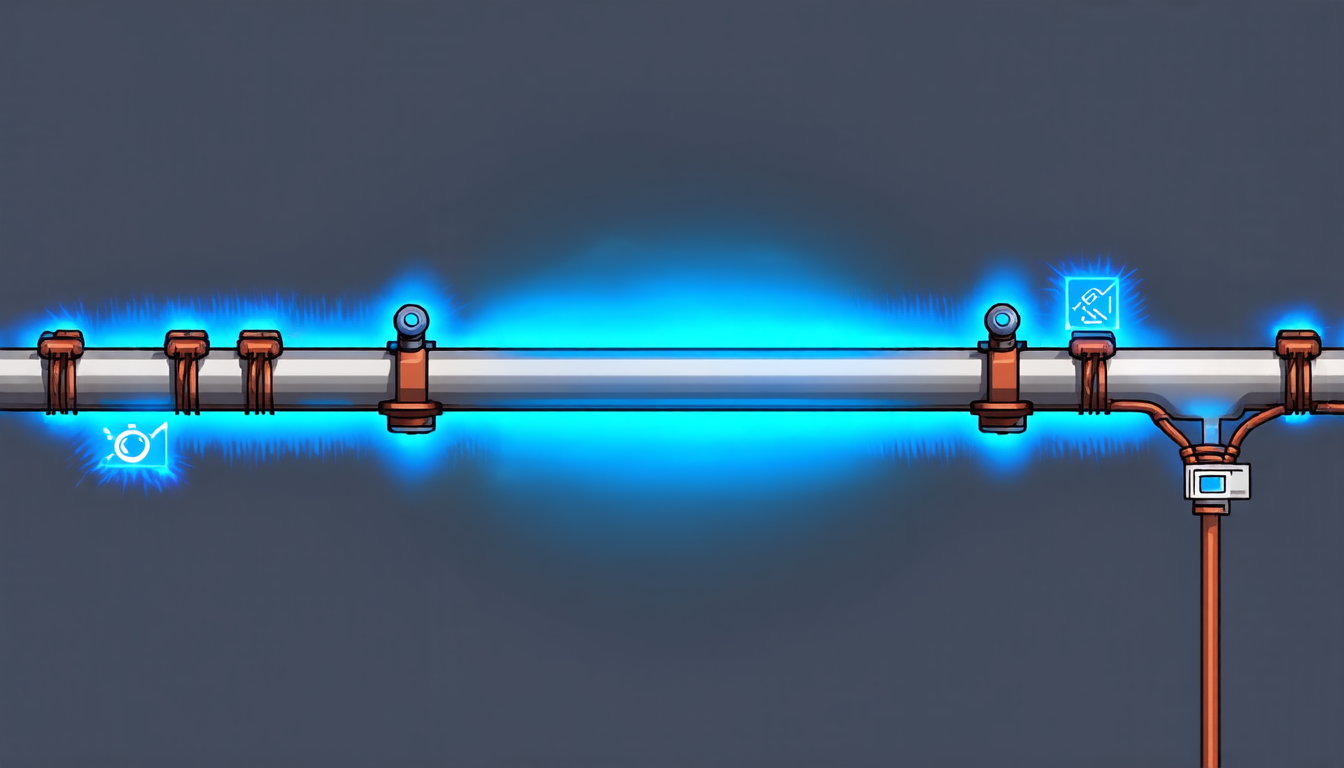
Welds are the Achilles’ heel of pipelines, prone to cracking and failure over time. Identifying them early on is crucial for preventing costly repairs and minimizing environmental damage. Traditionally, inspectors rely on manual inspections, which can be laborious and often miss subtle signs of wear. The new technology, however, uses advanced algorithms and machine learning techniques to analyze data from sensors embedded in the pipeline.
These sensors capture a wealth of information about the pipe’s condition, including changes in magnetic fields, vibration patterns, and acceleration. By processing this data, the system can detect welds with an impressive 98% accuracy rate. Moreover, it can pinpoint their location with remarkable precision, reducing the time and effort required for manual inspections.
The team used real-world data from a Colombian pipeline to test their system, achieving results that outperformed traditional methods. They also experimented with different combinations of sensors and algorithms, finding that certain pairings yielded better results than others.
This technology has far-reaching implications beyond just pipeline maintenance. It could revolutionize the way we inspect and maintain other critical infrastructure, such as bridges and buildings. Imagine being able to detect potential weaknesses before they become catastrophic failures.
The system’s creators are optimistic about its future applications, envisioning a scenario where pipelines can be monitored in real-time, allowing for swift responses to any issues that arise. As our global infrastructure continues to expand and age, innovations like this could prove invaluable in ensuring public safety and minimizing environmental impacts.
In the world of engineering, progress often stems from solving specific problems. This research is a testament to the power of interdisciplinary collaboration, marrying advances in artificial intelligence with practical applications in industry. The result is a tool that has the potential to transform the way we approach maintenance and inspection, making our infrastructure safer, more efficient, and more resilient.
Cite this article: “Automated Weld Detection in Pipelines Using Intelligent Tool Inspection and Machine Learning Techniques”, The Science Archive, 2025.
Pipelines, Welds, Sensors, Machine Learning, Algorithms, Infrastructure, Maintenance, Inspection, Artificial Intelligence, Engineering





