

Wednesday 09 April 2025
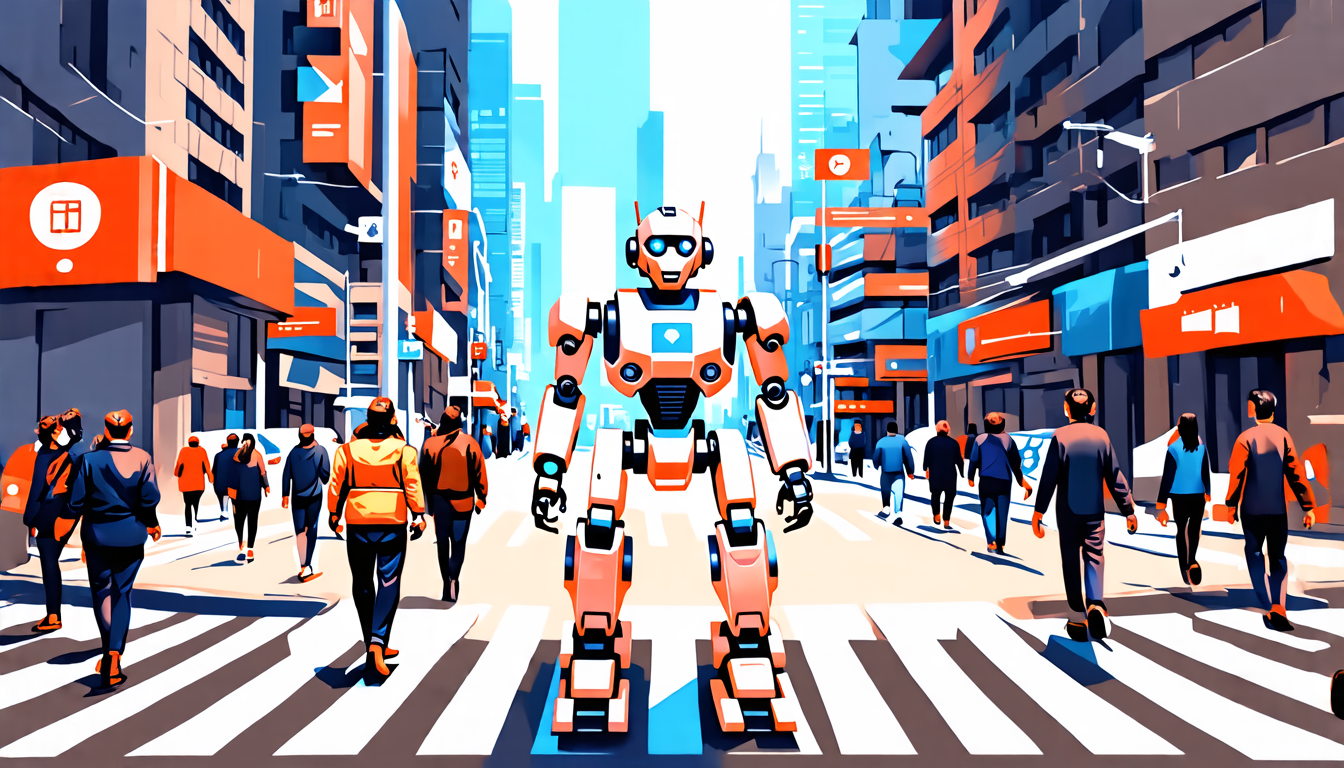
The challenge of navigating crowded spaces is one that many of us face on a daily basis. Whether it’s avoiding collisions in a busy shopping mall or finding our way through a densely populated subway station, humans have long struggled to move efficiently and safely through crowded areas. For robots, this problem is particularly vexing – they must not only avoid obstacles but also anticipate the movements of other agents, such as humans, while navigating their own path.
A team of researchers has recently made significant progress in addressing this challenge by developing a novel approach to crowd navigation that combines advanced predictive modeling with real-time optimization. The result is a system that not only enables robots to move safely and efficiently through crowded spaces but also improves the overall experience for humans sharing those spaces.
At its core, the system relies on a type of machine learning algorithm known as a diffusion model, which is capable of generating highly accurate predictions of human movement patterns in crowded environments. By incorporating this predictive power into a real-time optimization framework, the researchers have created a system that can adapt to changing circumstances and adjust the robot’s path accordingly.
The key innovation here lies in the way the system handles uncertainty. Traditional approaches to crowd navigation typically rely on fixed trajectories or predetermined routes, which can lead to inefficiencies and even collisions when faced with unexpected events. In contrast, this new approach uses the predictive model to estimate the likelihood of different outcomes – for example, whether a human is likely to move in a certain direction or change course suddenly.
By incorporating these uncertainty estimates into the optimization framework, the system can adapt to changing circumstances in real-time and adjust its path accordingly. This not only improves the robot’s ability to navigate crowded spaces but also reduces the risk of collisions or other safety incidents.
The researchers have tested their approach through a series of simulations and experiments using a robotic platform designed to mimic human movement patterns. The results are impressive, with the system consistently outperforming traditional approaches in terms of navigation efficiency and safety.
One potential application of this technology is in the development of autonomous delivery robots or service robots that must navigate crowded public spaces. By enabling these robots to move safely and efficiently through crowded areas, we may see a significant increase in their adoption and use cases.
The broader implications of this research are also worth noting. As our cities become increasingly crowded and complex, the need for efficient and safe navigation systems will only continue to grow.
Cite this article: “Unlocking Safe Crowd Navigation with Joint Human Trajectory Forecasting and Model Predictive Control”, The Science Archive, 2025.
Crowd Navigation, Robots, Machine Learning, Diffusion Model, Predictive Modeling, Real-Time Optimization, Uncertainty Estimation, Collision Avoidance, Autonomous Delivery Robots, Safe Navigation.





