

Wednesday 09 April 2025
Researchers have made a significant breakthrough in understanding how heat flows through two-dimensional materials, which could lead to more efficient cooling systems and better electronics.
These materials, known as transition metal dichalcogenides (TMDs), are made up of layers of atoms that can be arranged in different patterns. They have unique properties that make them useful for a variety of applications, including electronics and energy storage.
One of the most important properties of TMDs is their ability to conduct heat. However, understanding how heat flows through these materials has been challenging because they are so thin. Conventional methods for measuring thermal conductivity are not suitable for such small scales.
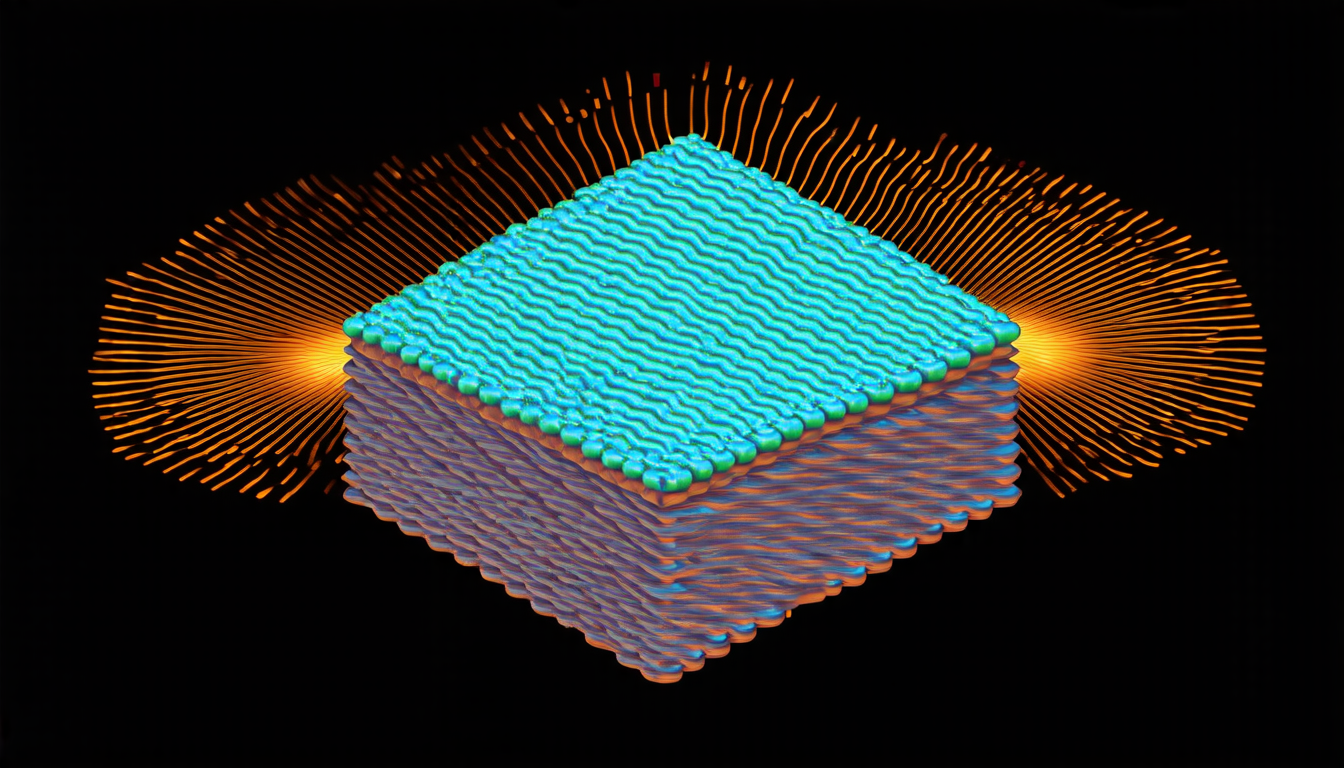
To overcome this challenge, researchers used a combination of theoretical modeling and computer simulations to study the behavior of phonons – the particles that carry heat in solids – in TMDs. They found that the twist angle between the layers has a significant impact on the thermal conductivity.
When the layers are twisted at certain angles, the phonons can move more easily through the material, increasing its thermal conductivity. However, when the layers are twisted at other angles, the phonons become trapped and cannot move as freely, reducing the thermal conductivity.
This discovery could have important implications for the development of new cooling systems that are smaller and more efficient than those currently available. It could also lead to the creation of new electronic devices that are faster and more powerful.
In addition to its potential applications, this research has also shed light on the fundamental physics of heat transfer in TMDs. The study found that the twist angle between the layers can be used to tune the thermal conductivity of the material, allowing it to be tailored for specific applications.
The researchers used a combination of theoretical modeling and computer simulations to study the behavior of phonons in TMDs. They developed a new method for calculating the thermal conductivity of these materials, which takes into account the twist angle between the layers.
This method was then used to simulate the behavior of phonons in different TMDs with varying twist angles. The results showed that the thermal conductivity of these materials is highly dependent on the twist angle, and can be tuned by adjusting this parameter.
The study’s findings have significant implications for the development of new cooling systems and electronic devices. It could lead to the creation of smaller, more efficient cooling systems that are better suited for use in portable electronics and other applications.
In addition, it could enable the development of new electronic devices that are faster and more powerful than those currently available.
Cite this article: “Unlocking the Secrets of Moiré Patterns in Transition Metal Dichalcogenides: A Path to High-Temperature Superconductivity?”, The Science Archive, 2025.
Heat Transfer, Thermal Conductivity, Transition Metal Dichalcogenides, Tmds, Phonons, Computer Simulations, Theoretical Modeling, Cooling Systems, Electronics, Energy Storage.





