

Wednesday 09 April 2025
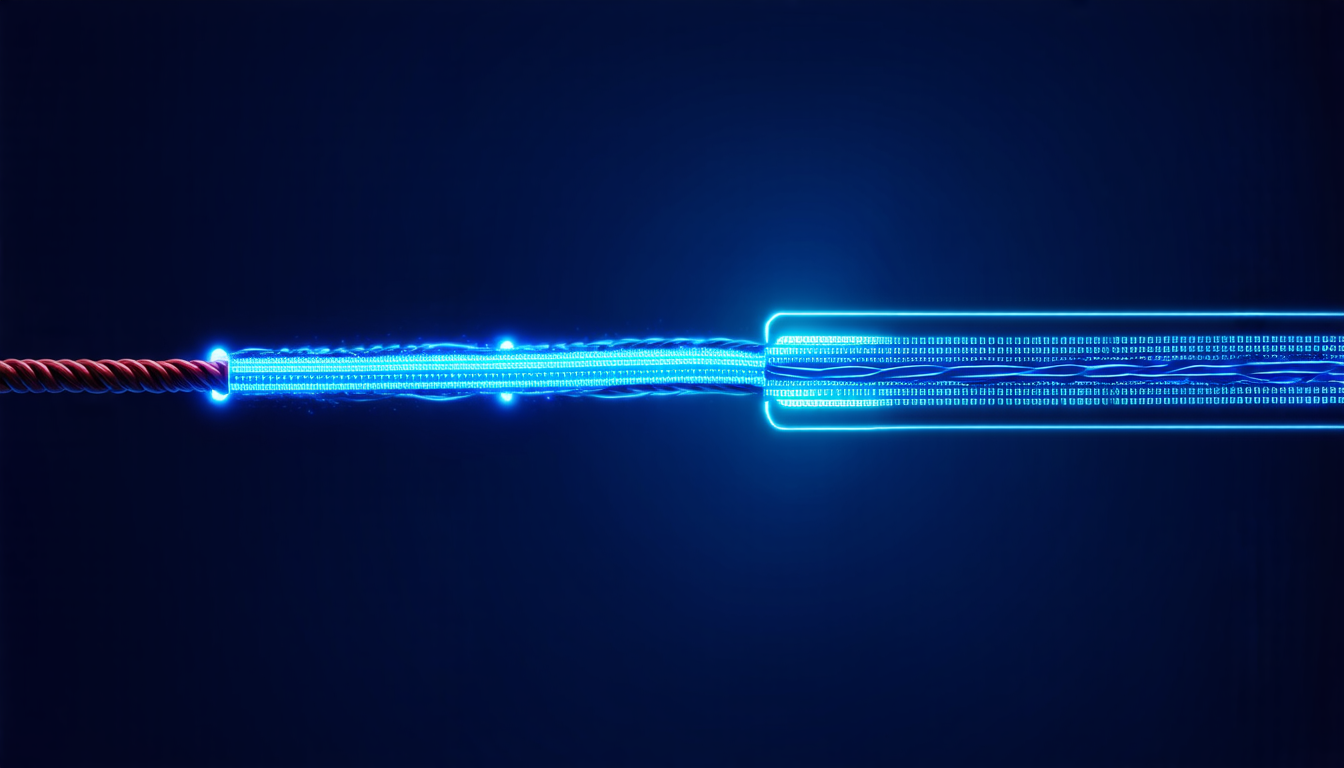
The quest for faster, more efficient data transmission has led researchers to explore innovative ways to cram more information onto a single fiber optic cable. One promising approach is the use of self-coherent receivers, which can extract valuable data without the need for complex and power-hungry digital signal processing (DSP) units.
Traditionally, high-speed optical communication systems rely on coherent detection, where a laser beam is used to amplify and stabilize the incoming light signal before it’s processed by the receiver. This method is effective but requires significant power and computational resources, making it less suitable for low-power applications like data centers.
Self-coherent receivers, on the other hand, use a different approach. Instead of amplifying and stabilizing the signal, they employ a technique called recurrent optical spectrum slicing (ROSS) to extract the data from the incoming light. This method is inspired by the way our brains process information – it relies on a series of neural networks that iteratively refine their understanding of the signal.
The ROSS system consists of a photonic accelerator, which uses a combination of waveguides and Mach-Zehnder interferometers to manipulate the light signal in a way that mimics the behavior of neurons in our brain. This allows the receiver to extract information from the signal without the need for complex DSP algorithms, resulting in significant power savings.
In their latest research paper, scientists have demonstrated the effectiveness of self-coherent receivers using ROSS technology. They tested the system by transmitting 32-gigabit-per-second (Gbaud) quadrature amplitude modulation (QAM-4/16) signals over distances of up to 25 kilometers (15.5 miles). The results showed that the ROSS-based receiver was able to accurately recover the transmitted data, while consuming significantly less power than traditional coherent detection methods.
The implications of this technology are significant. For one, it could enable the development of low-power, high-speed optical communication systems for applications like data centers and cloud computing. This would not only improve overall efficiency but also reduce the environmental impact of these operations.
Furthermore, self-coherent receivers using ROSS technology could potentially be used in other fields, such as medical imaging or astronomy, where high-speed data transmission is crucial but power consumption is a major concern.
As researchers continue to refine this technology, we can expect to see even more innovative applications emerge.
Cite this article: “Unlocking the Power of Self-Coherent Optical Communication: A Game-Changer for Next-Generation Data Centers?”, The Science Archive, 2025.
Fiber Optic, Self-Coherent Receivers, Ross Technology, Optical Communication, Data Transmission, High-Speed, Low-Power, Neural Networks, Mach-Zehnder Interferometers, Waveguides.





