

Thursday 10 April 2025
Researchers have made a significant breakthrough in understanding how graphs can be embedded on surfaces, a crucial concept in mathematics and computer science. Graphs are visual representations of connections between objects, and embedding them on surfaces has numerous applications in fields such as networking, biology, and materials science.
The study focuses on a specific type of graph called rooted graphs, which have designated starting points. The researchers were able to demonstrate that every 3-connected, rooted graph without a certain structure can be embedded on a surface with a bounded number of faces. This is significant because it provides a way to analyze and understand the properties of these graphs.
The team used a combination of mathematical techniques and computational methods to achieve their result. They first defined a new concept called face covers, which are collections of faces in the embedding that meet certain criteria. The researchers then developed an algorithm to find face covers with a bounded number of faces, allowing them to bound the size of the face cover.
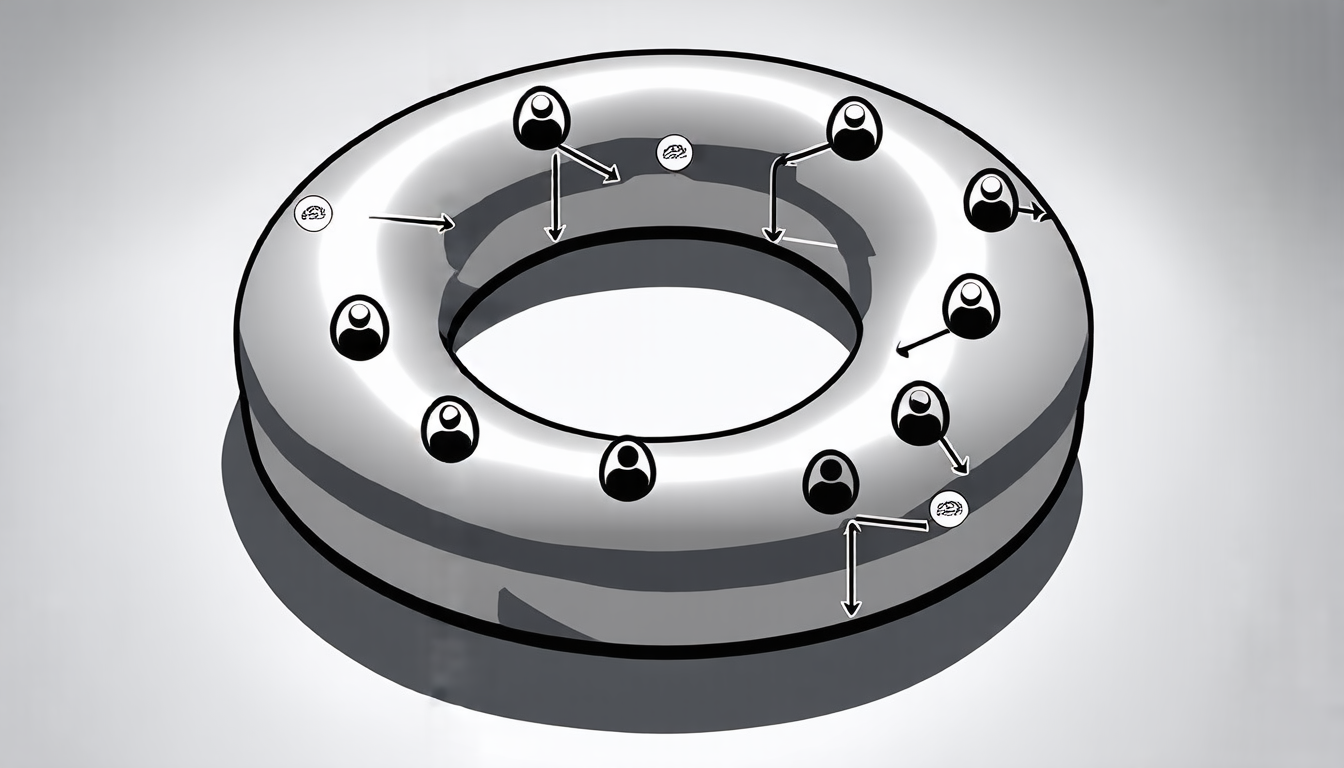
The study also explored the properties of bagels, a type of graph that is particularly challenging to embed on surfaces. Bagels are formed by taking two cycles and identifying their edges in a specific way. The researchers found that bagels without a certain structure cannot be embedded on a surface with a small number of faces, providing new insights into the limitations of surface embedding.
The team’s results have significant implications for fields such as computer networks, where understanding how to embed graphs on surfaces can improve network design and optimization. In biology, graph theory is used to model the connections between molecules in cells and the spread of diseases, making this research relevant to understanding complex biological systems.
The researchers’ approach combines mathematical rigor with computational power, demonstrating the importance of interdisciplinary collaboration in solving complex problems. The study’s findings have the potential to impact a wide range of fields, from computer science to biology, and will likely inspire further research into the properties and applications of graphs on surfaces.
Cite this article: “Graph Theory Breakthrough: Solving the Face-Width Conjecture”, The Science Archive, 2025.
Mathematics, Computer Science, Graph Theory, Surface Embedding, Rooted Graphs, Network Design, Optimization, Biology, Interdisciplinary Collaboration, Computational Methods





