

Thursday 10 April 2025
A new approach to simulating complex chemical reactions has been developed, allowing researchers to better understand the intricate dance of electrons and nuclei within molecules.
The traditional method for studying these reactions involves solving a set of equations that describe how the particles interact. However, this can be computationally expensive and often requires making simplifying assumptions about the behavior of the particles.
In contrast, the new approach uses a technique called Rothe’s method, which is based on an adaptive algorithm that adjusts its precision as needed to ensure accurate results. This allows researchers to simulate complex chemical reactions with greater ease and accuracy than ever before.
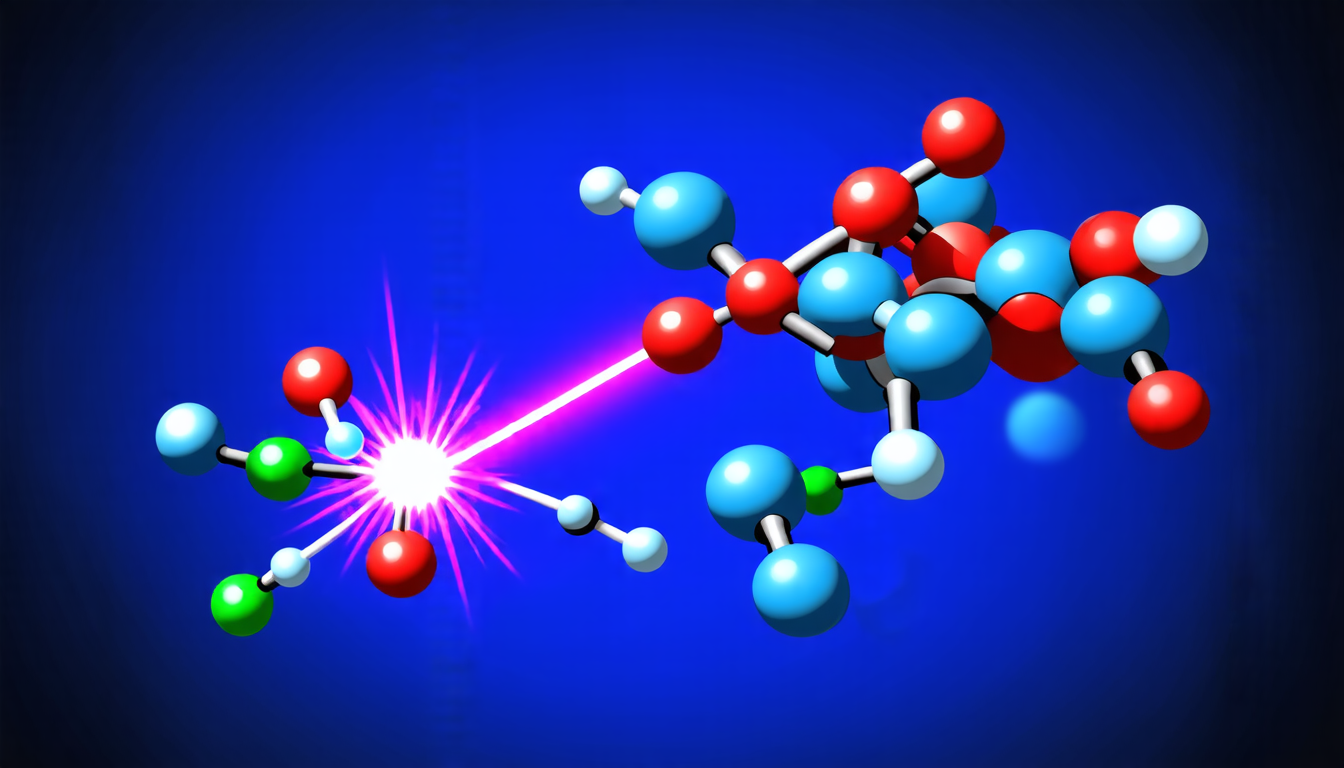
The technique was developed by a team of scientists who used it to study the reaction between a molecule of hydrogen and an intense laser pulse. The simulation showed how the energy from the laser pulse excites the electrons in the molecule, causing them to jump to higher energy levels.
This process is known as ionization, and it’s a crucial step in many chemical reactions. By simulating this process with greater accuracy than ever before, researchers hope to gain a deeper understanding of the underlying mechanisms that drive these reactions.
The new approach also has potential applications in fields beyond chemistry, such as materials science and biology. For example, it could be used to study the behavior of molecules in biological systems, or to design new materials with specific properties.
In addition to its scientific significance, the development of Rothe’s method is also a testament to the power of human ingenuity and creativity. The algorithm was developed through a combination of mathematical insight and computational expertise, demonstrating the importance of interdisciplinary collaboration in advancing our understanding of the natural world.
As researchers continue to refine this technique, it’s likely that we’ll see even more exciting applications emerge in the years to come.
Cite this article: “Unlocking Quantum Secrets with Gaussian Wavepackets”, The Science Archive, 2025.
Chemical Reactions, Molecular Dynamics, Rothe’S Method, Adaptive Algorithm, Ionization, Laser Pulse, Energy Levels, Electron Behavior, Materials Science, Biology





