

Thursday 10 April 2025
A team of researchers has made a significant breakthrough in understanding the behavior of wireless networks, particularly in regards to the saturation throughput region. This region refers to the maximum amount of data that can be transmitted through a network before congestion sets in and performance begins to degrade.
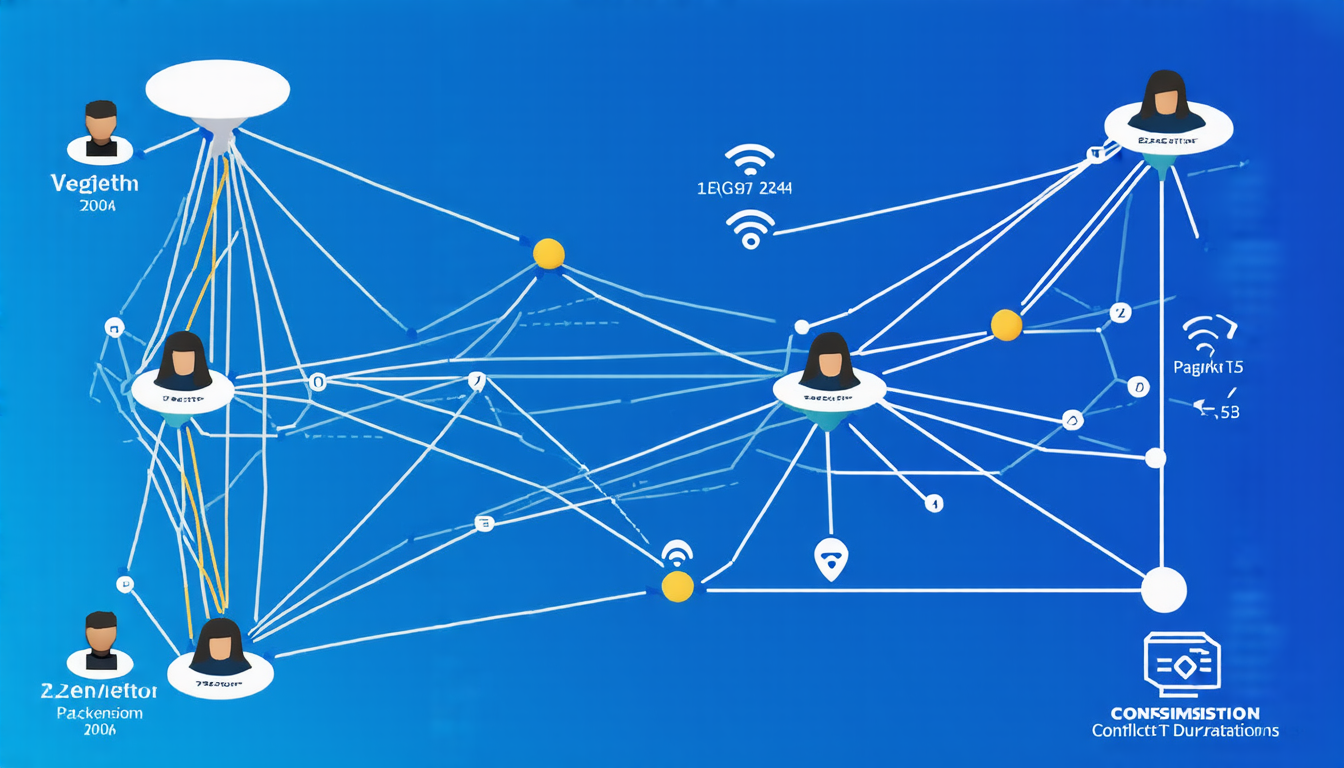
The study, published recently, presents a novel approach to modeling and analyzing wireless networks using Markov chains. The researchers have developed a framework that accurately captures the behavior of nodes in a network, taking into account factors such as packet length, transmission duration, and conflict graphs.
Traditionally, models used to analyze wireless networks have been based on simplifications and assumptions that don’t always hold true in real-world scenarios. For example, many models assume that all nodes are fully connected and can transmit simultaneously, which is not the case in most real-world networks. The new framework addresses these limitations by incorporating more realistic assumptions about network topology and node behavior.
The researchers have applied their model to a range of scenarios, including star topologies and Erdos-Renyi random graphs. In each case, they found that the model accurately predicted the saturation throughput region, which is a critical metric for understanding network performance.
One of the key benefits of the new framework is its ability to capture the impact of different transmission durations on network performance. In many wireless networks, nodes may have varying packet lengths or transmission rates, which can affect the overall performance of the network. The model takes these variations into account, providing a more accurate picture of how the network will behave in real-world scenarios.
The researchers also explored the optimization of transmission probabilities to maximize weighted sums of utility functions. This is particularly important for wireless networks, where nodes may have different priorities or requirements for data transmission. By optimizing transmission probabilities, network administrators can ensure that each node receives the necessary resources and attention to meet its specific needs.
Overall, this study represents a significant step forward in our understanding of wireless networks and their behavior under realistic conditions. The new framework offers a powerful tool for analyzing and optimizing network performance, which could have important implications for the design and operation of wireless systems.
Cite this article: “Unlocking Wireless Networks: A Markov Chain Framework for Maximizing Throughput and Utility”, The Science Archive, 2025.
Wireless Networks, Markov Chains, Saturation Throughput Region, Network Performance, Optimization, Transmission Probabilities, Utility Functions, Node Behavior, Conflict Graphs, Wireless Systems.





