

Thursday 10 April 2025
Researchers have been studying the intricate patterns and structures that emerge in complex systems, like social networks or biological organisms. But what about the mathematical frameworks that underlie these systems? A new paper delves into the properties of a specific type of graph theory called Paley graphs, which have far-reaching implications for cryptography and coding theory.
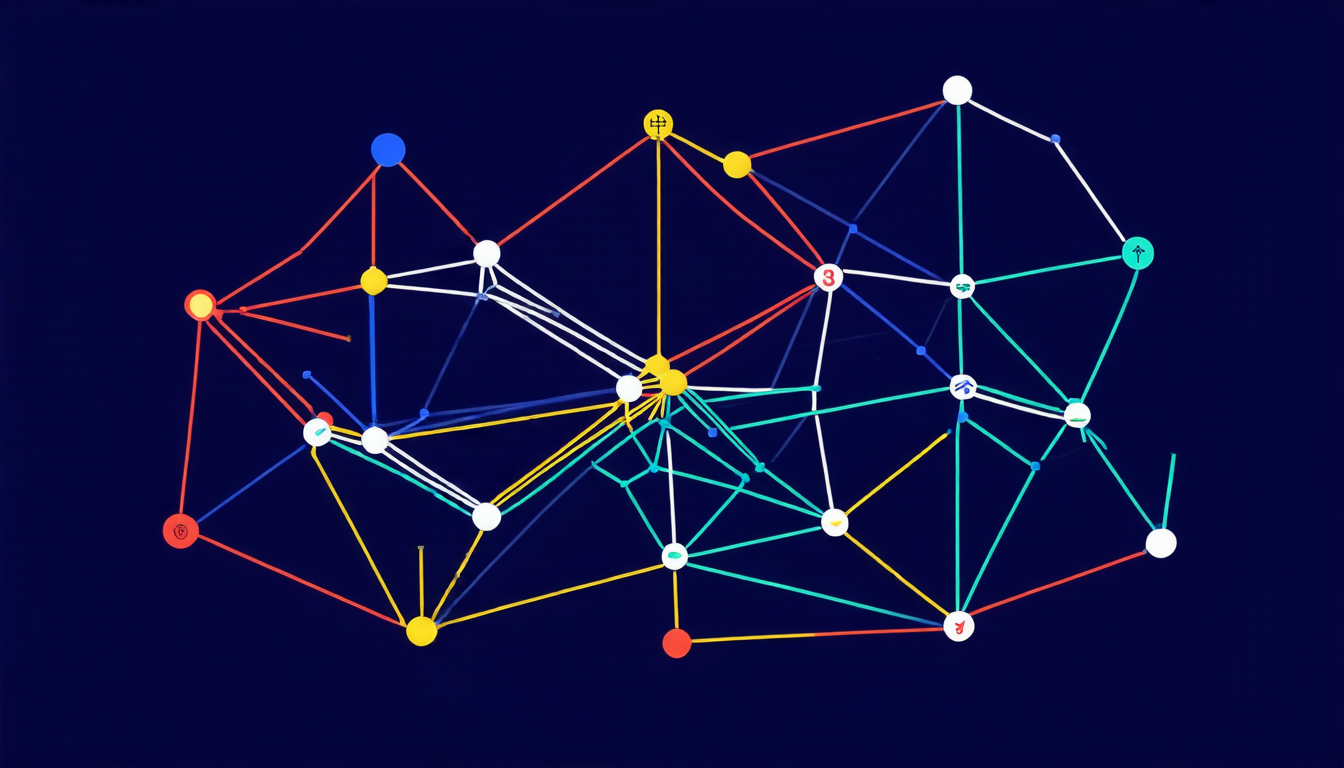
Paley graphs are a special class of strongly regular graphs, meaning they possess certain symmetry properties that make them useful for encoding and decoding information. Think of it like a puzzle: each node in the graph represents a piece of data, and the connections between nodes determine how those pieces fit together. In Paley graphs, the patterns of connection create a web-like structure that’s surprisingly robust to errors and tampering.
The researchers focused on a specific subset of Paley graphs called Paley graphs of square order, which have a unique property: they can be used to construct optimal error-correcting codes for transmitting data over noisy channels. These codes are essential in modern communication systems, like wireless networks or satellite transmissions, where errors can occur due to interference or signal degradation.
The team’s findings shed new light on the properties of these Paley graphs, revealing patterns and structures that had previously been unknown. By analyzing the sizes of the maximal cliques – essentially, the groups of nodes that are most tightly connected – they were able to identify a number of connections between different graph theories and coding theory.
For instance, the researchers found that certain types of Paley graphs can be used to construct optimal codes for transmitting data over channels with specific properties. This has significant implications for cryptography, as it could potentially lead to more secure methods for encrypting and decrypting sensitive information.
The study also touches on the connections between graph theory, coding theory, and other areas of mathematics, like combinatorics and algebra. By exploring these interconnections, researchers can gain a deeper understanding of how complex systems work and develop new tools for analyzing and modeling them.
In the end, this research has far-reaching implications for our ability to transmit information reliably over noisy channels – and it’s a testament to the power of mathematical frameworks in shaping our understanding of the world.
Cite this article: “Unlocking the Secrets of Finite Fields: A New Perspective on Maximal Cliques in Paley Graphs”, The Science Archive, 2025.
Paley Graphs, Graph Theory, Coding Theory, Cryptography, Error-Correcting Codes, Communication Systems, Noisy Channels, Optimal Codes, Combinatorics, Algebra.





