

Thursday 10 April 2025
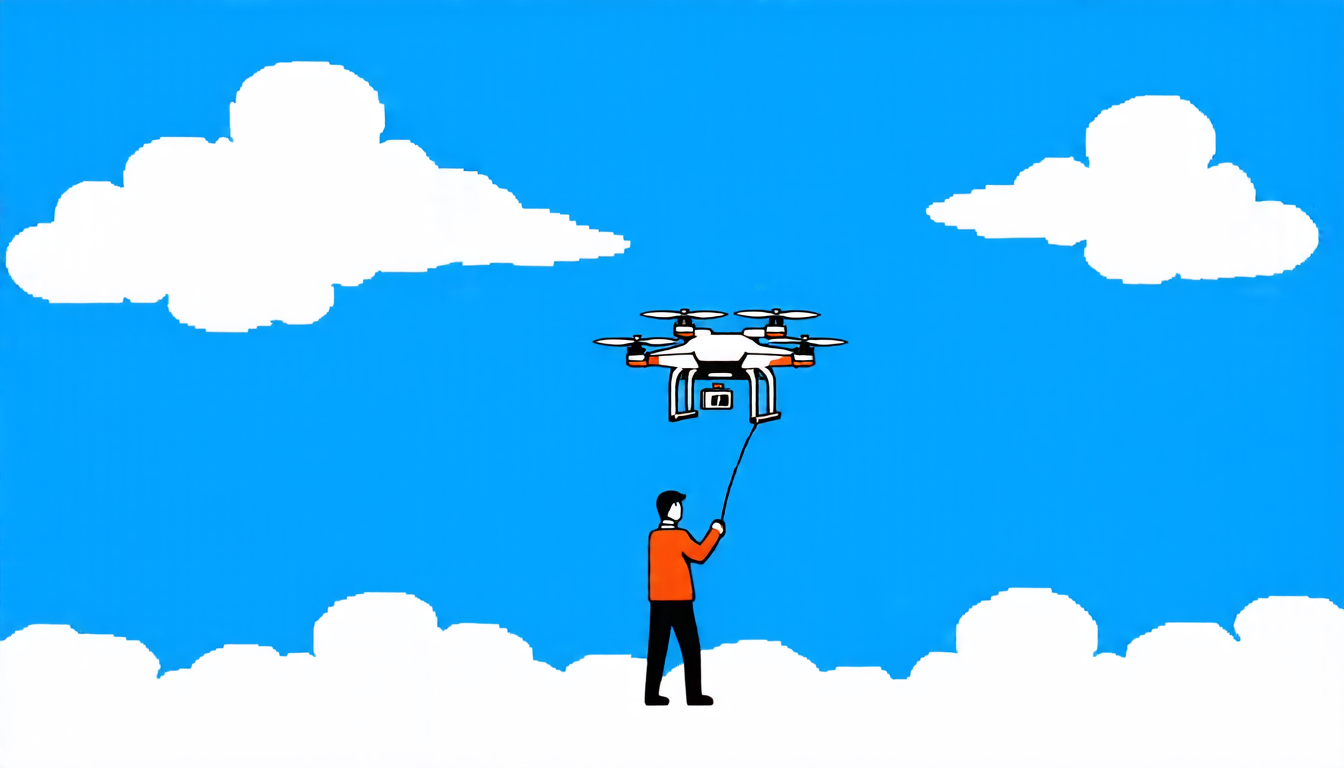
Researchers have made a significant breakthrough in developing a system that enables humans to physically interact with and control unmanned aerial vehicles (UAVs) to transport payloads. The innovative system, which combines advanced control strategies and human-machine interfaces, allows for precise trajectory tracking and stability, making it an attractive solution for various applications such as search and rescue operations, construction, and environmental monitoring.
The system consists of two quadrotors attached to a common payload, which are controlled using a combination of adaptive backstepping and fast nonsingular terminal sliding mode control (FNTSMC). The FNTSMC controller ensures the stability and responsiveness of the UAVs, while the adaptive backstepping control strategy enables the system to adapt to changing conditions.
The human-machine interface is facilitated through an admittance controller that measures the interaction forces between the operator and the UAVs. This allows the operator to physically guide the UAVs to transport the payload along a desired trajectory. The system’s stability and responsiveness are ensured by generating reference trajectories based on the applied forces, which are then tracked by the position and attitude controllers.
The researchers demonstrated the effectiveness of their system through simulations, where they successfully transported a payload along a zigzag corridor using human physical interaction. The simulation results showed that the system was able to maintain stability and track the desired trajectory accurately, despite disturbances and uncertainties.
The potential applications of this technology are vast, including search and rescue operations, construction, environmental monitoring, and disaster response. In these scenarios, the ability to physically interact with UAVs could greatly enhance their capabilities and effectiveness. For example, in search and rescue operations, human operators could guide UAVs to locate survivors or retrieve critical equipment.
The researchers’ innovative approach to developing a human-UAV interaction system has significant implications for the field of robotics and automation. The integration of advanced control strategies and human-machine interfaces has enabled the creation of a highly responsive and stable system that can adapt to changing conditions. This technology has the potential to revolutionize the way we interact with UAVs, enabling them to become more effective tools in a wide range of applications.
The system’s stability and responsiveness were tested through simulations, which showed that it was able to maintain accuracy and track the desired trajectory despite disturbances and uncertainties. The results demonstrated the effectiveness of the system in transporting payloads along a zigzag corridor using human physical interaction.
The researchers’ innovative approach has significant implications for the field of robotics and automation.
Cite this article: “Cooperative Aerial Manipulation: Quadrotors Work Together to Transport Heavy Payloads with Human Guidance”, The Science Archive, 2025.
Uavs, Human-Machine Interfaces, Control Strategies, Adaptive Backstepping, Fntsmc, Quadrotors, Stability, Responsiveness, Trajectory Tracking, Robotics And Automation.





