

Thursday 10 April 2025
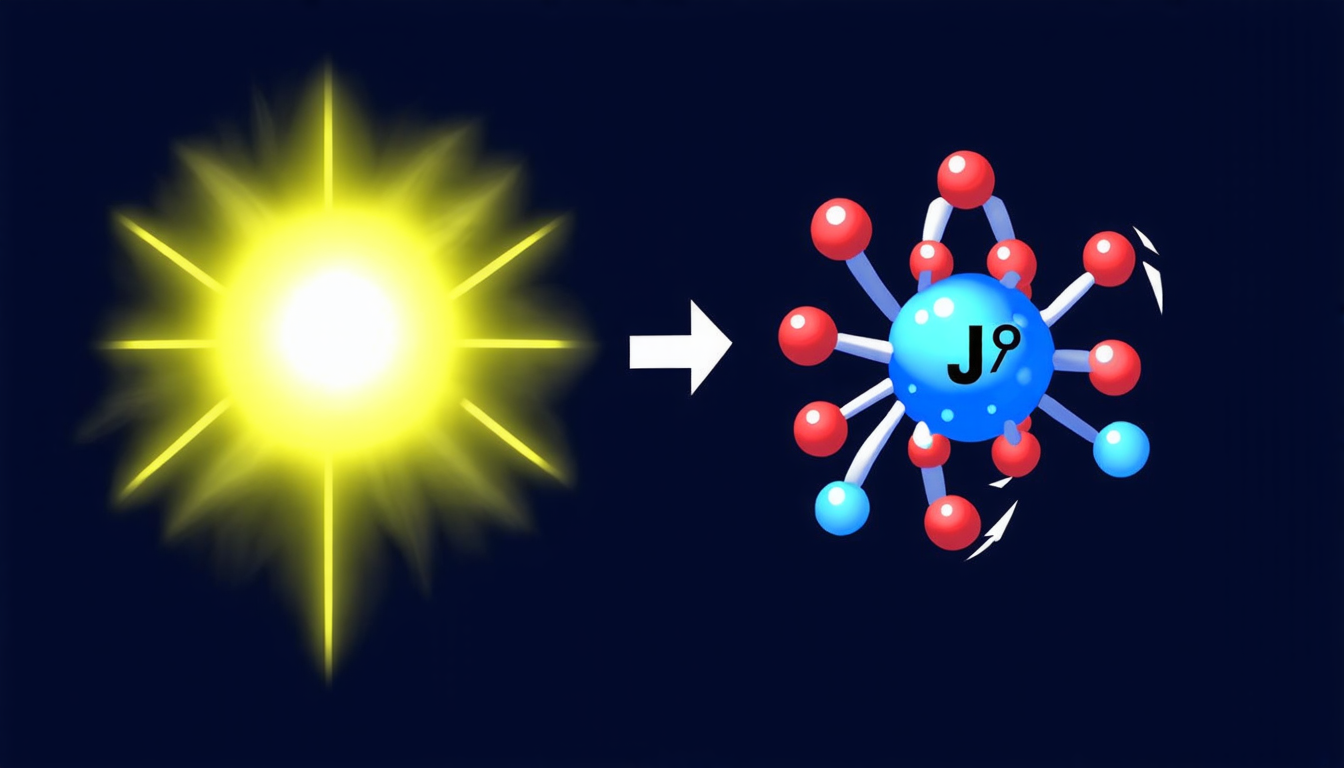
A new study has shed light on the mysterious process of J/ψ meson photoproduction, a phenomenon that has puzzled physicists for decades. The researchers used a combination of theoretical models and experimental data to better understand how photons interact with nucleons to produce these exotic particles.
The J/ψ meson is a type of subatomic particle made up of a charm quark and its antiparticle. It’s a bit like a heavy version of the more familiar pions, which are made up of up and down quarks. But while pions are relatively common, J/ψ mesons are much rarer, and their production is still not well understood.
One of the key challenges in studying J/ψ photoproduction is that it requires extremely high energies to produce these particles. This makes it difficult to study them using traditional particle accelerators, which can only reach certain energy thresholds. To get around this problem, researchers have turned to theoretical models that can simulate the interactions between photons and nucleons.
In their new study, the researchers used a combination of two different theoretical approaches: one based on Regge theory, which describes the behavior of particles at high energies, and another based on dynamical models of meson production. By combining these approaches with experimental data from previous studies, they were able to create a more complete picture of J/ψ photoproduction.
The results show that the process is much more complex than previously thought, involving multiple interactions between photons and nucleons. The researchers found that the dominant mechanism for producing J/ψ mesons involves the exchange of light-meson particles, such as pions and eta mesons, between the photon and the nucleon.
These findings have important implications for our understanding of the strong nuclear force, which is responsible for holding quarks together inside protons and neutrons. The study shows that the strong nuclear force plays a crucial role in mediating the interactions between photons and nucleons, and that it’s essential to include these forces in any theoretical model of J/ψ photoproduction.
The research also has implications for our understanding of the properties of quarks and gluons, which are the building blocks of protons and neutrons. The study suggests that quarks and gluons play a more important role in mediating the interactions between photons and nucleons than previously thought, and that they may be responsible for some of the unusual features observed in J/ψ photoproduction.
Cite this article: “Unlocking the Secrets of J/ψ Photoproduction: A New Dynamical Model Reveals Hidden Charm”, The Science Archive, 2025.
J/Ψ Meson, Photoproduction, Theoretical Models, Regge Theory, Dynamical Models, Strong Nuclear Force, Quarks, Gluons, Particle Interactions, High-Energy Physics
Reference: Sang-Ho Kim, “$J/ψ$-meson photoproduction off the nucleon in a dynamical model” (2025).





