

Thursday 10 April 2025
The latest advancements in artificial intelligence have brought us closer to achieving seamless navigation in complex environments, where humans and machines coexist. Researchers have been working tirelessly to develop more sophisticated systems that can interpret visual and linguistic cues, enabling them to navigate through spaces with greater ease and accuracy.
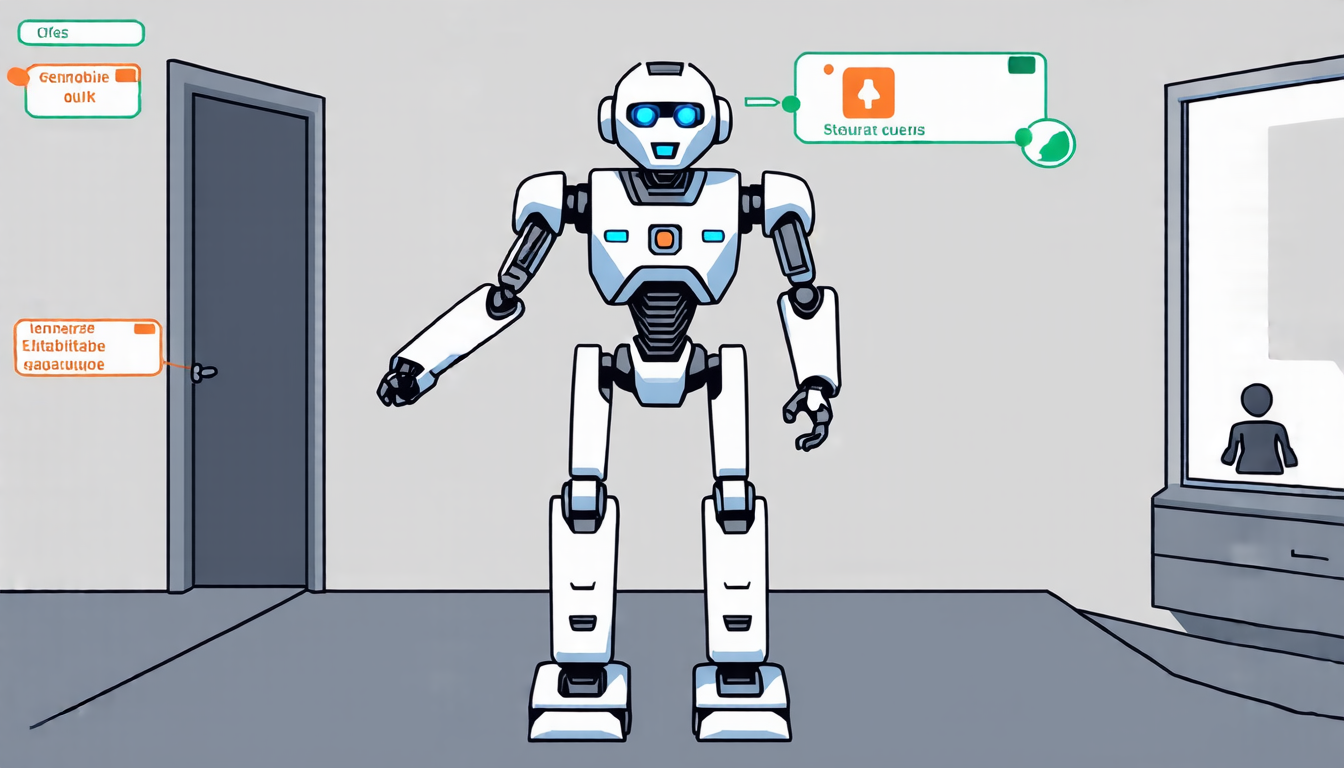
One such system is the vision-and-language navigation framework, which combines computer vision and natural language processing to enable agents to understand and execute instructions in real-world environments. This technology has far-reaching implications for various fields, including robotics, autonomous vehicles, and assistive technologies.
The researchers behind this project have made significant strides in developing a zero-shot learning approach, which allows the system to learn from scratch without requiring extensive training data. This is achieved through the use of masked cross-attention fusion, an innovative technique that combines visual features with linguistic information to generate more accurate predictions.
Another key aspect of this framework is its ability to incorporate occupancy-aware loss functions, which enable the system to predict and avoid obstacles in its path. This is particularly useful in scenarios where the environment is dynamic or contains moving objects, requiring the agent to adapt quickly and make informed decisions.
The system’s navigation capabilities are further enhanced by its integration with a Multi-Modal Large Language Model (MLLM)-based navigator. This module enables the agent to reason about historical events and make adaptive path planning decisions, allowing it to recover from mistakes and navigate through complex spaces more efficiently.
To test the effectiveness of this framework, researchers conducted experiments in both simulated and real-world environments. The results show that the system is capable of achieving state-of-the-art performance in zero-shot settings, outperforming other approaches by a significant margin.
The implications of this technology are vast and varied. For instance, it has the potential to revolutionize the field of robotics, enabling robots to navigate through complex spaces with greater ease and accuracy. Similarly, autonomous vehicles could benefit from this technology, allowing them to better interpret visual and linguistic cues and make more informed decisions on the road.
Moreover, this framework has significant applications in assistive technologies, such as helping individuals with visual impairments or disabilities to navigate through their surroundings with greater independence. By providing a more accurate and efficient navigation system, researchers hope to improve the quality of life for those affected by these conditions.
As AI continues to evolve and advance, we can expect to see even more sophisticated systems emerge, capable of tackling complex tasks with ease and precision.
Cite this article: “Unlocking Continuous Environments: A Zero-Shot Vision-Language Navigation Framework”, The Science Archive, 2025.
Artificial Intelligence, Navigation, Computer Vision, Natural Language Processing, Robotics, Autonomous Vehicles, Assistive Technologies, Zero-Shot Learning, Masked Cross-Attention Fusion, Occupancy-Aware Loss Functions.





