

Thursday 10 April 2025
Researchers have made significant strides in developing a novel method for enabling collision-free flight in cluttered environments without relying on detailed 3D maps or generating and tracking collision-free trajectories. This approach, which combines model predictive control (MPC) with dual KD-trees, has been successfully tested in both simulated and real-world scenarios.
The traditional methods for autonomous quadrotor navigation involve a multi-stage hierarchical framework that includes environmental data integration through explicit map representations, path planning, trajectory generation, and tracking. While effective in real-world cluttered environments, this cascade paradigm faces two inherent limitations: the accumulation of errors from each sequential module can produce biased actions leading to collisions, and the sequential workflow introduces significant computational delays impairing responsiveness.
The new method, on the other hand, leverages the dual KD-trees mechanism to directly produce safe actions from sparse waypoints and point clouds from a depth camera. The Obstacle KD-Tree quickly identifies the nearest obstacle for avoidance, while the Edge KD-Tree provides a robust initial guess for the MPC solver, preventing it from getting stuck in local minima during obstacle avoidance.
In simulation experiments, the proposed method has been tested against several state-of-the-art approaches and has demonstrated superior performance at high speeds. The results show that the new method achieves a success rate of 100% at speeds of up to 12 meters per second (m/s), whereas other methods begin to deteriorate significantly above 5 m/s.
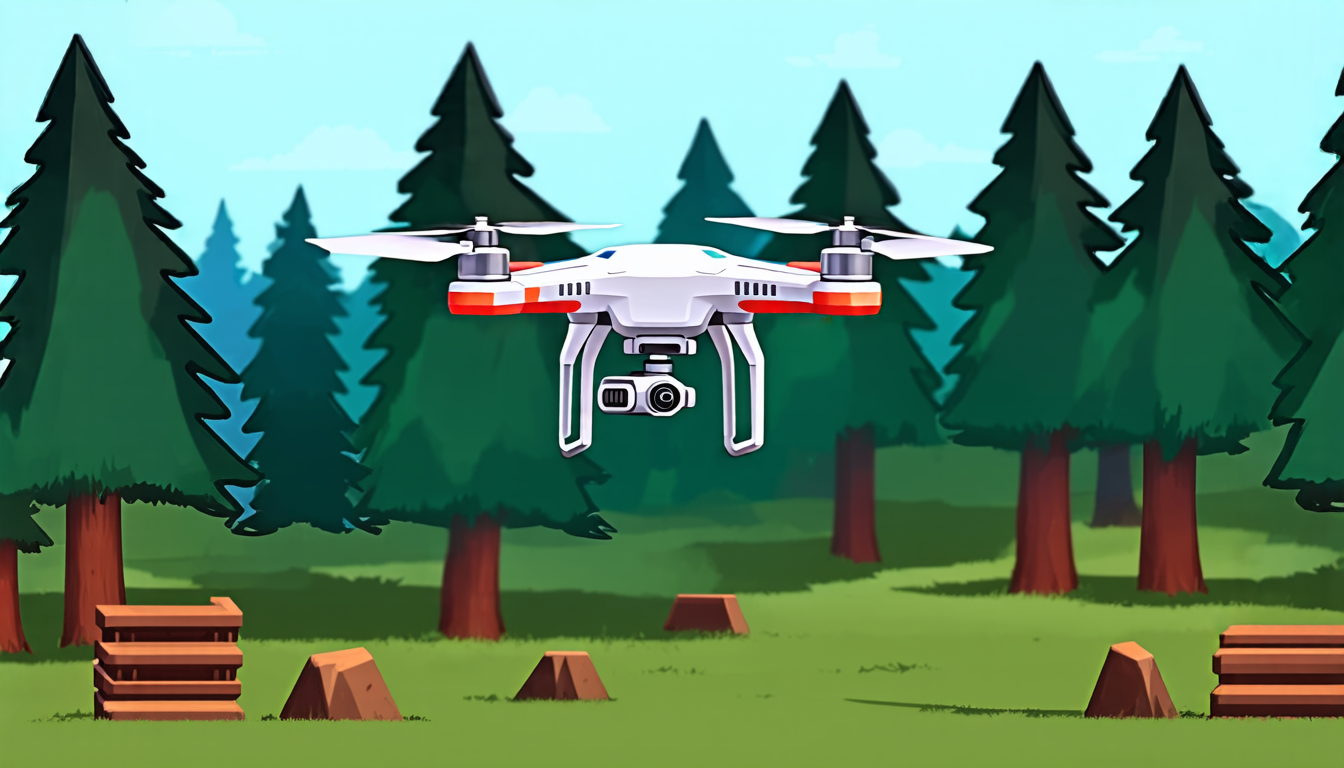
Real-world experiments have also been conducted using a lightweight quadrotor platform equipped with an Intel RealSense D435i depth camera and an Intel N100 onboard computer. The results demonstrate the robustness and generalization capabilities of the method, as the quadrotor successfully navigated through various unknown environments, including dense tree areas, narrow windows, and obstructed spaces.
The use of dual KD-trees has been shown to significantly improve the performance of the MPC solver by providing a better initial guess. This is particularly important for high-speed applications where the solver may become stuck in local minima. Additionally, the method’s ability to adapt to changing environments and dynamic obstacles has been demonstrated through experiments.
The implications of this research are significant, as it has the potential to enable autonomous quadrotors to navigate complex environments with ease and precision. This technology could be applied in a variety of fields, including search and rescue, environmental monitoring, and infrastructure inspection.
Cite this article: “Agile Flight Made Easy: A Novel MPC-Based Approach for Obstacle Avoidance in Complex Environments”, The Science Archive, 2025.
Autonomous Navigation, Quadrotors, Model Predictive Control, Mpc, Dual Kd-Trees, Obstacle Avoidance, Real-World Scenarios, Simulation Experiments, Collision-Free Flight, Environmental Monitoring.





