

Thursday 10 April 2025
The pursuit of efficient and scalable distributed optimization has been a longstanding challenge in the fields of computer science, control theory, and operations research. In recent years, researchers have made significant progress in developing novel algorithms that can efficiently solve large-scale problems by dividing them into smaller sub-problems that are solved independently.
One such algorithm is sensitivity-based distributed model predictive control (SBDP), which has been gaining attention for its ability to tackle complex optimization problems with ease. The key innovation behind SBDP lies in its use of sensitivities, or derivative information, to coordinate the solution process across multiple agents.
In traditional model predictive control (MPC) algorithms, each agent solves a local optimization problem using only its own data and constraints. This approach can lead to suboptimal solutions due to the lack of coordination between agents. SBDP addresses this issue by having each agent share its sensitivity information with its neighbors, allowing them to adjust their decisions accordingly.
The beauty of SBDP lies in its simplicity and scalability. Each agent only needs to solve a small-scale optimization problem using its local data and constraints, while the global solution is obtained through a distributed coordination process. This approach has several advantages over traditional MPC algorithms, including reduced computational complexity and improved robustness.
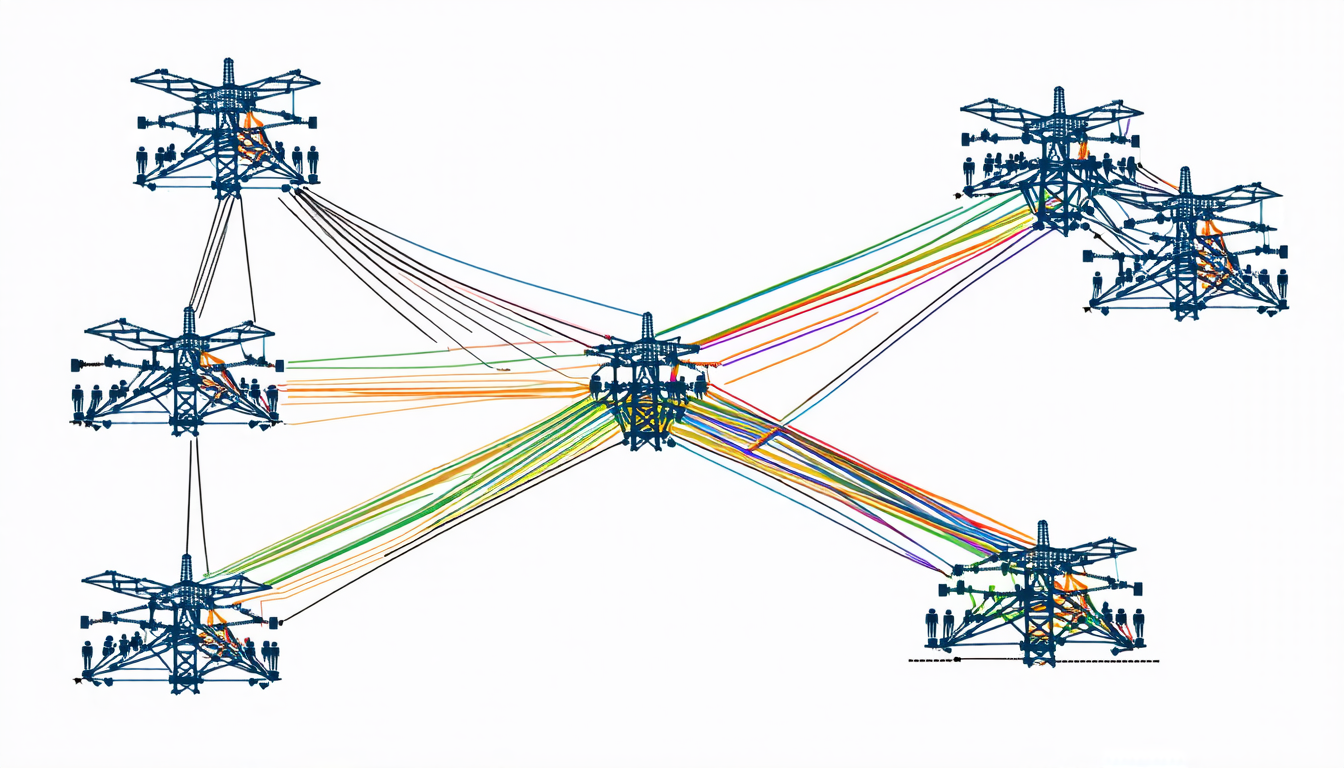
To illustrate the power of SBDP, consider a distributed optimal control problem where multiple agents need to coordinate their actions to optimize a common objective function. In this scenario, SBDP can be used to develop a decentralized control strategy that is both efficient and scalable.
The authors of the paper demonstrate the effectiveness of SBDP using several examples from various fields, including power systems, transportation networks, and robotic formations. They show that SBDP can achieve significant improvements in terms of computational efficiency and solution quality compared to traditional MPC algorithms.
One potential limitation of SBDP is its reliance on accurate sensitivity information, which may not always be available or reliable. However, the authors propose several strategies for addressing this issue, including the use of approximations and online estimation techniques.
Overall, the development of SBDP represents a significant step forward in the field of distributed optimization and control theory. Its ability to efficiently solve large-scale problems with ease makes it an attractive solution for many real-world applications, from power grid management to autonomous vehicle navigation. As researchers continue to refine and extend this algorithm, we can expect to see even more impressive results in the years to come.
Cite this article: “Unlocking Scalability in Distributed Optimization: A Novel Sensitivity-Based Approach”, The Science Archive, 2025.
Distributed Optimization, Model Predictive Control, Sensitivity-Based Distributed Model Predictive Control, Decentralized Control, Power Systems, Transportation Networks, Robotic Formations, Computational Efficiency, Solution Quality, Scalability.





