

Thursday 10 April 2025
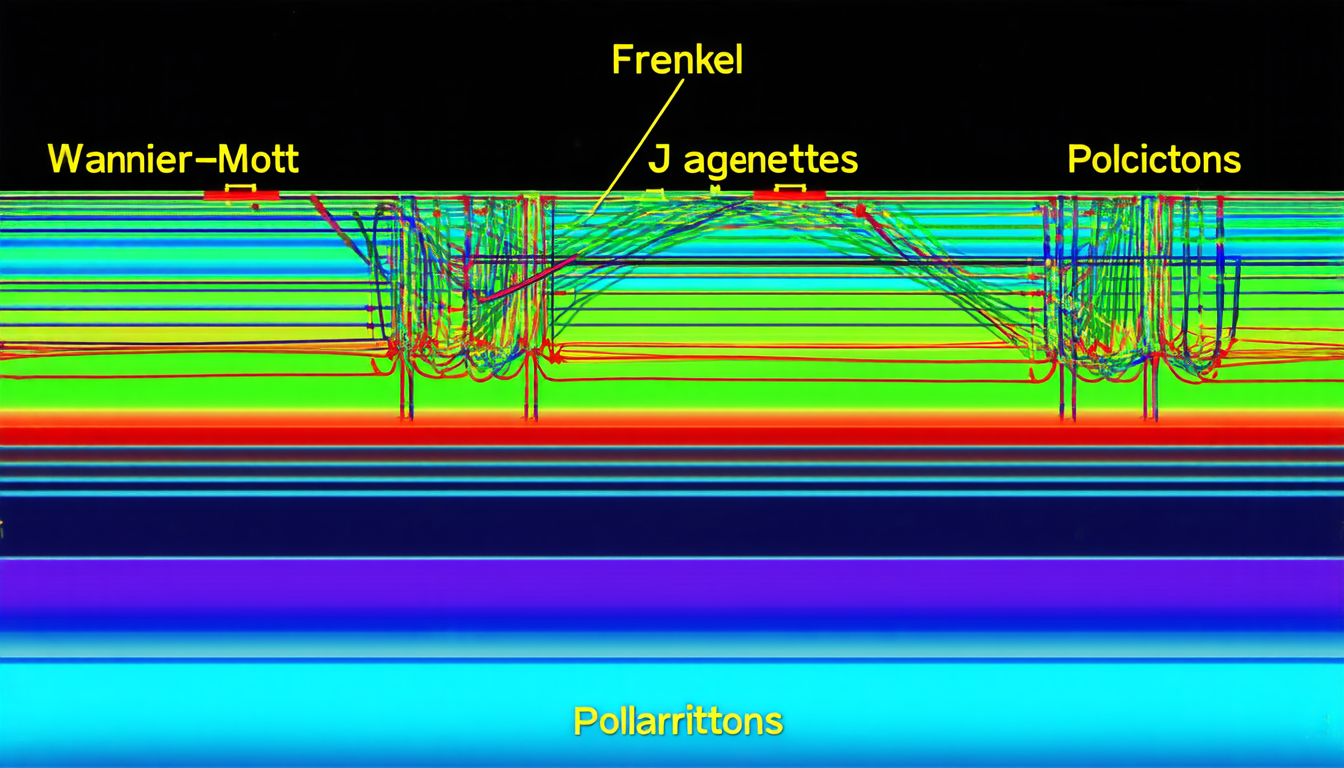
Scientists have made a significant breakthrough in the field of optics by successfully creating a hybrid system that combines two types of excitons, Wannier-Mott and Frenkel, to produce new and exciting properties. This achievement has the potential to revolutionize our understanding of light-matter interactions and open up new avenues for technological innovations.
The research team used a thin layer of tungsten disulfide (WS2) as the base material, which is known for its unique optical properties. They then deposited a layer of J-aggregates, a type of molecular complex, on top of the WS2. The J-aggregates were chosen because they have a high degree of structural order, which allows them to interact with the Wannier-Mott excitons in a specific way.
The team used spectroscopic ellipsometry to measure the dielectric functions of the WS2 and J-aggregates layers. This technique involves shining light on the sample at different angles and measuring the changes in its polarization state. By analyzing these measurements, the researchers were able to determine the optical properties of each layer and how they interact with each other.
The results showed that the hybrid system exhibits a unique behavior known as strong coupling, where the Wannier-Mott excitons and Frenkel excitons interact with each other in a way that enhances their properties. This interaction leads to the creation of new types of polaritons, which are particles that combine light and matter.
One of the most striking features of this hybrid system is its ability to tune the properties of the polaritons by adjusting the number of J-aggregates molecules present. By increasing the number of molecules, the team was able to shift the energy range over which the polaritons exist, allowing them to explore new regions of the electromagnetic spectrum.
This breakthrough has significant implications for various fields, including optics, photonics, and materials science. The creation of hybrid systems that combine different types of excitons could lead to the development of new optical devices and sensors with unprecedented sensitivity and selectivity. Additionally, this research could pave the way for the development of novel materials with unique optical properties.
The study’s findings demonstrate the power of interdisciplinary research, where scientists from different fields come together to push the boundaries of our understanding of the world. By combining expertise in materials science, optics, and spectroscopy, the researchers were able to achieve a major milestone that could have far-reaching consequences for future technological advancements.
Cite this article: “Unlocking the Secrets of Plasmonic Hybridization: A Revolutionary Step Towards Quantum Computing?”, The Science Archive, 2025.
Optics, Excitons, Wannier-Mott, Frenkel, Hybrid System, Polaritons, Spectroscopic Ellipsometry, Materials Science, Photonics, Strong Coupling.





