

Sunday 13 April 2025
Scientists have long been puzzled by a mysterious phenomenon known as dark matter, which makes up about 27% of our universe but remains invisible and undetectable. One theory is that dark matter could be made up of tiny black holes called primordial black holes (PBHs), formed in the early days of the universe. But until now, there was no way to test this idea.
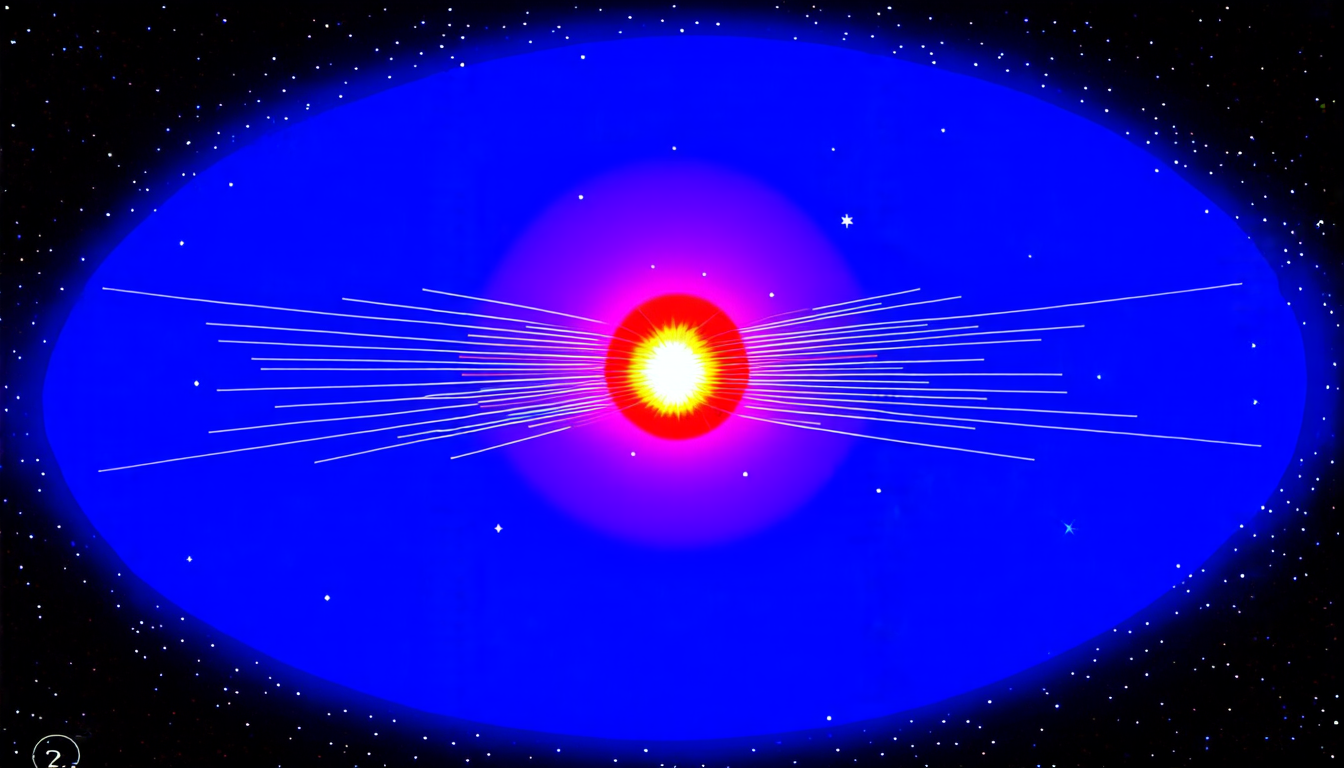
Enter a team of researchers who have discovered a clever new method to detect PBHs using the temperature of the intergalactic medium (IGM), the material that fills the vast spaces between galaxies. By studying the IGM’s temperature over billions of years, they were able to put a limit on how much dark matter could be made up of these tiny black holes.
The researchers used observations from quasar spectra, which are incredibly bright and distant objects that can be seen from Earth. They analyzed the absorption lines in the light coming from these quasars, which are caused by the IGM’s temperature and density. By comparing their results to simulations, they were able to infer how much energy was deposited into the IGM over time.
The team found that if PBHs existed in large numbers, they would have had a significant impact on the IGM’s temperature. But what they discovered was surprising – there wasn’t enough evidence of this heating effect to support the idea that PBHs make up a significant portion of dark matter. In fact, their results suggest that PBHs could only account for a tiny fraction of dark matter at most.
This discovery has important implications for our understanding of the universe and the nature of dark matter. If PBHs are not responsible for dark matter, then we may need to look elsewhere for answers. The researchers’ method is also a powerful tool for studying the early universe and could be used to investigate other mysteries, such as how galaxies formed and evolved.
The search for dark matter remains an active area of research, with scientists using a variety of methods to try and detect it. While this discovery doesn’t solve the puzzle of dark matter once and for all, it provides valuable insights into its nature and behavior. As our understanding of the universe continues to evolve, we may eventually uncover the truth behind this mysterious phenomenon.
Cite this article: “Dark Matters Secret Past: Primordial Black Holes Unveiled as IGM Heat Sources”, The Science Archive, 2025.
Dark Matter, Primordial Black Holes, Intergalactic Medium, Quasar Spectra, Absorption Lines, Temperature, Dark Energy, Universe, Galaxies, Cosmology





