

Wednesday 16 April 2025
Language models, those clever algorithms that can generate text and chat like humans, have a major problem: they’re biased. And it’s not just a matter of being a little unfair – these biases can have real-world consequences.
For instance, language models are often trained on vast amounts of text data, which is frequently generated by humans with their own set of biases. This means that the models absorb those biases, perpetuating harmful stereotypes and discrimination. It’s like a digital echo chamber, where prejudices get amplified and reinforced.
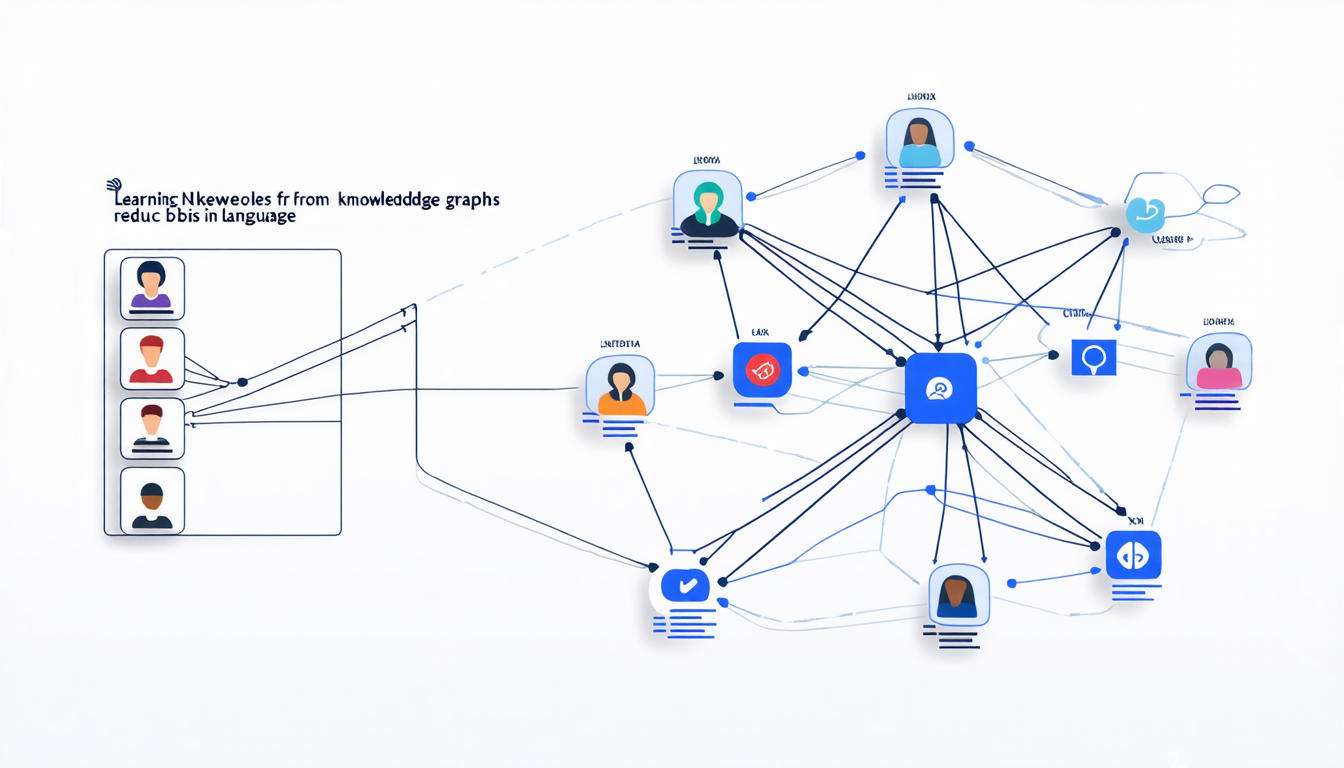
Researchers have been working to address this issue by incorporating knowledge graphs into language models. Knowledge graphs are essentially databases that contain structured information about entities and their relationships. By integrating these graphs with language models, the hope is to reduce bias and create more balanced and fair outputs.
One approach is to use graph neural networks to encode the knowledge graphs. These networks can learn to represent complex relationships between entities, which in turn helps the language model to generate more accurate and unbiased text.
Another strategy is to fine-tune the language models with domain-specific knowledge graphs. This involves creating tailored graphs that reflect specific domains or industries, such as healthcare or finance. By training the model on these graphs, it can learn to recognize and avoid biases that are unique to those fields.
The results are promising. In experiments, researchers have seen significant improvements in bias mitigation when using knowledge graphs with language models. For example, one study found that a language model trained on a knowledge graph reduced gender bias by 15%, while another study showed that a model fine-tuned on a healthcare-specific graph improved accuracy and fairness in medical diagnosis.
But there’s still much work to be done. Language models are only as good as the data they’re trained on, so ensuring the quality and diversity of that data is crucial. Additionally, researchers need to develop more sophisticated methods for detecting and mitigating bias in language models.
As we continue to rely on language models to perform tasks like text generation and chatbots, it’s essential that we prioritize fairness and accuracy. By incorporating knowledge graphs into these models, we can create more reliable and trustworthy AI systems that don’t perpetuate harmful biases.
The potential implications are far-reaching – from improving accessibility in healthcare to enhancing customer service in finance. As we push the boundaries of what language models can do, it’s crucial that we also address the elephant in the room: bias.
Cite this article: “Fairness in AI: A Novel Approach to Mitigating Bias in Large Language Models Using Knowledge Graphs”, The Science Archive, 2025.
Language Models, Biased Data, Knowledge Graphs, Graph Neural Networks, Domain-Specific Knowledge Graphs, Fine-Tuning, Bias Mitigation, Text Generation, Chatbots, Fairness Accuracy.





