

Wednesday 16 April 2025
Acoustic signals are all around us, invisible and inaudible unless we take a moment to tune in. From the hum of our smartphones to the chirping of birds outside, these signals fill the airwaves, carrying information that can be harnessed for a wide range of applications. In recent years, researchers have made significant strides in using acoustic sensing technology to track and locate objects, from cars to people to even tiny insects.
One of the most promising areas of research is in the field of drone tracking. With the rise of unmanned aerial vehicles (UAVs) and their increasing presence in our daily lives, finding ways to accurately monitor and track these devices has become a pressing concern. This is particularly important for commercial uses like package delivery or search and rescue operations, where precise location information can mean the difference between life and death.
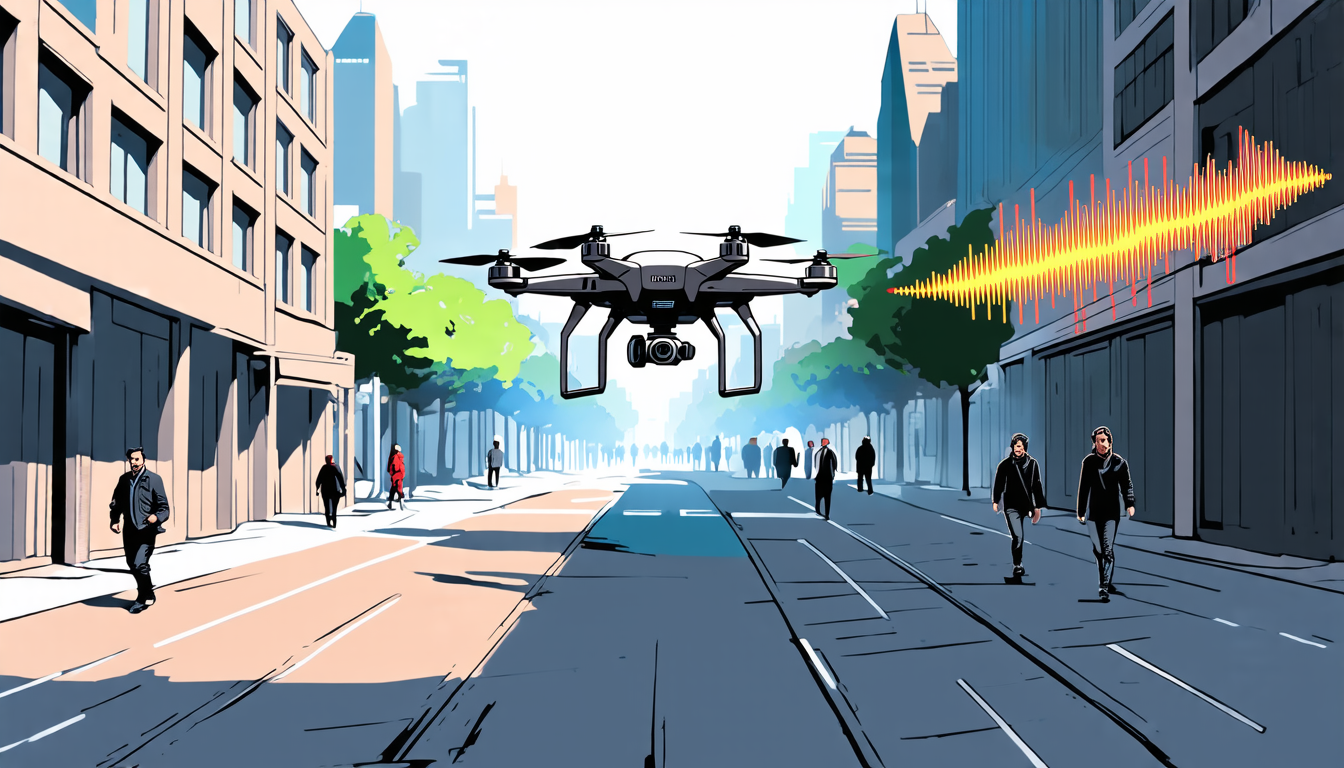
A team of researchers from Tsinghua University has made significant progress in this area by developing an innovative acoustic-based tracking system called AIM (Acoustic Inertial Measurement). By using a single microphone array, AIM is able to detect and localize drones with unprecedented accuracy, even in complex indoor environments. The technology works by analyzing the unique acoustic signature emitted by each drone’s propellers as it flies through space.
The researchers used a commercial off-the-shelf (COTS) drone, the DJI Mini 2, to test their system in various scenarios. They placed the microphone array at different distances and angles from the drone, simulating real-world tracking conditions. The results were impressive: AIM was able to pinpoint the drone’s location with an average error of just 0.5 meters, even in areas with multiple obstacles and sources of noise.
But what makes AIM truly remarkable is its ability to operate independently of GPS signals, which can be unreliable or unavailable in certain environments. This means that AIM can track drones in areas where other tracking systems would fail, making it an attractive solution for a wide range of applications.
The potential uses of AIM are vast and varied. In addition to commercial drone delivery services, the technology could also be used to monitor and track wildlife populations, detect and prevent terrorist attacks, or even provide real-time feedback for athletes and musicians. As the world becomes increasingly connected and automated, innovations like AIM will play a critical role in keeping us safe and informed.
The researchers are now working to refine their system and explore its potential applications further.
Cite this article: “Acoustic Inertial Measurement: A Novel Approach to Indoor Drone Localization and Tracking”, The Science Archive, 2025.
Drone Tracking, Acoustic Sensing, Aim Technology, Microphone Array, Propeller Signature, Gps Signals, Location Accuracy, Obstacle Detection, Noise Reduction, Innovation.





