

Wednesday 16 April 2025
The quest for efficient mesh generation has long been a thorn in the side of computational fluid dynamics (CFD) researchers and engineers. With the increasing complexity of flow simulations, traditional methods have struggled to keep pace, often resulting in lengthy computation times and poor results. A recent study proposes an innovative solution: leveraging machine learning (ML) to predict near-optimal meshes for CFD simulations.
The challenge lies in generating meshes that accurately capture the intricate details of fluid flow while minimizing computational overhead. Traditional meshing techniques rely on manual intervention or automated algorithms, which can be time-consuming and prone to error. In contrast, ML-based approaches aim to learn patterns from existing data to create optimal meshes.
The researchers employed a neural network (NN) architecture to predict anisotropic spacing functions, which describe the local refinement requirements of each mesh element. By training the NN on a dataset of pre-computed meshes and corresponding flow simulations, the model learns to identify key features that influence mesh quality. The predicted spacings are then used to generate new meshes tailored for specific simulation scenarios.
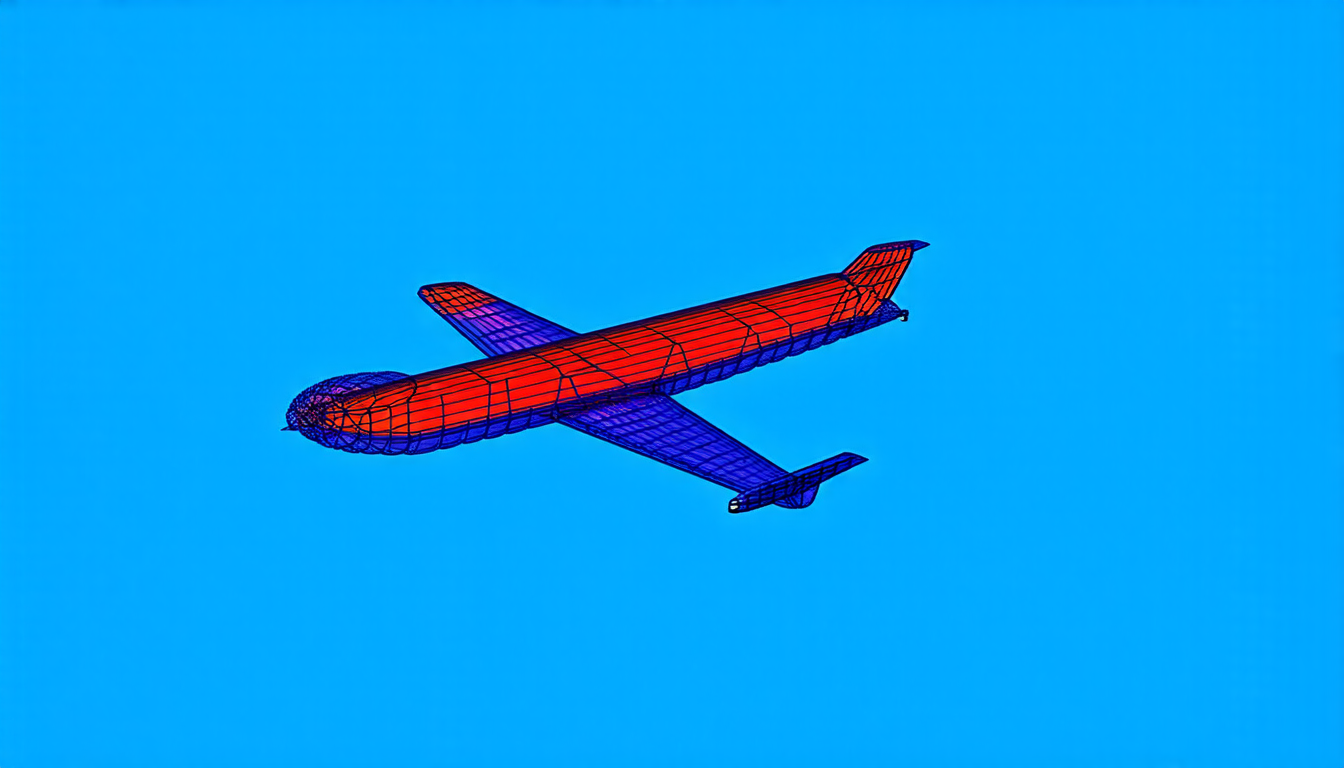
The study demonstrates the effectiveness of this ML-based approach through two case studies: a simplified wing geometry at transonic conditions and a full aircraft configuration with 11 geometric parameters. In both examples, the predicted meshes were compared to those generated using traditional methods, showcasing significant improvements in mesh quality and reduced computation times.
One notable aspect of this research is its focus on anisotropic spacings, which are critical for capturing complex flow phenomena. By predicting these spacings accurately, the ML model enables the generation of meshes that adapt to the local flow conditions, resulting in more accurate simulations and reduced computational costs.
While the study’s results are promising, there are still challenges to be addressed before this technology can be widely adopted. The researchers acknowledge the need for further investigation into the robustness and generalizability of their approach across different flow regimes and geometries.
Despite these limitations, the potential of ML-based mesh generation is undeniable. As CFD simulations become increasingly complex and demanding, innovative solutions like this one will be essential for advancing our understanding of fluid dynamics and optimizing engineering designs.
Cite this article: “Revolutionizing Mesh Generation with Neural Networks: A Game-Changer for Computational Fluid Dynamics”, The Science Archive, 2025.
Computational Fluid Dynamics, Mesh Generation, Machine Learning, Neural Network, Anisotropic Spacing, Flow Simulations, Computational Overhead, Error Reduction, Optimized Meshes, Fluid Dynamics.





