

Wednesday 16 April 2025
A team of researchers has made significant progress in understanding the intricacies of quantum graphs, complex mathematical structures that describe the behavior of quantum systems. By developing new techniques to analyze these graphs, the scientists have shed light on their properties and behavior, opening up new avenues for research in fields such as quantum computing and cryptography.
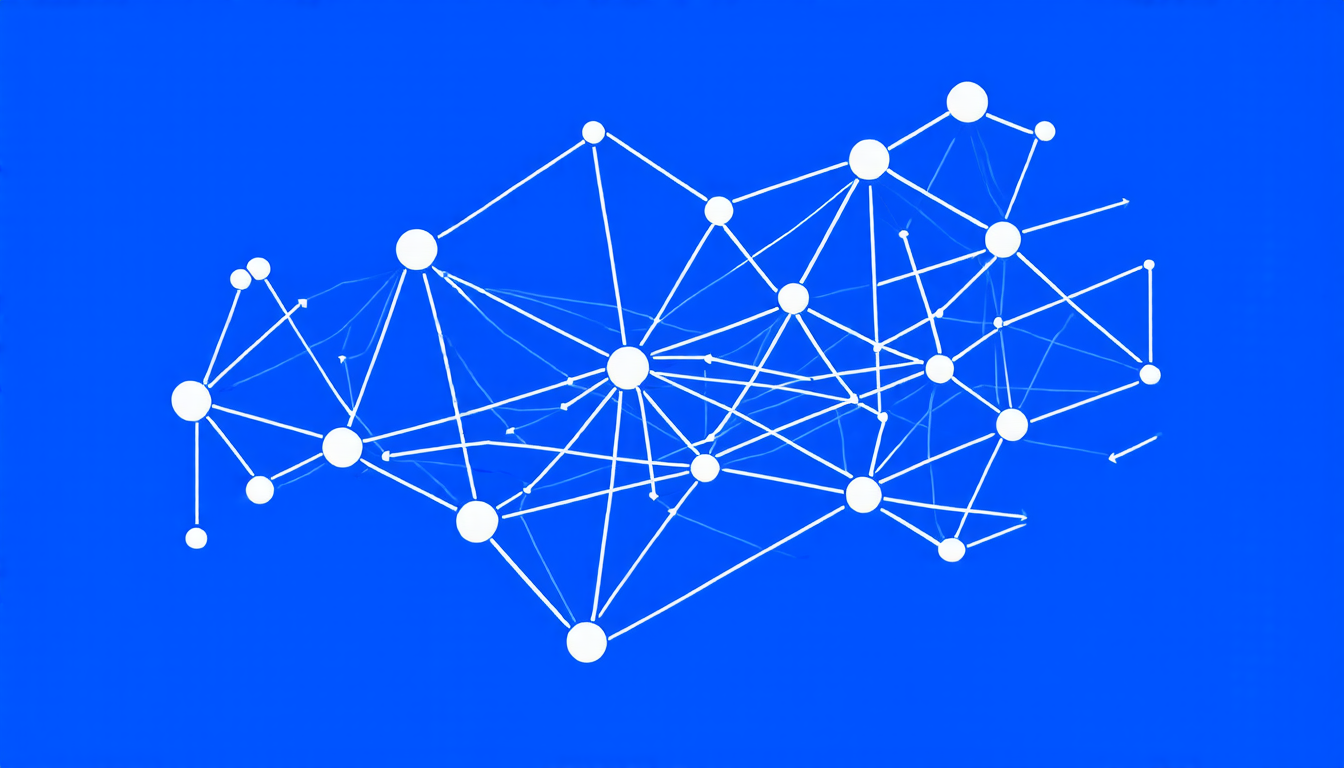
Quantum graphs are a type of C*-algebra, a mathematical structure used to describe the algebraic operations of quantum mechanics. They are often represented as directed graphs, with vertices and edges that correspond to the quantum states and transitions between them. The behavior of these graphs is governed by the Schrödinger equation, which describes how quantum systems evolve over time.
The researchers’ work focuses on a specific type of quantum graph known as a Cuntz-Pimsner algebra, named after the mathematicians Joachim Cuntz and Detlef Pimsner. These algebras are particularly interesting because they can be used to model complex quantum systems, such as those found in quantum computing and cryptography.
One of the key challenges in studying these graphs is understanding their ideal structure, which refers to the way they are composed of smaller subalgebras. The researchers have developed a new technique for analyzing this structure, using a combination of algebraic and geometric methods.
Their approach involves representing the Cuntz-Pimsner algebra as a tensor product of simpler algebras, known as C*-correspondences. These correspondences are used to describe the transitions between quantum states, and the researchers have developed a way to decompose them into smaller pieces using techniques from representation theory.
By doing so, they have been able to classify certain types of Cuntz-Pimsner algebras, which has important implications for their use in quantum computing and cryptography. For example, the researchers’ work could be used to develop more efficient algorithms for quantum error correction, or to create new cryptographic protocols that are resistant to attacks.
The team’s findings have also shed light on the connection between Cuntz-Pimsner algebras and other areas of mathematics, such as operator algebras and functional analysis. This has opened up new avenues for research, as well as potential applications in fields such as quantum information theory and statistical mechanics.
Overall, the researchers’ work represents a significant step forward in our understanding of quantum graphs and their properties.
Cite this article: “Unlocking the Secrets of Quantum Graphs: A New Perspective on Simple C-Algebras”, The Science Archive, 2025.
Quantum Graphs, C*-Algebras, Quantum Mechanics, Schrödinger Equation, Cuntz-Pimsner Algebras, Tensor Products, Representation Theory, Operator Algebras, Functional Analysis, Quantum Computing, Cryptography





