

Wednesday 16 April 2025
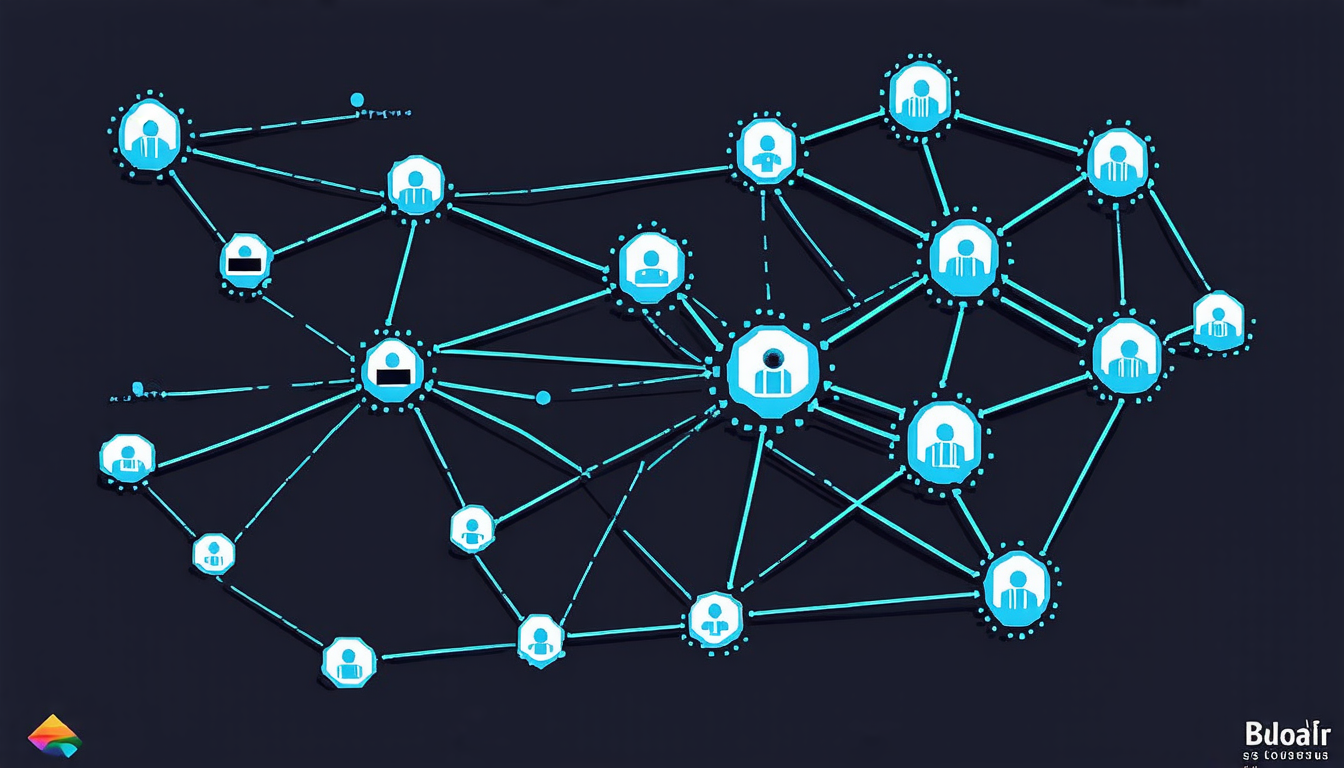
The art of modeling complex networks has long been a challenge for researchers in fields ranging from epidemiology to social network analysis. One particularly tricky aspect is accounting for the growth and evolution of these networks over time, as nodes and edges are constantly being added or removed. A new study published today sheds light on this issue by proposing a novel framework for modeling growing networks, with promising implications for our understanding of complex systems.
The authors begin by highlighting the limitations of traditional approaches to network modeling, which often rely on simplifying assumptions such as node exchangeability. However, these assumptions can lead to inaccurate predictions and fail to capture key features of real-world networks. Instead, the researchers propose a causal approach that focuses on the interventional structure of the network, or how interventions (such as adding or removing nodes or edges) affect the behavior of the system.
The resulting model, dubbed DAPA (Distributed Affine Preferential Attachment), is designed to capture the intricate dynamics of growing networks. By modeling the relationships between nodes and edges in a distributed manner, rather than relying on global parameters, DAPA can account for the non-stationarity and heterogeneity that are hallmarks of real-world networks.
One of the key innovations of DAPA is its ability to produce power-law degree distributions, which are common features of many complex networks. These distributions describe how the frequency of node degrees decreases as the degree increases, often following a precise mathematical formula. By capturing this behavior, DAPA can provide a more accurate and nuanced understanding of network structure and evolution.
The study also explores the phase transitions that occur in growing networks as the parameters of the model are varied. For example, when the rate at which new nodes are added is high, the average degree of the network may grow logarithmically with the number of nodes. Conversely, if the rate is low, the average degree may remain constant or even decrease.
These findings have significant implications for our understanding of complex systems and their behavior over time. By developing more accurate models of growing networks, researchers can better understand phenomena such as epidemic spread, traffic flow, and social influence. Furthermore, DAPA’s distributed approach may provide new insights into the organization and evolution of these systems at a fine-grained level.
The study’s authors are quick to acknowledge that their model is not without its limitations. For instance, DAPA assumes a fixed number of edges between each pair of nodes, which may not always be the case in real-world networks.
Cite this article: “Unlocking the Secrets of Growing Networks: A Mathematical Framework for Understanding Complex Systems”, The Science Archive, 2025.
Network Modeling, Complex Systems, Epidemiology, Social Network Analysis, Growing Networks, Dapa Model, Preferential Attachment, Power-Law Degree Distributions, Phase Transitions, Node Exchangeability.





