

Wednesday 16 April 2025
As humans, we often find ourselves in situations where we need to interact with robots, whether it’s for work or in our daily lives. But have you ever wondered how these machines can effectively communicate and respond to us? Researchers have been working on developing a new skill design that leverages large language models (LLMs) to generate action plans for tasks involving human-robot interaction.
The key to this innovative approach is the ability of LLMs to understand context and adapt to changing situations. By feeding these models with vast amounts of data, scientists can program them to recognize patterns and make decisions based on human behavior. This allows robots to respond in a more natural and intuitive way, making interactions feel more like a conversation.
The researchers have developed a skill design that incorporates LLMs into the decision-making process. This involves creating an action set, or a list of possible actions for the robot to take, and then using the LLM to generate a plan based on the current situation. The model takes into account factors such as the human’s attention, their activity, and even the environment they are in.
One of the most impressive aspects of this technology is its ability to adapt to different scenarios. In a series of experiments, the researchers tested the skill design with four distinct scenarios, each with its own set of challenges. The results were striking – the robot was able to successfully complete all four tasks, demonstrating its ability to generalize across different situations.
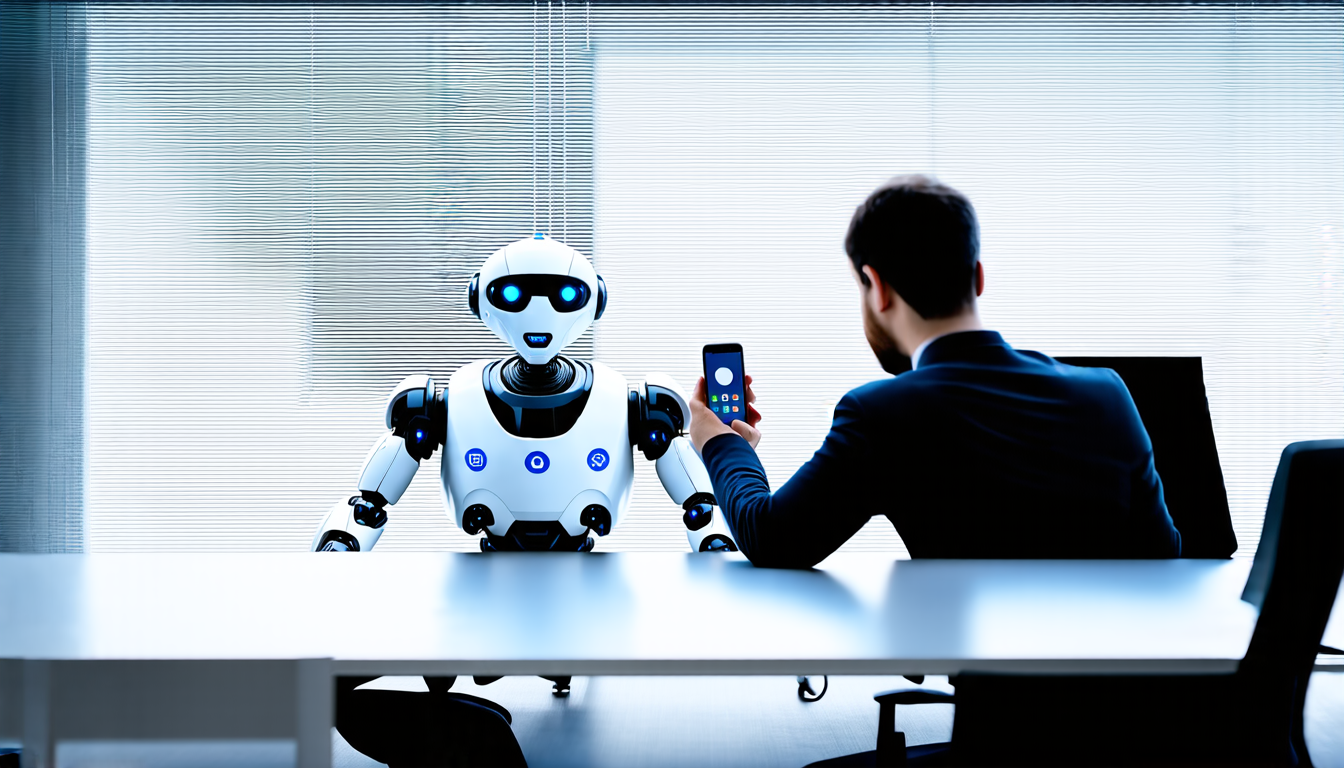
But how does it work? Let’s take an example. Say you’re in a meeting and your colleague is distracted by their phone. You need to get their attention, but you also don’t want to interrupt them too much. The robot, equipped with the LLM-powered skill design, would recognize that the human is not ready for engagement and wait until they are free before approaching them.
The implications of this technology are vast. Imagine being able to interact with robots in a more natural way, without having to worry about complex programming or commands. It could revolutionize industries such as healthcare, customer service, and even education.
Of course, there’s still much work to be done to fully integrate LLMs into human-robot interaction. But the potential is undeniable – and we’re one step closer to making robots an integral part of our daily lives.
Cite this article: “Unlocking Human-Robot Interaction: A New Approach Leveraging Large Language Models”, The Science Archive, 2025.
Large Language Models, Human-Robot Interaction, Robot Skills, Decision-Making, Contextual Understanding, Pattern Recognition, Task Planning, Action Sets, Generalization, Adaptability





