

Wednesday 16 April 2025
The quest for a deeper understanding of the intricate patterns that govern our world has led scientists to explore the uncharted territories of graph theory. A recent breakthrough in this field has shed new light on the mysterious relationships between the chromatic number, the quantum chromatic number, and the p-energies of graphs.
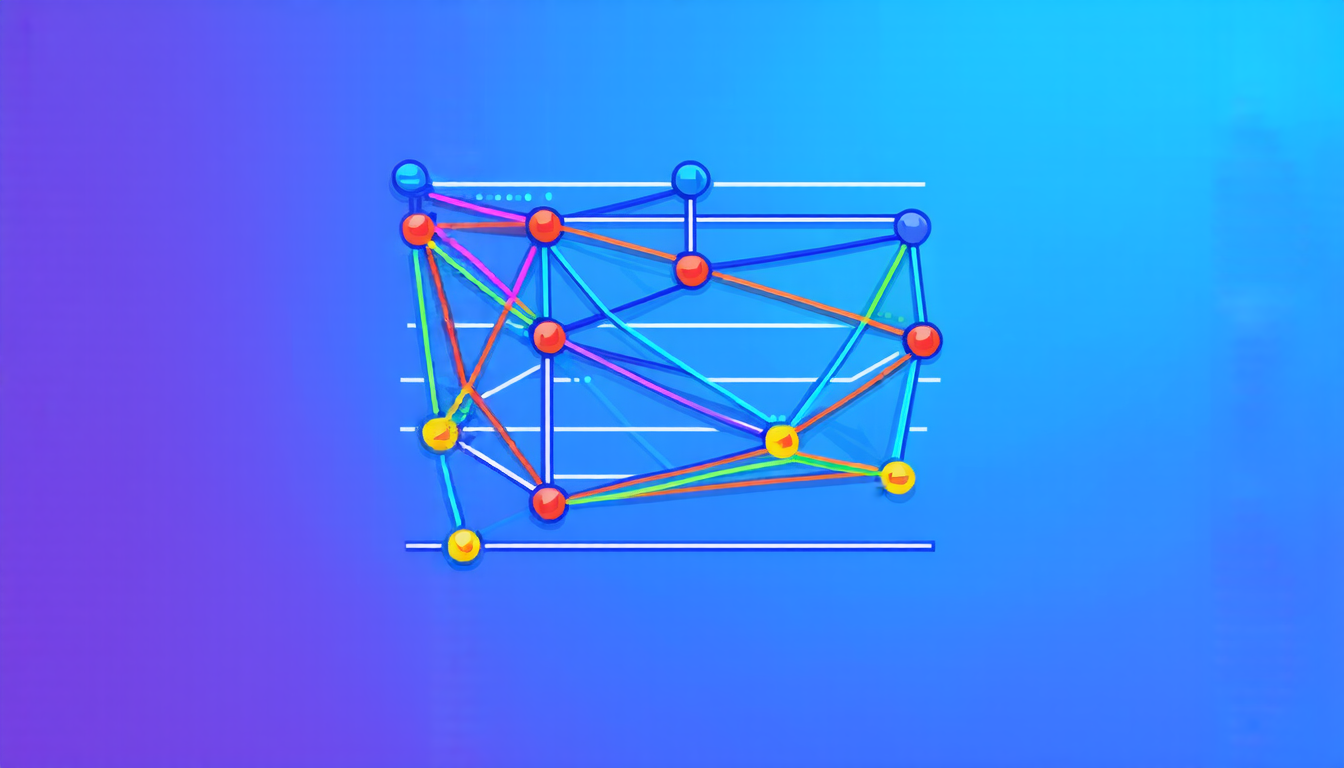
For those unfamiliar with the realm of graph theory, it’s worth noting that a graph is essentially a collection of nodes or vertices connected by edges. The properties of these connections can be used to model complex systems in a wide range of fields, from computer science to biology. One of the most fundamental questions in this area revolves around the chromatic number of a graph – the minimum number of colours required to colour each node such that adjacent nodes receive distinct colours.
In recent years, researchers have been working to develop more efficient methods for calculating the chromatic number of a given graph. This has led to the discovery of new spectral bounds on this value, which can be expressed in terms of the p-energies of the graph. But what exactly are these p-energies?
The answer lies in the realm of matrix theory, where the energy of a graph is calculated by summing the squares of its eigenvalues. The concept of p-energy takes this idea one step further by introducing a parameter p, which can take on any real value between 0 and infinity. By varying p, researchers have been able to uncover new insights into the properties of graphs and their chromatic numbers.
The recent breakthrough in question revolves around the development of a novel spectral bound on the chromatic number of a graph. This bound is expressed in terms of the p-energies of the graph, which can be calculated using a combination of matrix theory and algebraic methods. The implications of this result are far-reaching, as it has the potential to revolutionize our understanding of complex systems and their behaviour.
One of the key benefits of this new approach lies in its ability to provide tighter bounds on the chromatic number than previously thought possible. This is particularly significant in fields such as computer science, where efficient colouring algorithms can have a major impact on the performance of complex networks.
But what does this mean for our everyday lives? The answer lies in the potential applications of these new insights. By developing more efficient methods for calculating chromatic numbers, researchers may be able to create more robust and resilient systems that are better equipped to handle the demands of modern life.
Cite this article: “Unlocking Graph Complexity with Quantum-Inspired Energies”, The Science Archive, 2025.
Graph Theory, Chromatic Number, Quantum Chromatic Number, P-Energies, Matrix Theory, Eigenvalues, Spectral Bounds, Colouring Algorithms, Computer Science, Complex Systems.





