

Wednesday 16 April 2025
Recent research has delved into the fascinating world of piecewise Möbius transformations, a branch of mathematics that explores the properties of maps that combine multiple geometric transformations. These transformations have far-reaching implications in various fields, including engineering, physics, and computer science.
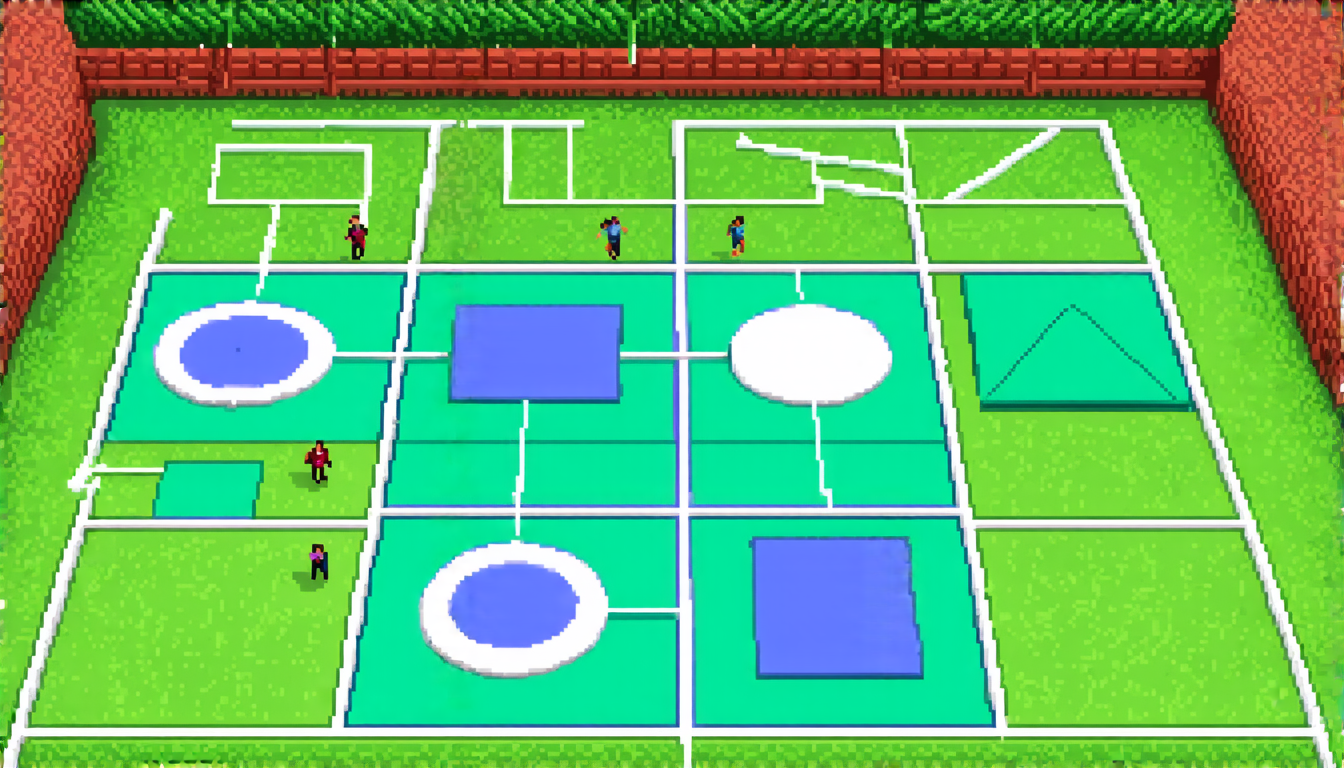
At its core, a piecewise Möbius transformation is a map that takes a point on the complex plane and applies different transformations to it depending on its location. Think of it like a game of hopscotch, where the player jumps from one square to another, with each square applying a different rule. In this case, the squares represent different regions of the complex plane, and the rules are the geometric transformations.
Researchers have been studying these transformations for their potential applications in fields such as signal processing, image compression, and cryptography. One key aspect is their ability to map complex shapes onto simpler ones, allowing for efficient encoding and decoding of information.
A recent paper published by Renato Leriche and Guillermo Sienra has shed new light on the dynamics of piecewise Möbius transformations. Their work focuses on the concept of structural stability, which refers to the property that a transformation remains unchanged under small perturbations.
The authors have developed a framework for analyzing the stability of these transformations, using techniques from complex analysis and topology. They have also identified certain conditions under which the transformations exhibit stable behavior, such as when they are hyperbolic or loxodromic.
One key finding is that piecewise Möbius transformations can be structurally stable even in the presence of discontinuities, such as jumps or singularities. This has important implications for applications where these transformations are used to process signals or images with complex structures.
The researchers have also explored the properties of a specific family of piecewise Möbius transformations known as the tent maps. These maps are defined by a parameter λ and exhibit different behaviors depending on its value. For example, when |λ| < 1, the map is globally attracting, while for |λ| > 1, it is globally repelling.
The authors have shown that these tent maps can be structurally stable under certain conditions, such as when the discontinuity set is bounded and the pre-discontinuity set is finite. This has implications for applications in signal processing, where stable transformations are crucial for accurate decoding of information.
In summary, the research on piecewise Möbius transformations has far-reaching implications for various fields.
Cite this article: “Unlocking the Secrets of Chaos: A New Understanding of Piecewise Möbius Transformations”, The Science Archive, 2025.
Complex Analysis, Topology, Signal Processing, Image Compression, Cryptography, Möbius Transformation, Piecewise Transformations, Structural Stability, Complex Shapes, Tent Maps
Reference: Renato Leriche, Guillermo Sienra, “Structural stability in piecewise Möbius transformations” (2025).





