

Wednesday 16 April 2025
Scientists have long been fascinated by the properties of graphs, which are abstract representations of connections between objects. In a recent paper, researchers delved into the world of graph theory to uncover new insights about the relationships between different types of graphs.
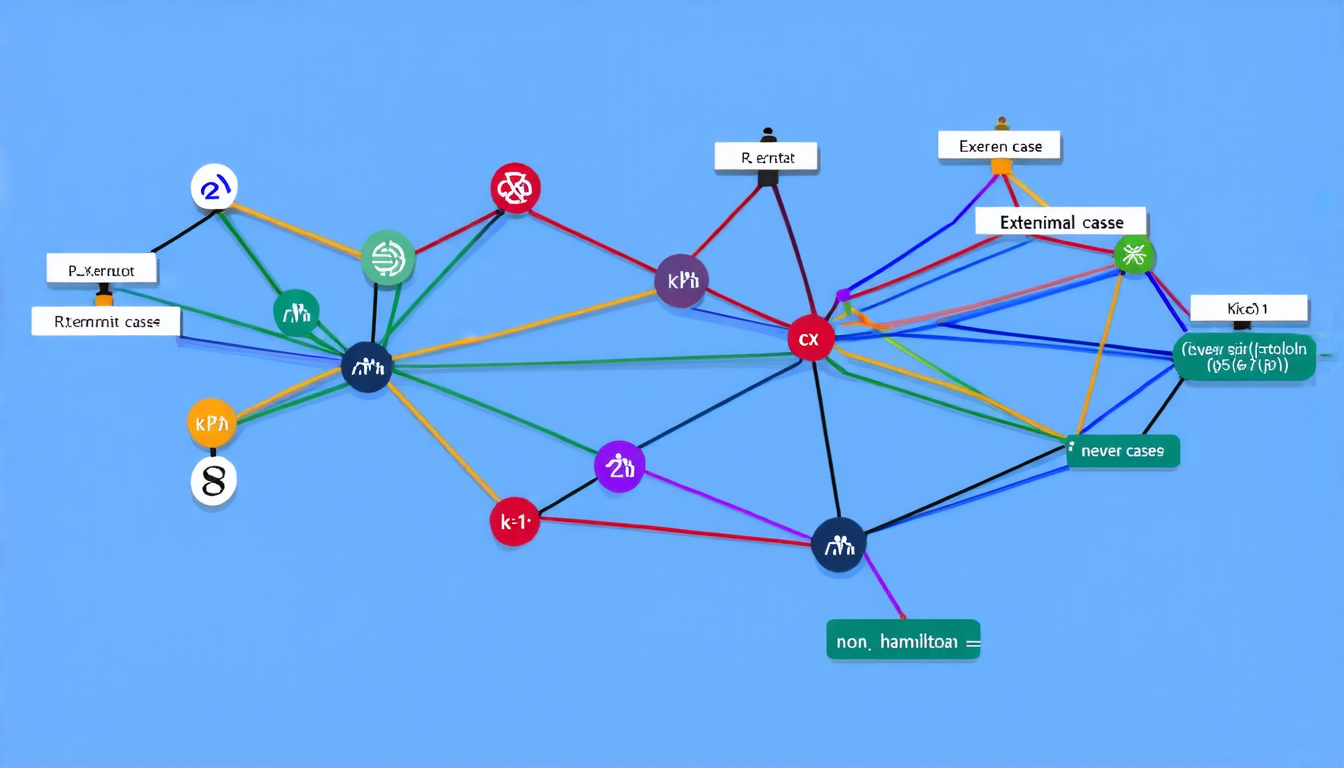
One type of graph that has garnered significant attention is the Kr+1-free graph, which is characterized by its absence of certain subgraphs. These graphs have been found to possess unique properties, such as being non-hamiltonian, meaning they do not contain a spanning cycle.
The researchers’ investigation focused on the extremal case, where they sought to identify the maximum number of edges that can be present in a Kr+1-free graph with given minimum degree and number of vertices. They discovered that this maximum number is achieved by two specific families of graphs, which were previously unknown.
One of these families consists of graphs known as Ki+ℓ+, which are constructed from smaller subgraphs called Ii ∪Kn−2i−ℓ. These subgraphs are then connected to form the larger graph. The researchers found that these graphs play a crucial role in maximizing the number of edges among non-hamiltonian graphs.
The other family of graphs identified by the researchers is based on a different construction method, which involves combining smaller subgraphs called Ii ∪Kn−2i−ℓ with complete bipartite graphs. These combined graphs also exhibit unique properties that make them extremal cases for certain graph properties.
The significance of this research lies in its potential applications to various fields, such as computer science and social network analysis. For instance, understanding the structure of complex networks can provide valuable insights into their robustness and resilience.
Furthermore, the researchers’ findings may have implications for cryptography and coding theory. The study of error-correcting codes, which are used to detect and correct errors in digital data transmission, relies heavily on graph theory. The discovery of new extremal graphs could lead to more efficient and reliable communication systems.
The investigation also highlights the importance of collaboration between mathematicians and computer scientists. By combining their expertise, researchers can tackle complex problems that have far-reaching consequences for various disciplines.
In summary, this research has shed light on the properties of Kr+1-free graphs, revealing new insights into the relationships between different types of graphs. The findings may have significant implications for a range of fields, from computer science to cryptography, and demonstrate the power of interdisciplinary collaboration in advancing our understanding of complex systems.
Cite this article: “Unlocking the Secrets of Graph Theory: A Breakthrough in Hamiltonian Cycle Research”, The Science Archive, 2025.
Graph Theory, Kr+1-Free Graph, Non-Hamiltonian Graphs, Maximum Edges, Minimum Degree, Number Of Vertices, Computer Science, Social Network Analysis, Cryptography, Coding Theory





