

Thursday 01 May 2025
A new mathematical framework has been developed that allows researchers to decompose complex systems into their constituent parts, revealing the underlying structure and interactions within.
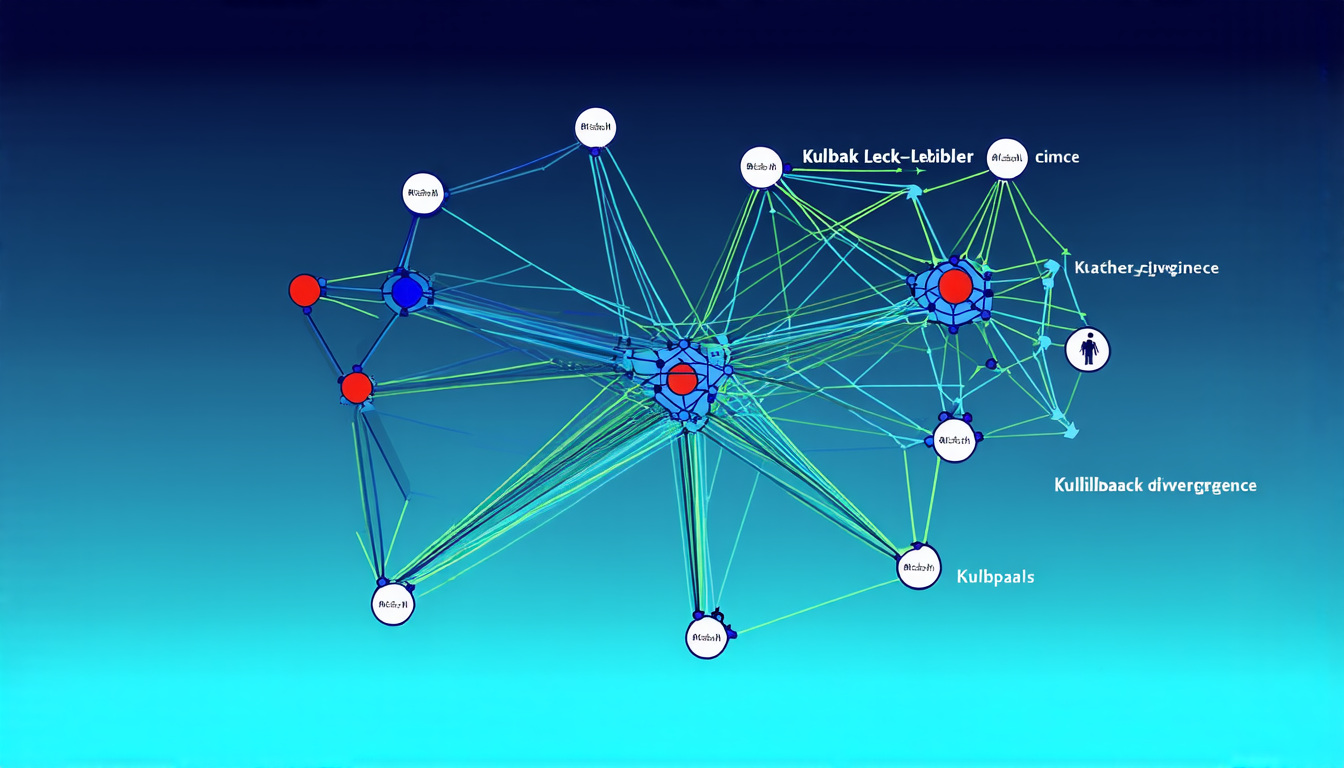
The Kullback-Leibler divergence is a fundamental concept in information theory, used to measure the difference between two probability distributions. However, calculating this divergence for high-dimensional systems can be computationally intensive and often requires simplifying assumptions. The new framework provides an exact and hierarchical decomposition of the Kullback-Leibler divergence, allowing researchers to separate the contributions from individual variables and interactions.
In complex systems, such as biological networks or financial markets, understanding how components interact is crucial for predicting behavior and making accurate predictions. By decomposing the Kullback-Leibler divergence into its constituent parts, researchers can identify which aspects of a system are driving differences between observed data and a reference model.
The framework uses a combination of mathematical techniques, including Möbius inversion and Shannon entropy, to break down the Kullback-Leibler divergence into three components. The first component represents the sum of marginal divergences, capturing how individual variables differ from their reference distributions. The second component is the total correlation, which measures the degree of statistical dependency between variables. The third component is a hierarchical decomposition of higher-order interactions, revealing the complex relationships between multiple variables.
The framework has been tested on several synthetic and real-world datasets, including those from finance and biology. In each case, the decomposition provided accurate and interpretable results, allowing researchers to identify the key factors driving differences between observed data and a reference model.
This new mathematical framework has significant implications for a wide range of fields, from machine learning and statistical physics to ecology and neuroscience. By providing a precise and hierarchical decomposition of complex systems, researchers can gain a deeper understanding of how components interact and drive behavior, ultimately leading to more accurate predictions and better decision-making.
In the future, this framework is likely to be used to analyze a wide range of complex systems, from the behavior of financial markets to the functioning of biological networks. By providing a powerful tool for decomposing complex systems, researchers can gain new insights into how these systems work and make more informed decisions about their behavior.
Cite this article: “Decomposing Complexity: A New Mathematical Framework for Understanding Interactions in Complex Systems”, The Science Archive, 2025.
Mathematics, Information Theory, Kullback-Leibler Divergence, Decomposition, Complex Systems, Probability Distributions, Statistical Physics, Machine Learning, Ecology, Neuroscience





