

Sunday 04 May 2025
The universe is a complex and mysterious place, full of secrets waiting to be uncovered. One of the most enduring puzzles has been the nature of dark energy, a mysterious force that drives the acceleration of the cosmos. Now, scientists have made a significant breakthrough in their quest to understand this enigmatic phenomenon.
For decades, researchers have struggled to pinpoint the source of dark energy, which accounts for about 70% of the universe’s total energy density. The problem is that it seems to be present everywhere, yet its properties are unknown. To tackle this challenge, scientists have developed a new approach that combines two seemingly disparate areas of research: gravity and thermodynamics.
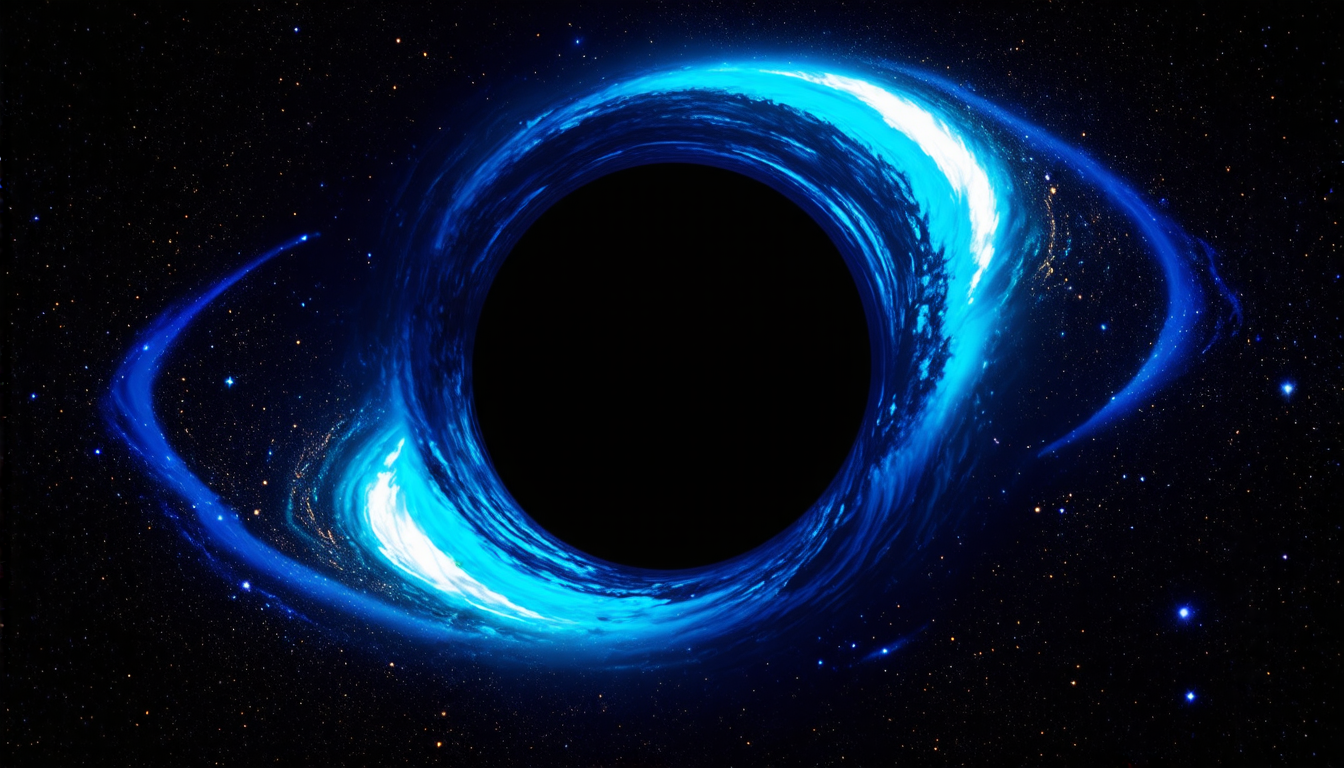
The idea is simple: by analyzing the behavior of black holes, researchers can gain insights into the fundamental laws of the universe. By studying how these cosmic monsters evolve over time, scientists hope to uncover clues about dark energy’s role in shaping the cosmos. The team used a combination of theoretical calculations and computer simulations to model the behavior of black holes under different conditions.
The results are nothing short of astonishing. According to the new study, dark energy is not some exotic form of matter or radiation, but rather a fundamental property of space itself. It’s as if the fabric of reality has an inherent tendency to expand and accelerate over time, driving the universe’s growth.
This discovery opens up new avenues for research, allowing scientists to probe the nature of dark energy in unprecedented ways. By studying the behavior of black holes in different environments, researchers can gain a deeper understanding of how this mysterious force affects the evolution of galaxies and galaxy clusters.
But what does it mean for our understanding of the universe? In short, it means that we’re one step closer to unraveling the secrets of dark energy. By grasping its fundamental nature, scientists hope to shed light on some of the most pressing questions in modern astrophysics: How did the universe begin? What drives its expansion and acceleration? And what lies beyond our cosmic horizon?
The implications are far-reaching, with potential applications in fields as diverse as cosmology, particle physics, and even theoretical biology. As scientists continue to probe the mysteries of dark energy, we may uncover new insights that challenge our current understanding of reality itself.
In the meantime, this breakthrough serves as a powerful reminder of the power of human curiosity and ingenuity. By pushing the boundaries of what we thought was possible, scientists are constantly surprising us with new discoveries that reshape our understanding of the universe and its many mysteries.
Cite this article: “Unraveling the Mystery of Dark Energy”, The Science Archive, 2025.
Dark Energy, Universe, Gravity, Thermodynamics, Black Holes, Space, Acceleration, Galaxies, Galaxy Clusters, Cosmology





