

Sunday 04 May 2025
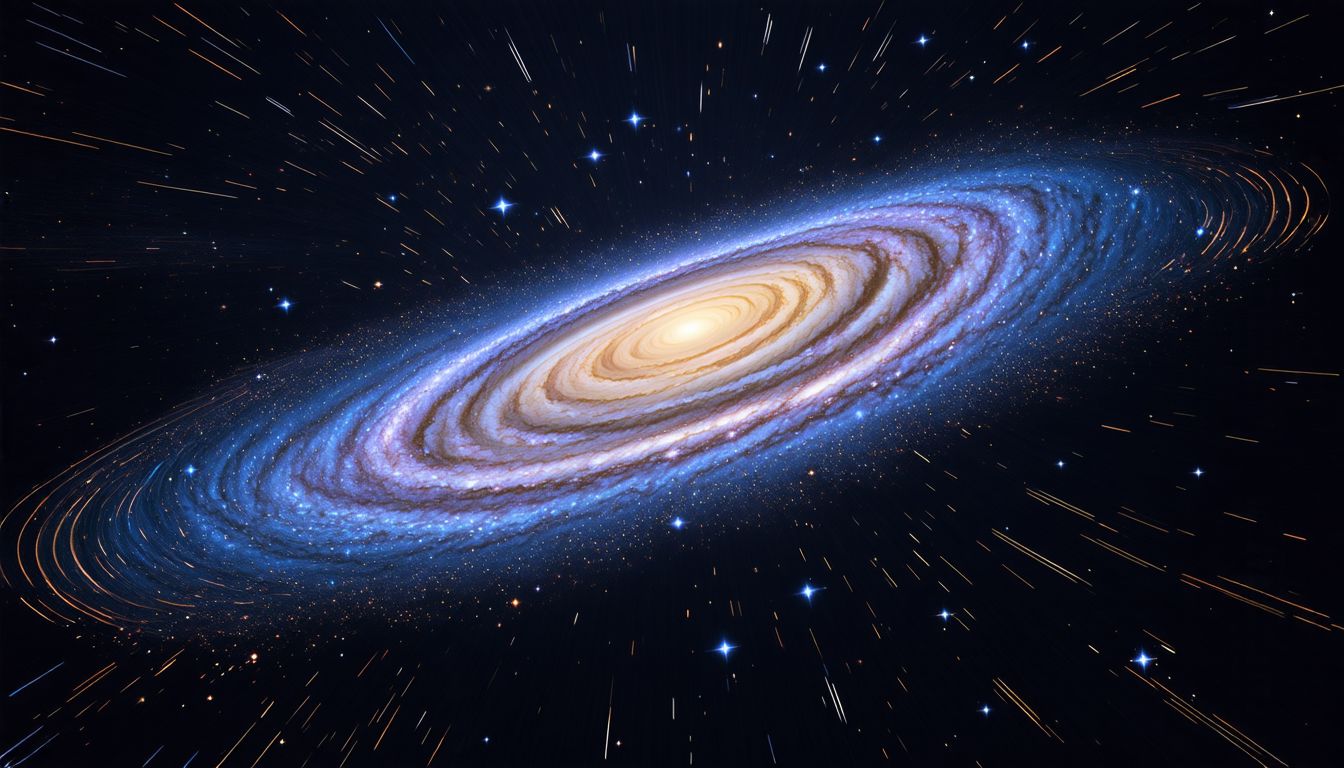
As galaxies collide and merge, stars are torn from their parent galaxy’s grasp, streaming away into intergalactic space like a cosmic tail of sparks. This phenomenon, known as ram pressure stripping, has long been a subject of fascination for astronomers.
Now, researchers have used cutting-edge computer simulations to delve deeper into the mysteries of star formation within these stripped tails. The team, led by Nina Akerman, has been studying two massive galaxies in the process of being torn apart by the gravitational forces of their surroundings.
The simulations reveal that most stars in the tail are born close to the parent galaxy’s disc at the beginning of stripping. These young stars then follow a predictable path, with older stars found farther out from the centre and younger ones closer in. This is because the gas from which they form is stripped away from the outer regions first, leaving only the innermost gas intact.
But the story doesn’t end there. The team also discovered that some stars are born with negative velocities, indicating a reversal of their trajectory back towards the parent galaxy. This ‘fallback’ effect is thought to occur when gas and dust are re-accreted onto the galaxy’s disc, potentially influencing the formation of new stars.
The simulations also showed that stars formed in the tail can have significantly different properties than those born within the parent galaxy. For instance, they may be faster-moving and less metal-rich, reflecting the influence of the surrounding intergalactic medium on their formation.
To visualize these findings, the team created mock UV maps of the stripped galaxies. These images reveal that the surface brightness of the galaxy is not significantly affected by the stripping process, even as stars are being torn away from the parent body. This is because the remaining stars are distributed relatively evenly across the galaxy’s face, smoothing out any irregularities.
The implications of these findings are significant for our understanding of how galaxies interact and evolve over cosmic time. By studying the stripped tails of galaxies, astronomers can gain insights into the processes that shape their structure and composition.
Cite this article: “Unraveling the Mysteries of Star Formation in Stripped Galactic Tails”, The Science Archive, 2025.
Galaxies, Collisions, Merging, Stars, Ram Pressure Stripping, Star Formation, Simulations, Galaxy Evolution, Intergalactic Space, Cosmic Time





