

Friday 23 May 2025
As we continue to rely more heavily on technology in our daily lives, concerns about data privacy and security have become increasingly paramount. In response, researchers have been working to develop new methods for protecting sensitive information while still enabling collaboration and sharing of data.
One such approach is vertical federated learning (VFL), which allows organizations with different datasets to collaborate and train models without having to share their raw data. This is achieved by using a process called differential privacy, which adds artificial noise to the training data to prevent any individual’s information from being identified.
However, VFL systems often face significant challenges when it comes to incentivizing participation from clients who contribute to the model training process. After all, each client has its own unique dataset and may have different motivations for participating in the collaboration. Some may be driven by a desire to improve their own models, while others may be more interested in accessing aggregated results.
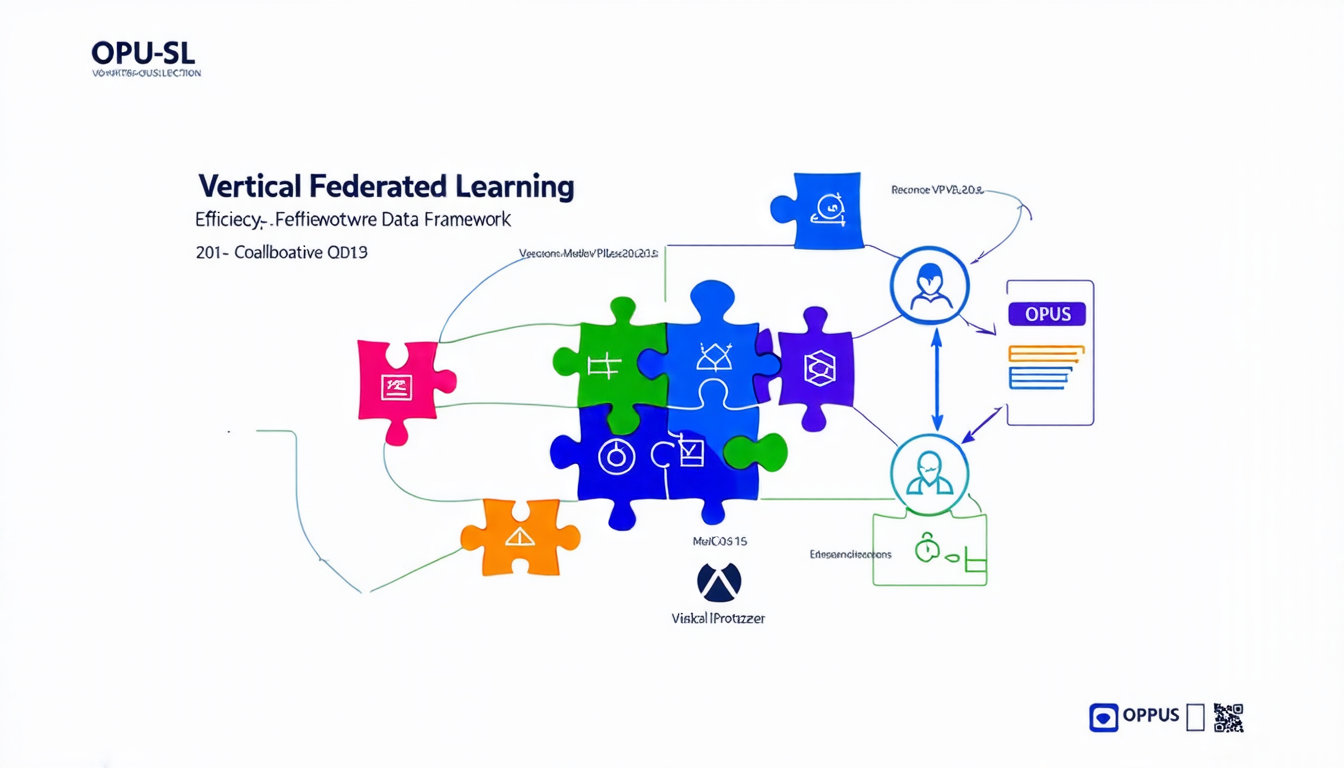
To address this issue, researchers have developed a new framework called OPUS-VFL, which introduces a novel incentive mechanism that rewards clients based on a combination of factors, including their model contribution, privacy preservation, and resource investment. This approach helps to ensure that each client has an equal opportunity to contribute meaningfully to the global model, while also promoting fairness and efficiency in the training process.
In addition to its innovative incentive mechanism, OPUS-VFL also incorporates several other key features designed to improve the overall performance of VFL systems. For example, it uses a lightweight leave-one-out strategy to quantify feature importance per client, which helps to identify the most valuable contributions being made by each participant. It also employs an adaptive differential privacy mechanism that enables clients to dynamically adjust their noise levels in response to changes in their resource availability.
To test the effectiveness of OPUS-VFL, researchers conducted a series of experiments using real-world datasets and found that it outperformed existing VFL baselines in terms of training efficiency, scalability, and robustness against label inference attacks. They also observed that clients with heterogeneous resource capabilities were able to participate meaningfully and fairly in the collaboration process.
One of the most promising aspects of OPUS-VFL is its ability to adapt dynamically to changes in the environment. By adjusting its privacy parameter in response to client contributions and resource availability, the system can ensure that each participant has an equal opportunity to contribute while still maintaining a high level of data protection.
Cite this article: “Boosting Federated Learning with OPUS-VFL: A Novel Framework for Secure Data Collaboration”, The Science Archive, 2025.
Here Are The Keywords: Data Privacy, Security, Vertical Federated Learning, Differential Privacy, Opus-Vfl, Incentive Mechanism, Model Training, Resource Investment, Feature Importance, Adaptive Differential Privacy





