

Friday 01 August 2025
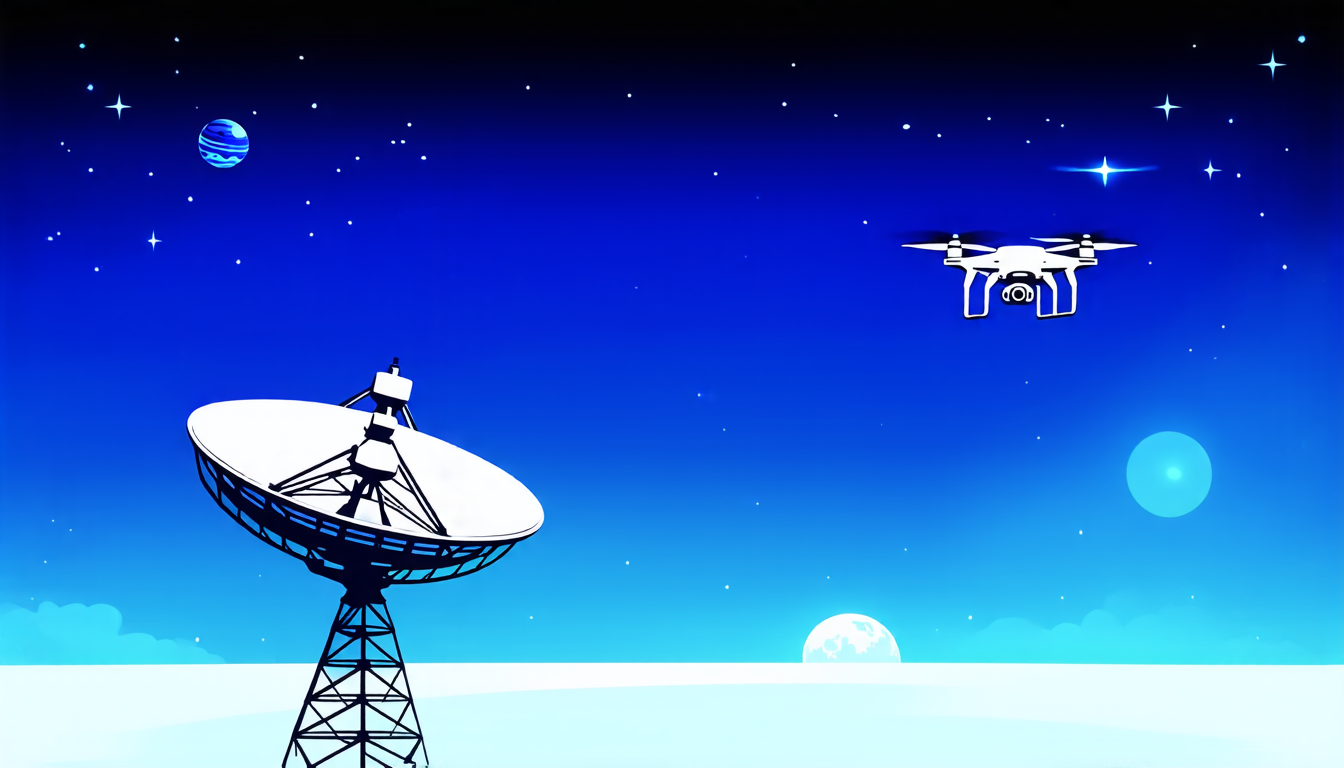
Scientists are getting creative in their quest to understand the mysteries of the universe. In a recent study, researchers have developed an innovative way to test the performance of radio telescopes using drones. This technique allows scientists to measure the antenna patterns of these massive instruments with unprecedented precision, paving the way for more accurate observations of cosmic phenomena.
Radio telescopes are crucial tools in astronomy, as they allow us to detect and study the faint signals emitted by distant objects like stars, galaxies, and black holes. However, these instruments are incredibly complex, comprising thousands of individual components that must be precisely aligned to function properly. Measuring the performance of these antennas is a daunting task, especially considering their massive size – some radio telescopes span dozens of meters in diameter.
Traditionally, scientists have relied on elaborate laboratory setups and precision mechanical systems to test antenna patterns. However, these methods are often expensive, time-consuming, and limited in their scope. Enter the drones, which offer a more agile and cost-effective solution for measuring antenna performance.
Researchers used custom-built drones equipped with specialized sensors to fly around the radio telescopes and collect data on their antenna patterns. By hovering above the antennas at precise distances and angles, the drones were able to capture detailed information about how the signals are transmitted and received. This approach allowed scientists to test the antennas in a more realistic environment, mimicking the conditions under which they would operate during actual observations.
The study highlights the potential of this drone-based technique for improving the accuracy of radio telescope measurements. By accurately characterizing antenna patterns, scientists can better understand how these instruments respond to different environmental conditions and optimize their performance for specific applications. This could ultimately lead to more precise observations of cosmic phenomena, such as the detection of faint signals from distant galaxies or the mapping of black hole activity.
The implications of this research extend beyond astronomy, as similar techniques could be applied to other fields where precision antenna measurements are critical. For example, drone-based testing could revolutionize the development of wireless communication systems, enabling more efficient and reliable data transmission.
As scientists continue to push the boundaries of what is possible with radio telescopes, innovative approaches like this drone-based technique will play a vital role in their success. By embracing new technologies and methods, researchers can unlock fresh insights into the mysteries of the universe, driving our understanding forward and inspiring new generations of explorers and innovators.
Cite this article: “Drones Take to the Skies to Improve Radio Telescope Accuracy”, The Science Archive, 2025.
Radio Telescopes, Drones, Antenna Patterns, Precision Measurement, Astronomy, Cosmic Phenomena, Wireless Communication, Data Transmission, Innovative Technology, Scientific Research





