

Saturday 06 September 2025
Mathematicians have long been fascinated by the properties of Hilbert spaces, which are infinite-dimensional vector spaces that play a crucial role in quantum mechanics and signal processing. But what happens when you try to combine multiple Hilbert spaces into one? That’s exactly what researchers have done in a new paper, introducing the concept of direct integrals of locally Hilbert spaces.
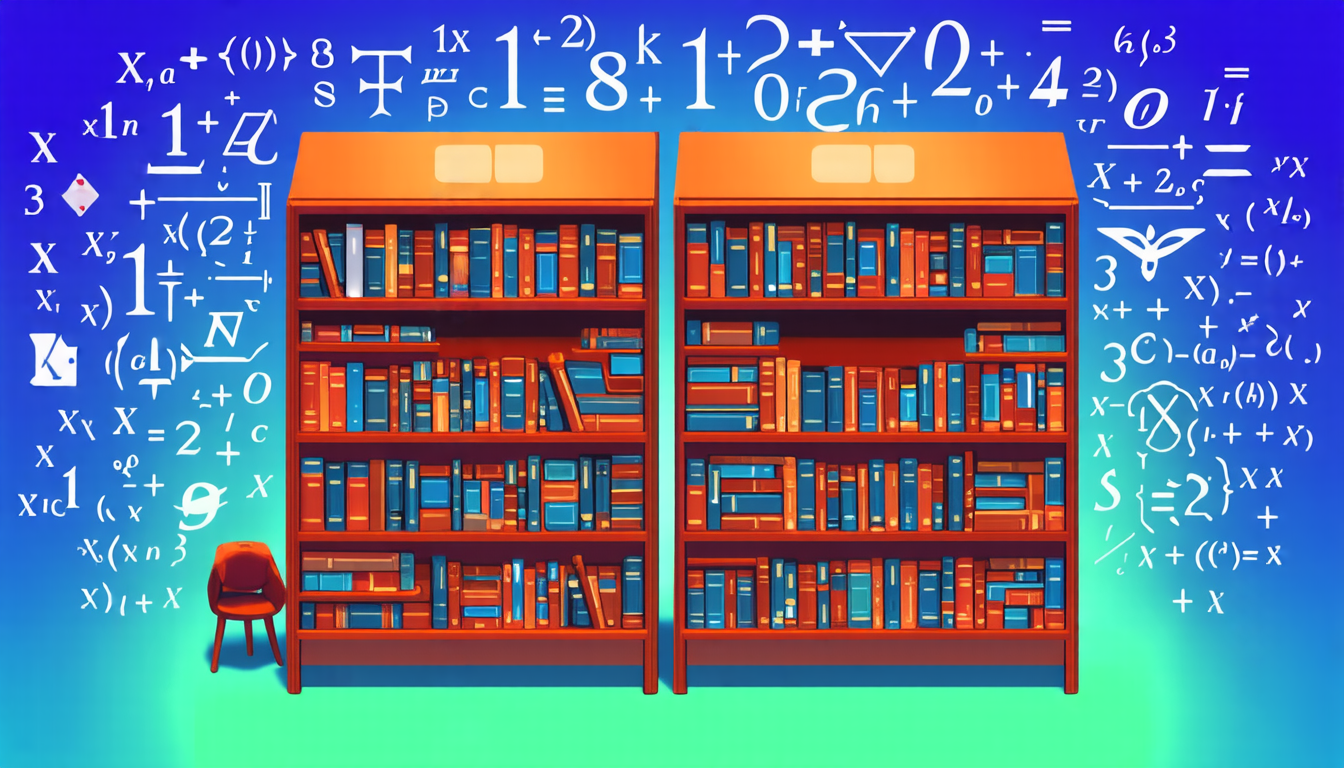
The problem is that traditional methods for combining Hilbert spaces don’t work well when dealing with infinite-dimensional spaces. Think of it like trying to merge two giant libraries with an infinite number of books – you’d need a way to organize and categorize the contents in a meaningful way. That’s where direct integrals come in.
A direct integral is essentially a mathematical object that combines multiple Hilbert spaces into one, allowing for a more nuanced understanding of how they interact. It’s like creating a new library system that can seamlessly integrate the two giant libraries, making it easier to find and access information.
The researchers achieved this by generalizing the traditional notion of a measure space – a fundamental concept in mathematics – to create a locally measurable space. This allowed them to define a direct integral of locally Hilbert spaces over such a space.
But what does this mean in practice? For one, it opens up new possibilities for signal processing and data analysis. Think of audio or image compression: by combining multiple Hilbert spaces, you could develop more efficient algorithms that can better capture the nuances of sound or image quality.
The implications also extend to quantum mechanics. In a nutshell, direct integrals could help us better understand the behavior of particles at the atomic level, potentially leading to breakthroughs in fields like quantum computing and cryptography.
The paper’s authors used a combination of mathematical tools – including locally measurable spaces, direct integrals, and von Neumann algebras – to develop their concept. While it may sound like jargon to non-experts, these tools are the bread and butter of mathematicians working in operator theory and functional analysis.
In short, the researchers have cracked open a new door for mathematicians and physicists alike, offering a fresh perspective on how to combine infinite-dimensional Hilbert spaces into one cohesive whole. As we continue to push the boundaries of human knowledge, it’s exciting to think about what other secrets this concept might unlock in the future.
Cite this article: “Combining Infinite-Dimensional Hilbert Spaces: A New Concept in Mathematics and Physics”, The Science Archive, 2025.
Hilbert Spaces, Direct Integrals, Locally Hilbert Spaces, Measure Space, Signal Processing, Data Analysis, Quantum Mechanics, Operator Theory, Functional Analysis, Von Neumann Algebras





