

Saturday 01 February 2025
Scientists have made a significant breakthrough in developing a new method for solving complex mathematical problems related to the transport of energy and particles through materials. The method, known as mesh sweeping, uses a clever technique called Voronoi tessellations to break down large problems into smaller, more manageable pieces.
The problem being tackled is the Boltzmann transport equation, which describes how energy and particles move through materials in response to external forces such as light or radiation. This equation is crucial for understanding many natural phenomena, from the way plants photosynthesize to the behavior of atomic nuclei.
Traditionally, solving the Boltzmann transport equation has been a challenging task, requiring vast amounts of computational power and complex algorithms. However, by using Voronoi tessellations, scientists have developed a new approach that can solve these problems much more efficiently.
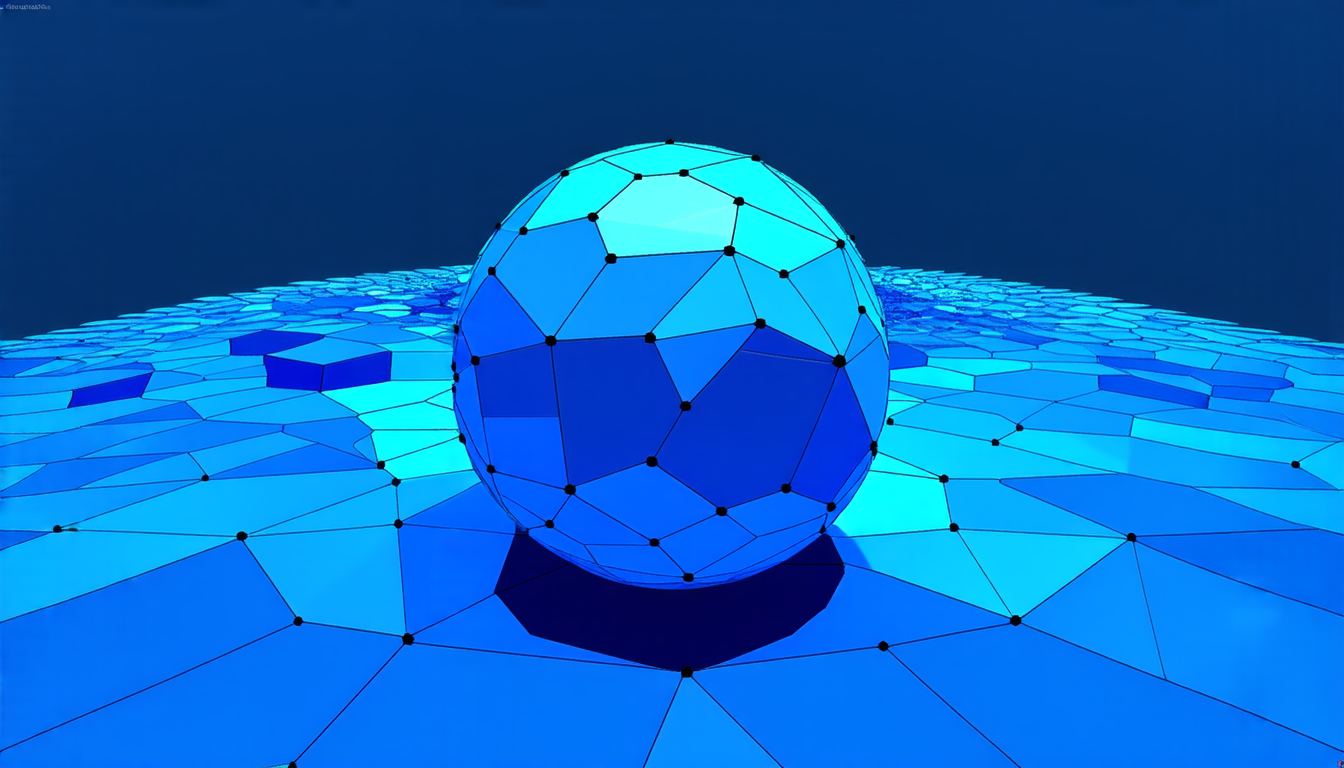
Voronoi tessellations are a type of geometric decomposition that divides space into smaller regions based on the distance from a central point. In this case, the central point is the source of energy or particles being transported through the material. By dividing the problem into smaller regions, scientists can use simpler algorithms to solve each region independently, reducing the overall computational complexity.
The new method has been tested on complex problems related to nuclear reactors and particle accelerators, and has shown promising results. In particular, it has been able to accurately simulate the behavior of particles in these systems, which is essential for designing more efficient and safer reactors.
One of the key advantages of this new method is its ability to handle complex geometries and irregular shapes, which are common in many real-world applications. This makes it a powerful tool for scientists who need to model complex physical systems.
In addition, the method has been shown to be highly scalable, meaning that it can be easily adapted to larger and more complex problems as computational power increases. This makes it an attractive option for scientists who need to tackle increasingly complex challenges in fields such as materials science, biomedicine, and energy research.
Overall, the development of this new mesh sweeping method is an important step forward in our ability to understand and simulate complex physical systems. By providing a more efficient and effective way to solve the Boltzmann transport equation, scientists can gain valuable insights into a wide range of natural phenomena and develop new technologies that benefit society as a whole.
Cite this article: “Mesh Sweeping: A Novel Approach to Solving Complex Mathematical Problems”, The Science Archive, 2025.
Boltzmann Transport Equation, Voronoi Tessellations, Mesh Sweeping, Computational Complexity, Nuclear Reactors, Particle Accelerators, Complex Geometries, Irregular Shapes, Scalable Algorithms, Materials Science.





