

Sunday 02 February 2025
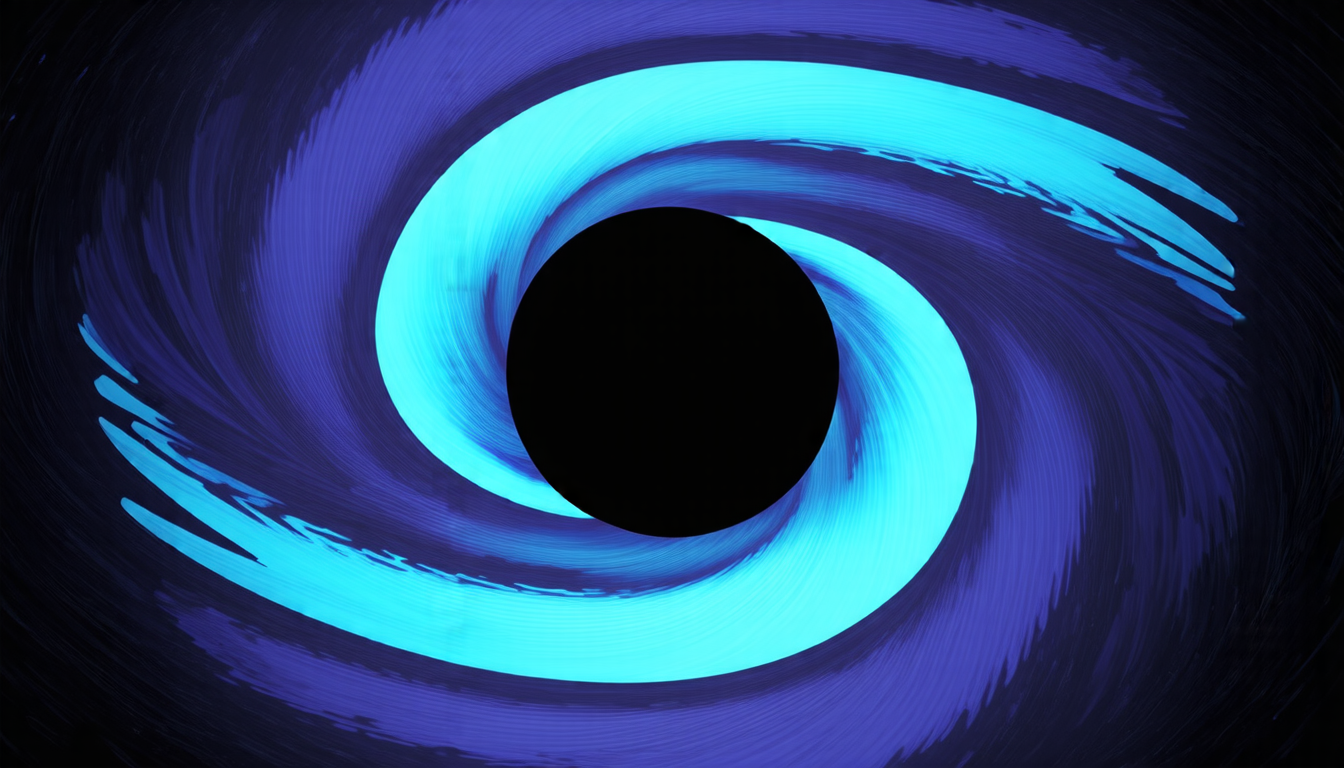
For decades, scientists have been fascinated by the mysteries of black holes. These regions of spacetime are characterized by their intense gravitational pull and enigmatic properties. One of the most intriguing questions in astrophysics is whether it’s possible to create a regular black hole, one that doesn’t have a singularity at its center.
A recent study has made significant progress in addressing this question. Researchers have discovered a new way to generate regular black holes by incorporating higher-curvature corrections into Einstein’s theory of general relativity. These corrections are based on the idea that spacetime is not flat but rather has curvature, which can lead to novel physical phenomena.
In their investigation, the scientists employed a mathematical framework called Palatini gravity, which involves modifying the gravitational action to include higher-order derivatives of the metric tensor. This approach allows for the creation of black holes with nonsingular centers, where the curvature is finite and well-behaved.
The researchers found that these regular black holes exhibit unique properties, such as a finite size and a stable event horizon. The event horizon is the point of no return around a black hole, beyond which anything that enters cannot escape. In contrast to traditional black holes, which have infinite density at their centers, these new black holes have a finite density, making them more accessible for study.
The implications of this discovery are far-reaching and could challenge our current understanding of spacetime and gravity. If confirmed, regular black holes would open up new avenues for research in astrophysics and cosmology. They could also provide insights into the fundamental laws of physics and the behavior of matter under extreme conditions.
The team’s findings have sparked excitement among scientists, who are eager to explore the potential consequences of this breakthrough. The discovery of regular black holes could lead to a deeper understanding of the universe and its many mysteries, including dark matter and dark energy. It may also shed light on the origins of the universe itself, revealing new secrets about the cosmos.
As researchers continue to study these novel objects, they are likely to uncover more surprises and challenges our current understanding of the universe. The discovery of regular black holes is a testament to humanity’s relentless pursuit of knowledge and our desire to unravel the mysteries that lie at the heart of existence.
Cite this article: “Regular Black Holes: A New Frontier in Astrophysics”, The Science Archive, 2025.
Black Holes, General Relativity, Palatini Gravity, Spacetime, Curvature, Singularity, Event Horizon, Density, Astrophysics, Cosmology





