

Sunday 23 February 2025
Scientists have long been fascinated by the way tiny particles move through membranes, which are thin layers of material that separate two environments. Understanding this process is crucial for a wide range of applications, from desalination plants to medical devices.
Recently, researchers have made significant progress in understanding how ions – positively and negatively charged particles – move through these membranes when there’s a concentration gradient between the two sides. In other words, when one side has more ions than the other, they tend to flow towards the area with fewer ions.
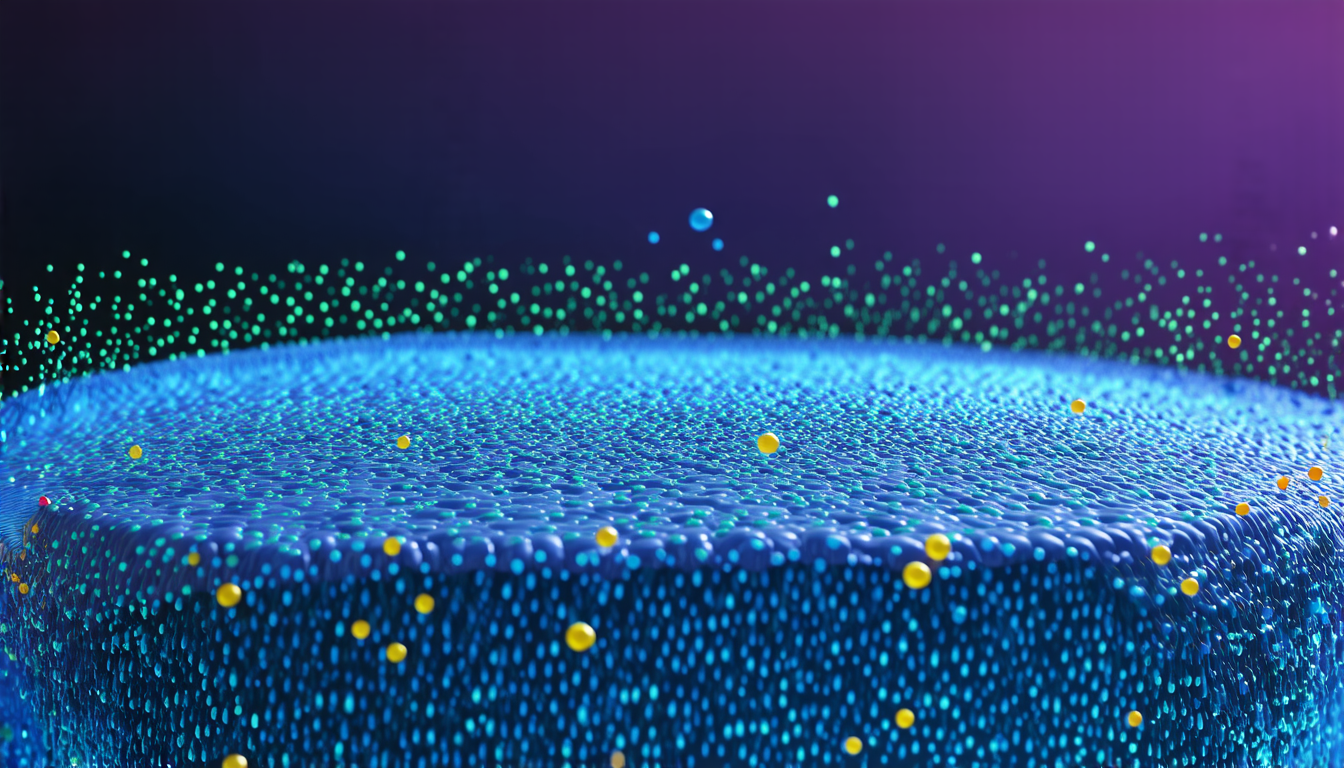
The team used computer simulations to study this process in detail. They created virtual models of membranes with different properties and then watched how ions moved through them in response to a concentration gradient.
One of the key findings was that the way ions move through the membrane depends on the size of the pore, or opening, in the membrane. When the pore is small, the ions tend to flow slowly and steadily through it. But when the pore is larger, the ions can move more quickly and erratically.
The researchers also found that the surface charge of the membrane plays a crucial role in the movement of ions. If the surface has a positive charge, positively charged ions are repelled and negatively charged ions are attracted. This can affect the overall flow of ions through the membrane.
These findings have important implications for various applications. For example, they could help improve the efficiency of desalination plants by designing membranes that allow salt to be removed more effectively from seawater. They could also lead to new medical devices that use tiny pores to filter out pathogens or toxins.
In addition, the study provides a deeper understanding of how ions move through biological membranes, which is essential for understanding many physiological processes. This knowledge could ultimately lead to new treatments for diseases related to ion imbalances in the body.
Overall, this research sheds light on the complex and fascinating world of ion transport through membranes. By better understanding these processes, scientists can develop innovative solutions that improve our daily lives and advance medical research.
Cite this article: “Unraveling the Secrets of Ion Transport Through Membranes”, The Science Archive, 2025.
Membranes, Ions, Concentration Gradient, Pore Size, Surface Charge, Desalination, Medical Devices, Biological Membranes, Physiological Processes, Ion Transport





