

Sunday 23 February 2025
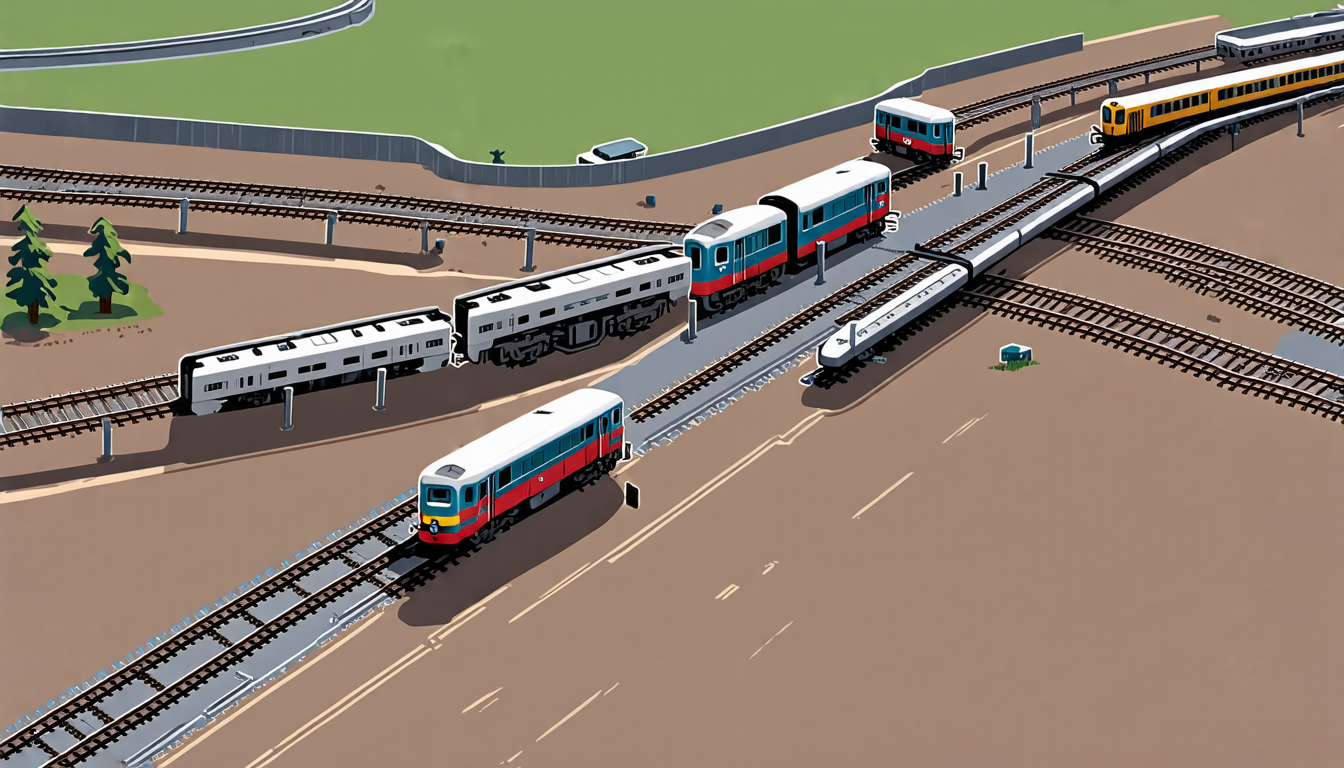
The railway network is a complex system that requires careful planning and management to ensure efficient and safe transportation of passengers and goods. One critical aspect of this system is determining the capacity of individual railway junctions, which can have a significant impact on the overall performance of the network.
Researchers have developed a new method for estimating the capacity of railway junctions using a continuous-time Markov chain (CTMC) model. This approach takes into account various factors that affect the flow of trains through the junction, including arrival and service rates, as well as the variation in these rates over time.
The CTMC model is particularly useful because it allows for the simulation of complex scenarios that may not be feasible with traditional methods. For example, the model can simulate the effects of different train types on the capacity of the junction, or the impact of varying arrival and service rates on the overall performance of the network.
To validate their approach, the researchers conducted extensive simulations using a range of scenarios and parameters. They found that the CTMC model provided highly accurate estimates of railway junction capacity, even in complex and dynamic situations.
One of the key advantages of this method is its ability to handle uncertain or changing conditions. For example, if there is a sudden increase in demand for train services, the CTMC model can quickly adapt to these changes and provide updated estimates of capacity.
The researchers also explored the use of phase-type distributions to improve the accuracy of their model. Phase-type distributions are a type of probability distribution that can be used to describe complex systems with multiple states or phases.
By incorporating phase-type distributions into their model, the researchers were able to achieve even more accurate estimates of railway junction capacity. This is particularly important in situations where the flow of trains is highly variable and unpredictable.
The implications of this research are significant for railway operators and planners. By using a CTMC model with phase-type distributions, they can gain a better understanding of the complex dynamics of their network and make more informed decisions about how to optimize capacity and performance.
This approach has the potential to revolutionize the way that railway junctions are managed and planned, enabling operators to respond quickly and effectively to changing conditions. It also highlights the importance of using advanced mathematical models and simulation techniques to understand and improve complex systems like the railway network.
Overall, this research demonstrates the power of innovative approaches to solving complex problems in transportation planning and management.
Cite this article: “Advancing Railway Junction Capacity Estimation with Continuous-Time Markov Chain Models”, The Science Archive, 2025.
Railway Junction Capacity, Continuous-Time Markov Chain, Simulation, Train Flow, Arrival Rates, Service Rates, Phase-Type Distributions, Transportation Planning, Network Management, Railway Operations.





