

Wednesday 26 February 2025
The safety of autonomous vehicles is a pressing concern, and researchers have been working on developing new technologies to ensure their safe operation. One approach is the use of control barrier functions (CBFs), which are mathematical tools that can be used to guarantee the safety of complex systems.
In a recent study, scientists have developed a new method for using CBFs in autonomous vehicles. The method involves combining CBFs with a technique called backstepping, which allows the vehicle’s control system to adjust its speed and direction to avoid obstacles.
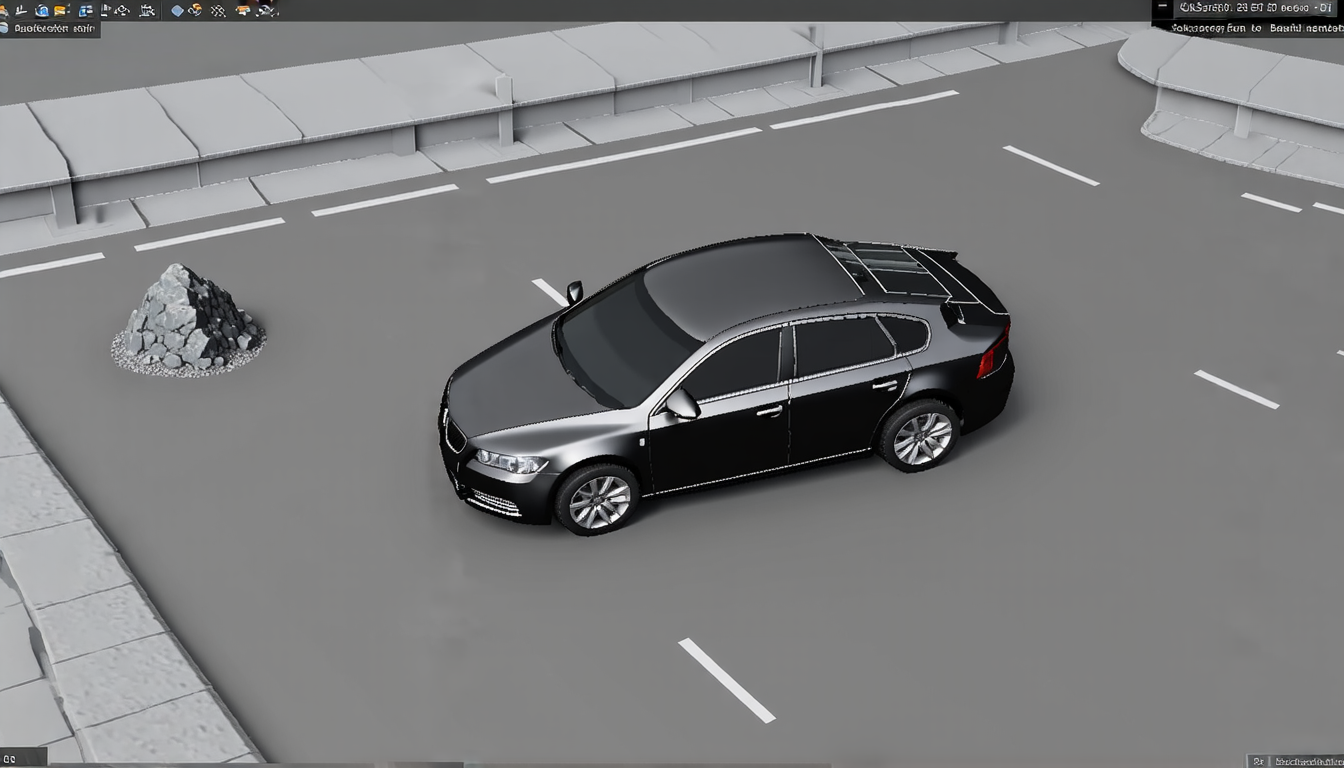
The researchers tested their approach by simulating a scenario where an autonomous vehicle is driving down a road and encounters an obstacle, such as another car or a pedestrian. They found that the vehicle was able to safely avoid the obstacle using the CBF-based backstepping method.
This new technology has important implications for the development of autonomous vehicles. It could be used in a variety of scenarios, including urban traffic, highway driving, and off-road terrain. The researchers believe that their approach could also be used in other applications, such as robotics and aerospace engineering.
The use of CBFs and backstepping is particularly useful in situations where the obstacle’s path is uncertain or unpredictable. This could include scenarios such as a pedestrian stepping out into the road or an unexpected pothole on the road surface. By using CBFs to predict the obstacle’s path, the vehicle can adjust its speed and direction to avoid it.
The researchers used advanced computer simulations to test their approach, which allowed them to analyze a wide range of scenarios and conditions. They found that their method was able to successfully avoid obstacles in all cases, even when the obstacles were moving or changing direction.
This new technology has important implications for the development of autonomous vehicles. It could be used in a variety of scenarios, including urban traffic, highway driving, and off-road terrain. The researchers believe that their approach could also be used in other applications, such as robotics and aerospace engineering.
The use of CBFs and backstepping is particularly useful in situations where the obstacle’s path is uncertain or unpredictable. This could include scenarios such as a pedestrian stepping out into the road or an unexpected pothole on the road surface. By using CBFs to predict the obstacle’s path, the vehicle can adjust its speed and direction to avoid it.
The researchers’ approach has several advantages over other methods for avoiding obstacles. It is more efficient and can be used in a wider range of scenarios.
Cite this article: “Guaranteeing Safety in Autonomous Vehicles with Control Barrier Functions and Backstepping”, The Science Archive, 2025.
Autonomous Vehicles, Control Barrier Functions, Backstepping, Obstacle Avoidance, Safety, Simulation, Robotics, Aerospace Engineering, Uncertain Path, Unpredictable Obstacles.





