

Sunday 02 March 2025
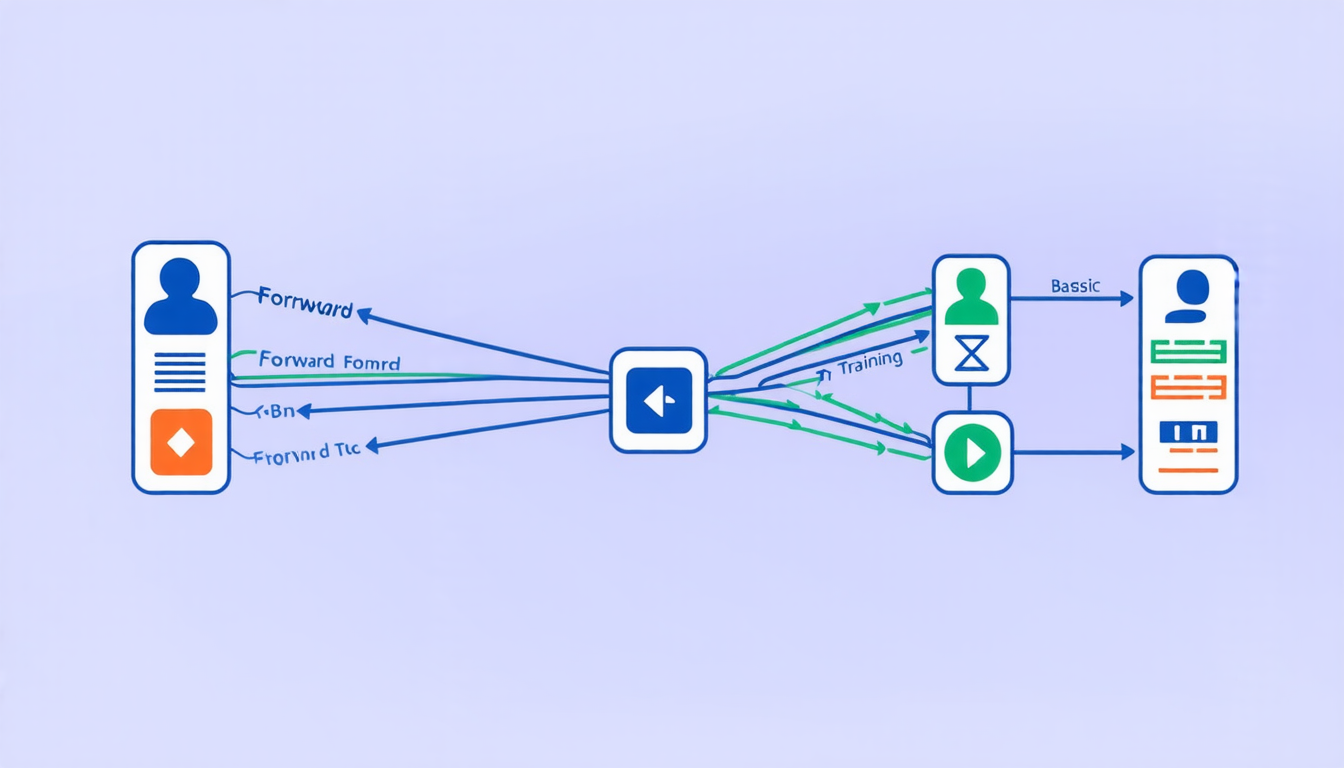
A team of researchers has made a significant breakthrough in the field of artificial intelligence, developing an algorithm that can train neural networks without the need for backpropagation. The new method, known as Scalable Forward-Forward (SFF), uses a combination of forward passes and layer-wise training to achieve results comparable to or even surpassing those achieved with traditional backpropagation.
The SFF algorithm is particularly noteworthy because it can be applied to large convolutional neural networks, which are commonly used in image recognition tasks. These networks typically require extensive computational resources and can be challenging to train, but the SFF method simplifies this process by eliminating the need for complex negative sample generation and channel partitioning.
One of the key advantages of SFF is its ability to learn feature hierarchies that are compatible with traditional backpropagation-trained models. This means that SFF-trained weights can be easily fine-tuned using existing techniques, making it a versatile tool for a wide range of applications.
The researchers tested the SFF algorithm on several benchmark datasets, including CIFAR-10 and Imagenette, and found that it achieved comparable or even better results than traditional backpropagation. The method also showed promise in small data settings, where it was able to outperform backpropagation when given limited training data.
Furthermore, the SFF algorithm can be used in conjunction with pre-training on large datasets, such as ImageNet, which can improve its performance even further. This makes it an attractive option for applications where large amounts of labeled data are not available.
The development of the SFF algorithm has significant implications for the field of artificial intelligence. It opens up new possibilities for training neural networks that are more efficient and easier to use, and could potentially lead to breakthroughs in areas such as medical imaging and natural language processing.
In addition to its potential applications, the SFF algorithm also provides valuable insights into the nature of deep learning and the role of backpropagation in the training process. By eliminating this step, researchers can better understand how neural networks learn and adapt, which could lead to new techniques for improving their performance.
Overall, the Scalable Forward-Forward algorithm represents a significant advancement in the field of artificial intelligence, with potential applications that range from image recognition to natural language processing. Its ability to simplify the training process and achieve comparable results to traditional backpropagation makes it an exciting development that is sure to generate further research and innovation in the years to come.
Cite this article: “Breakthrough in Artificial Intelligence: Scalable Forward-Forward Algorithm Simplifies Neural Network Training”, The Science Archive, 2025.
Artificial Intelligence, Neural Networks, Backpropagation, Scalable Forward-Forward Algorithm, Sff, Image Recognition, Convolutional Neural Networks, Deep Learning, Machine Learning, Computer Vision
Reference: Andrii Krutsylo, “Scalable Forward-Forward Algorithm” (2025).





