

Monday 03 March 2025
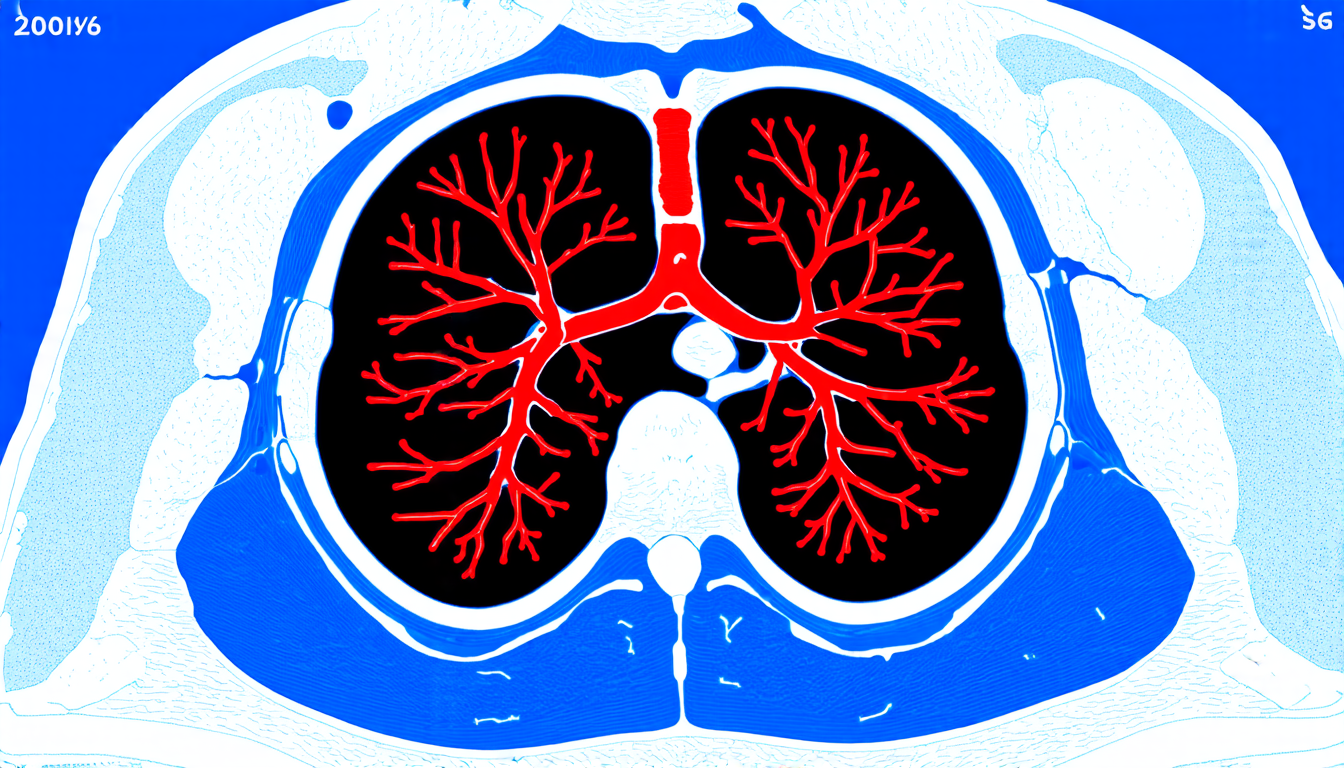
Scientists have made a significant breakthrough in the field of medical imaging, developing a new framework that enables the accurate segmentation of pulmonary arteries and veins in computed tomography (CT) scans.
The framework combines pre-trained language-vision models with self-adaptive feature learning pipelines to improve the accuracy of segmentation results. This approach leverages the strengths of both computer vision and natural language processing techniques to tackle the complex task of identifying and separating pulmonary vessels from surrounding tissue.
One of the key challenges in this area is the lack of labeled data, which makes it difficult for algorithms to learn how to accurately segment the vessels. To address this issue, researchers have developed a novel method that utilizes partial annotations to train the model. This approach allows the algorithm to learn from limited but valuable information, leading to improved performance.
The framework consists of several components, including a pre-trained language-vision model, a self-adaptive feature learning pipeline, and a data augmentation strategy. The pre-trained model is used as a strong feature extractor, generating high-quality features that are then fine-tuned using the self-adaptive pipeline. This approach enables the algorithm to learn from both labeled and unlabeled data, leading to improved accuracy.
The data augmentation strategy plays a crucial role in this framework, allowing the algorithm to generate additional training data by applying various transformations to the original images. This increases the diversity of the training set, which helps the model generalize better to new, unseen data.
To evaluate the performance of the framework, researchers used a large dataset of CT scans containing both pulmonary arteries and veins. The results showed that the proposed method outperformed state-of-the-art techniques in terms of accuracy, achieving an average Dice similarity coefficient (DSC) of 76.22%.
The new framework has significant implications for medical imaging and disease diagnosis. Accurate segmentation of pulmonary vessels is essential for diagnosing conditions such as pulmonary embolism and chronic thromboembolic pulmonary hypertension. By improving the accuracy of vessel segmentation, doctors can make more informed decisions about patient treatment.
In addition to its potential applications in medicine, this research has broader implications for the field of computer vision. The combination of language-vision models with self-adaptive feature learning pipelines is a novel approach that could be applied to other areas of medical imaging and beyond.
Overall, this study demonstrates the power of combining different techniques from computer science and medicine to tackle complex problems.
Cite this article: “Accurate Pulmonary Vessel Segmentation in CT Scans through Novel Framework”, The Science Archive, 2025.
Pulmonary Arteries, Pulmonary Veins, Computed Tomography Scans, Medical Imaging, Computer Vision, Natural Language Processing, Language-Vision Models, Feature Learning Pipelines, Data Augmentation, Dice Similarity Coefficient





