

Wednesday 05 March 2025
A team of astronomers has been studying the way stars move within galaxies, and their findings could have significant implications for our understanding of how these massive structures form and evolve.
Galaxies are thought to be made up of hundreds of billions of stars, each orbiting around a central point. But what happens when these stars get too close to the galaxy’s centre? Do they continue to follow their predetermined paths or do they change course?
Researchers have long been interested in understanding how stars migrate within galaxies, and how this migration affects the overall structure and evolution of the galaxy.
The latest study focused on a particular type of star movement known as radial migration. This occurs when stars move outward from the centre of the galaxy, rather than following their usual circular path around it.
The team used computer simulations to model the behaviour of stars within a simulated galaxy, taking into account various factors such as the strength of the galaxy’s gravitational pull and the presence of spiral arms.
Their results suggest that radial migration plays a significant role in shaping the structure of galaxies. The study found that stars can migrate outward from the centre of the galaxy by up to 30 per cent over a period of just six billion years – a relatively short timescale in cosmic terms.
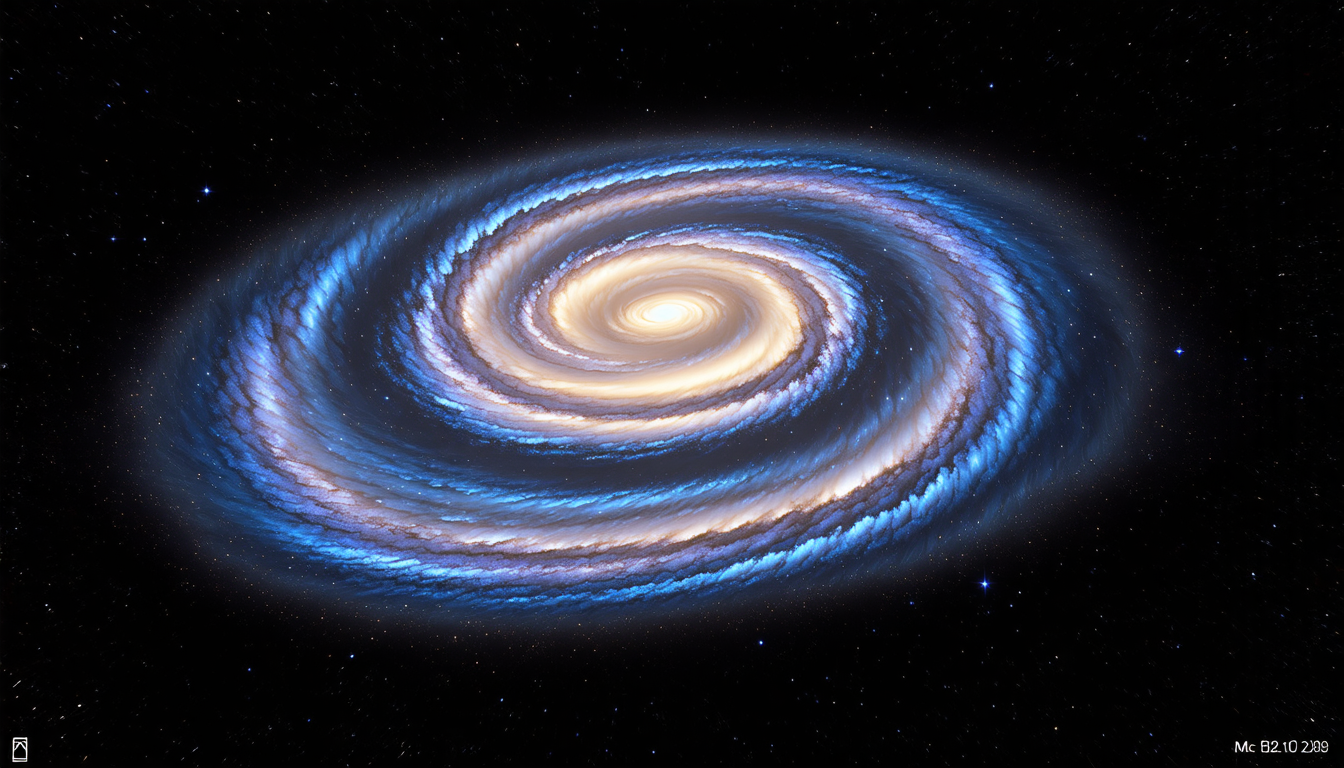
This movement is thought to be driven by the presence of spiral arms, which are sweeping patterns of stars and gas that form within the galaxy. As stars move through these arms, they can experience strong gravitational forces that cause them to change direction and migrate outward.
The study also found that the strength of the galaxy’s gravitational pull plays a crucial role in determining the extent of radial migration. Galaxies with stronger gravitational pulls tend to have less star migration, while those with weaker pulls allow stars to move more freely.
These findings could have significant implications for our understanding of how galaxies form and evolve over time. By studying the movement of stars within galaxies, astronomers can gain valuable insights into the history and structure of these massive structures.
In addition, the study highlights the importance of considering radial migration when trying to understand the evolution of galaxies. This type of star movement is often overlooked in favour of more traditional models of galactic evolution, but it appears to play a significant role in shaping the structure of galaxies.
Overall, this latest research provides valuable new insights into the complex and dynamic nature of galaxy formation and evolution.
Cite this article: “Radial Migration of Stars Reveals New Insights into Galaxy Formation and Evolution”, The Science Archive, 2025.
Galaxies, Stars, Migration, Radial, Gravity, Spiral Arms, Computer Simulations, Galactic Structure, Evolution, Astronomy





