

Friday 07 March 2025
Scientists have long struggled to accurately measure the thermal conductivity of complex materials, which is crucial for understanding and improving their properties. Thermal conductivity refers to a material’s ability to conduct heat, and it’s essential for applications like electronics, energy storage, and medical devices.
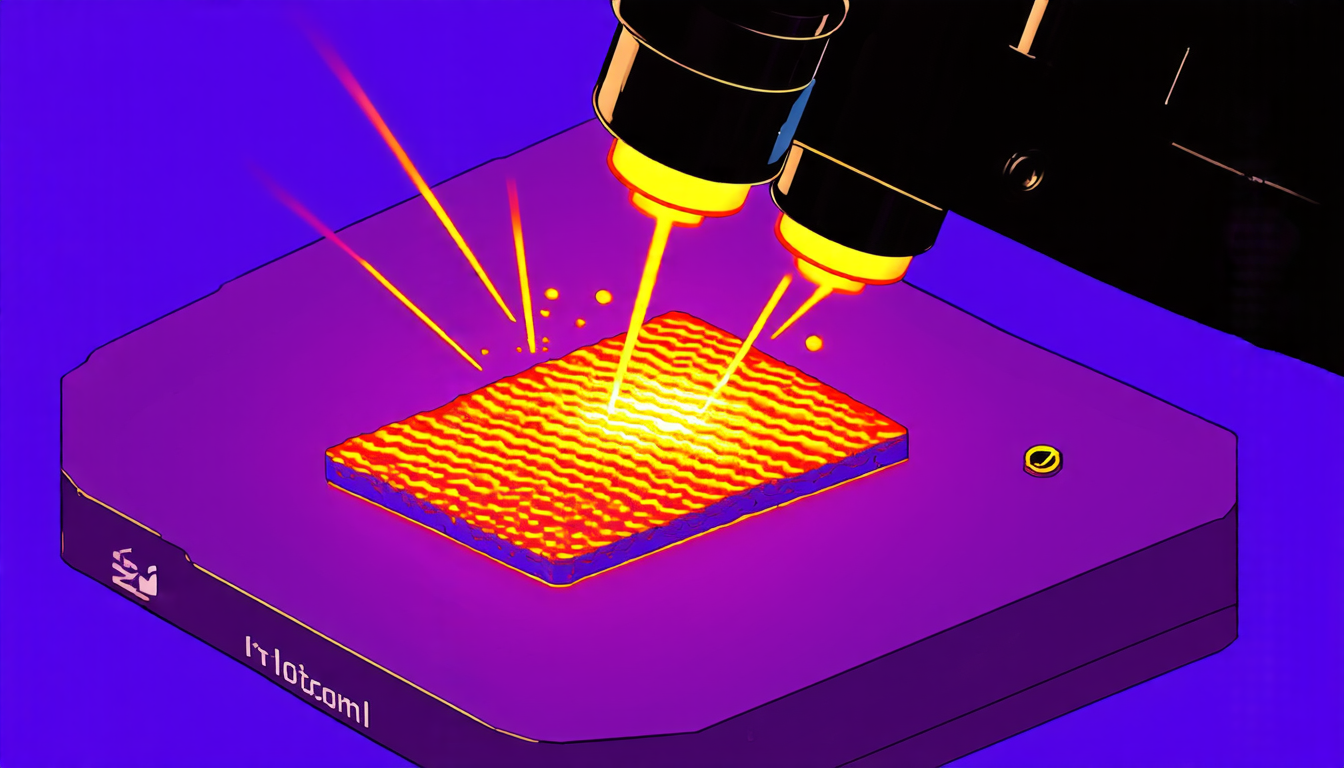
A new technique developed by researchers uses a combination of advanced optics and mathematical modeling to overcome the challenges of measuring thermal conductivity in complex materials. The method is called Three-Dimensional Spatially Resolved Lock-In Micro-Thermography (3D SR-LIT), and it’s capable of accurately measuring the thermal conductivity of materials with up to six independent components.
The key innovation behind 3D SR-LIT is its ability to resolve thermal patterns at the microscopic level, allowing researchers to pinpoint specific regions within a material where heat is being conducted. This is achieved through the use of advanced optics that can focus light onto extremely small areas, creating high-resolution images of temperature changes within the material.
The mathematical modeling aspect of 3D SR-LIT involves using complex algorithms to analyze the thermal patterns and extract accurate measurements of thermal conductivity. The researchers developed a novel adaptive mapping approach that enables high-throughput data acquisition, allowing for fast and efficient measurement of thermal conductivity.
One of the most significant benefits of 3D SR-LIT is its ability to accurately measure thermal conductivity in materials with complex anisotropic properties. Anisotropic materials have different thermal conductivity properties depending on their orientation or direction, making them challenging to study using traditional methods.
The researchers tested their technique on a range of materials, including x-cut quartz and AT-cut quartz, which are known for their complex thermal conductivity properties. They found that 3D SR-LIT was able to accurately measure the thermal conductivity of these materials with high precision, reducing uncertainty by over 50% compared to traditional methods.
The potential applications of 3D SR-LIT are vast and varied. It could be used to improve the performance of electronic devices, develop more efficient energy storage systems, and even advance medical research. The ability to accurately measure thermal conductivity in complex materials will also facilitate the discovery of new materials with unique properties.
In the future, scientists hope to continue refining the 3D SR-LIT technique, potentially incorporating it into a range of applications from medicine to consumer electronics. As researchers gain a better understanding of the thermal conductivity properties of complex materials, they’ll be able to design and develop more efficient, effective, and innovative technologies that will transform our daily lives.
Cite this article: “Accurate Measurement of Thermal Conductivity in Complex Materials Using 3D SR-LIT Technique”, The Science Archive, 2025.
Thermal Conductivity, Materials Science, Optics, Mathematical Modeling, Micro-Thermography, Lock-In Technique, Spatially Resolved, Three-Dimensional, Complex Materials, Anisotropic Properties.





