

Wednesday 12 March 2025
Scientists have made a significant breakthrough in understanding the behavior of complex networks, specifically those that change over time. These temporal networks are crucial for modeling real-world systems like social media, transportation grids, and even the spread of diseases.
Researchers have long studied static networks, where connections between nodes remain constant. However, many modern systems exhibit dynamic changes, making it essential to develop new methods for analyzing these temporal networks.
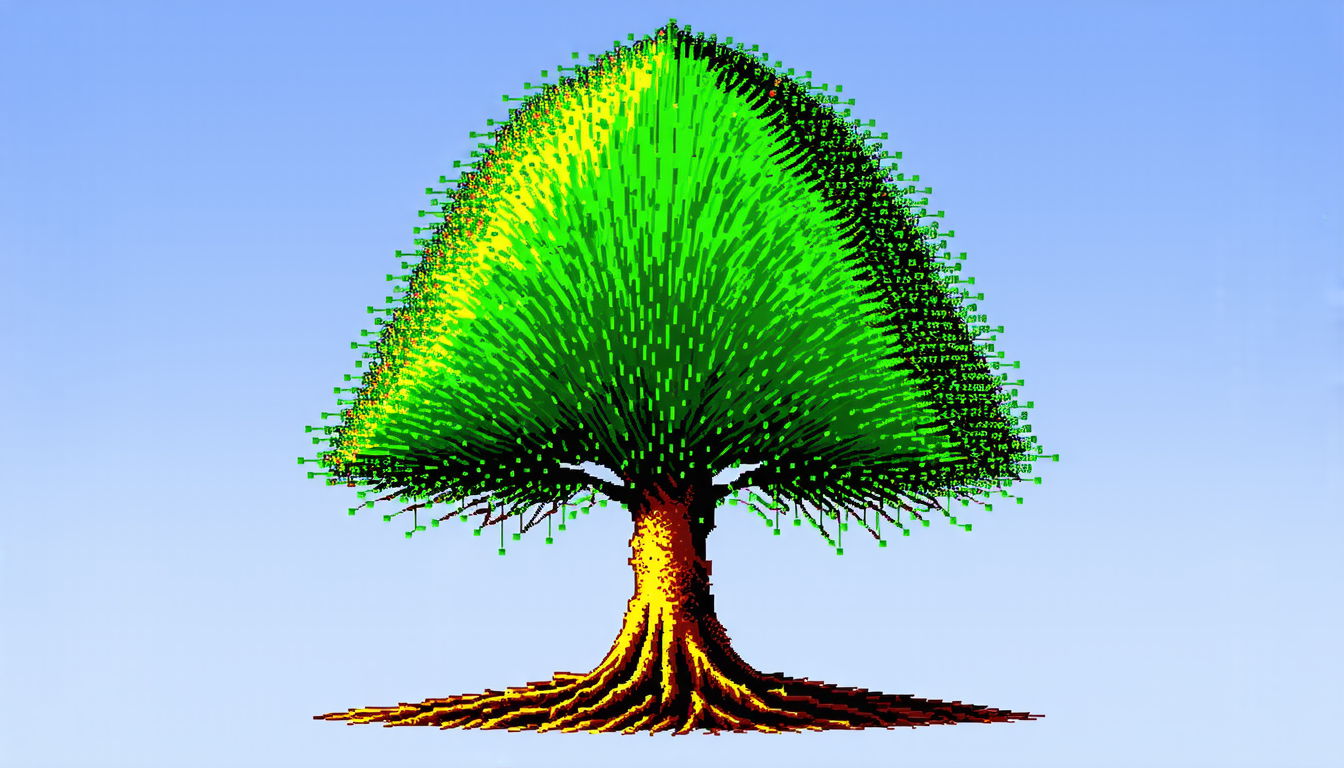
The study focuses on a particular type of temporal network called random temporal trees. These structures are generated by assigning random labels to the edges of a rooted complete infinite n-ary tree. The researchers then select only those vertices that have decreasing edge labels, creating a smaller, more manageable network.
By examining the properties of these random temporal trees, scientists can gain insights into the behavior of real-world systems. For instance, they can study how information spreads through a social network or how diseases propagate within a population.
One key finding is that the size of these temporal networks follows a peculiar pattern. As the number of nodes increases, the size of the network grows exponentially, but at a slower rate than expected. This is due to the way the labels are assigned and the pruning process that removes non-decreasing paths.
The researchers also discovered that the height of the trees, or the distance from the root node to the farthest leaf, exhibits a unique behavior. As the number of nodes grows, the height of the tree increases, but not linearly. Instead, it follows a more complex pattern, with sudden jumps and plateaus.
These findings have significant implications for understanding complex systems. By modeling real-world networks as random temporal trees, scientists can better predict how they will evolve over time. This knowledge can inform strategies for optimizing network performance, mitigating the spread of diseases, or even detecting anomalies in financial transactions.
The study’s results also shed light on the fundamental principles governing complex networks. By analyzing the behavior of random temporal trees, researchers can gain a deeper understanding of the underlying mechanisms driving these systems.
As our world becomes increasingly interconnected, it is essential to develop new tools and techniques for understanding and analyzing these complex networks. The breakthroughs in this study represent an important step forward in achieving that goal.
Cite this article: “Unlocking the Secrets of Temporal Networks: A Breakthrough in Understanding Complex Systems”, The Science Archive, 2025.
Complex Networks, Temporal Networks, Random Temporal Trees, Network Behavior, Dynamic Changes, Social Media, Transportation Grids, Disease Spread, Exponential Growth, Network Performance Optimization
Reference: Caelan Atamanchuk, Luc Devroye, Gabor Lugosi, “Uniform temporal trees” (2025).





