

Thursday 13 March 2025
The intricate dance of trees and leaves has long fascinated mathematicians, who have been trying to unravel its secrets for decades. Now, a team of researchers has made significant strides in understanding how to reconstruct complex networks of connected trees, known as tanglegrams.
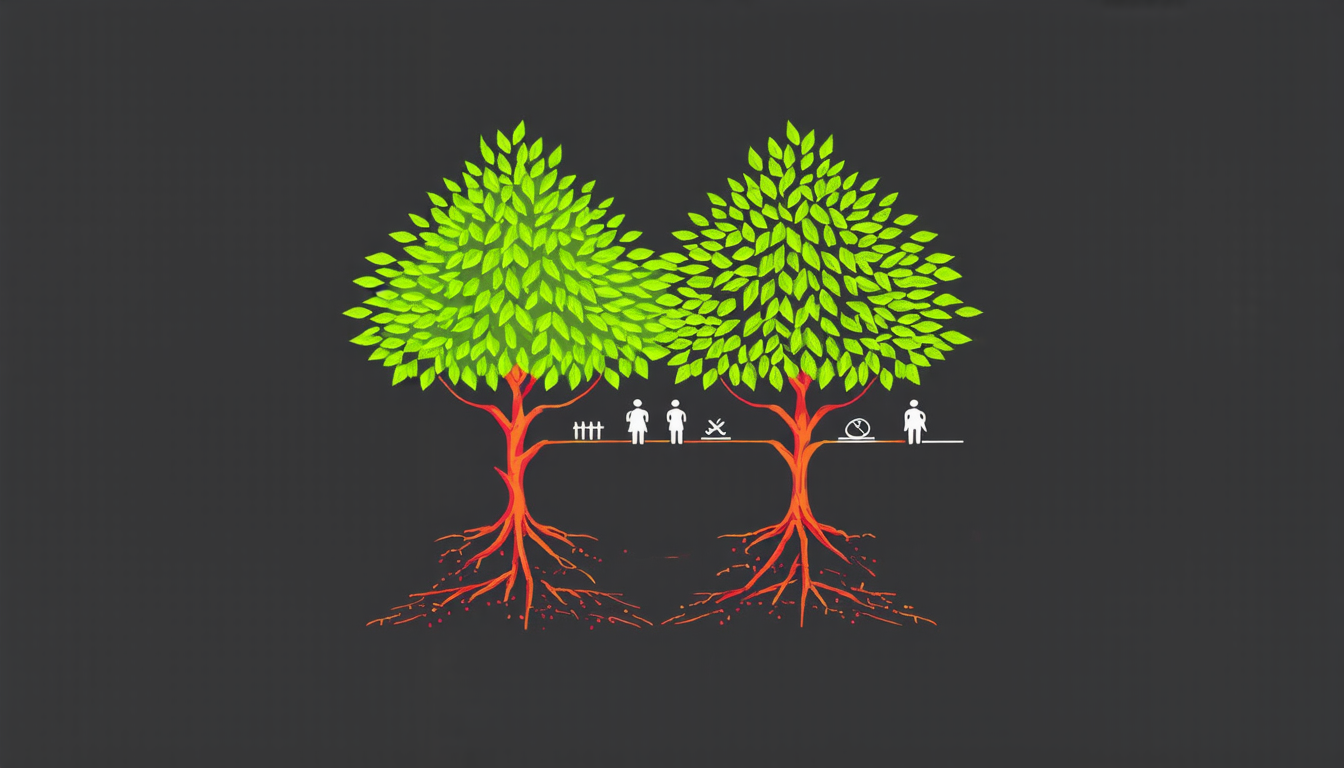
Tanglegrams are like the ultimate game of Jenga – you start with two trees, each with its own set of leaves, and then try to connect them in a way that makes sense. Sounds simple enough, but as the number of trees increases, so does the complexity of the connections between them. It’s like trying to untangle a knotty rope, only instead of knots, you have thousands of leaves and branches to keep track of.
Mathematicians have been struggling to come up with an efficient way to reconstruct these tanglegrams from their constituent parts – in other words, to figure out how the individual trees are connected. This is no trivial task, as the number of possible combinations grows exponentially with each new addition to the network.
Enter the researchers, who used a combination of mathematical techniques and computer simulations to crack the code. They focused on a specific type of tanglegram known as a caterpillar tree – a tree whose internal branches form a straight line, like the spine of an insect. By studying these trees, they were able to develop a set of algorithms that could accurately reconstruct the entire network from its individual components.
The implications are significant, as this breakthrough has far-reaching applications in fields such as biology, ecology, and even computer science. For example, biologists might use these techniques to study how different species interact with each other, while ecologists could apply them to understand how ecosystems function.
But what’s truly remarkable about this research is the way it highlights the interconnectedness of seemingly disparate fields. Math and biology may seem worlds apart, but as this study shows, they are intimately connected – just like the trees and leaves in a tanglegram.
The researchers’ findings also underscore the importance of simplicity and elegance in mathematical solutions. By focusing on a specific type of tree, they were able to develop a set of algorithms that could be applied more broadly. This is a powerful reminder that sometimes, taking things one step at a time can lead to profound insights and breakthroughs.
In short, this research represents a major step forward in our understanding of complex networks and the connections between them.
Cite this article: “Unraveling Tanglegrams: A Breakthrough in Understanding Complex Networks”, The Science Archive, 2025.
Mathematics, Biology, Ecology, Computer Science, Trees, Leaves, Tanglegrams, Networks, Algorithms, Simplicity





