

Wednesday 19 March 2025
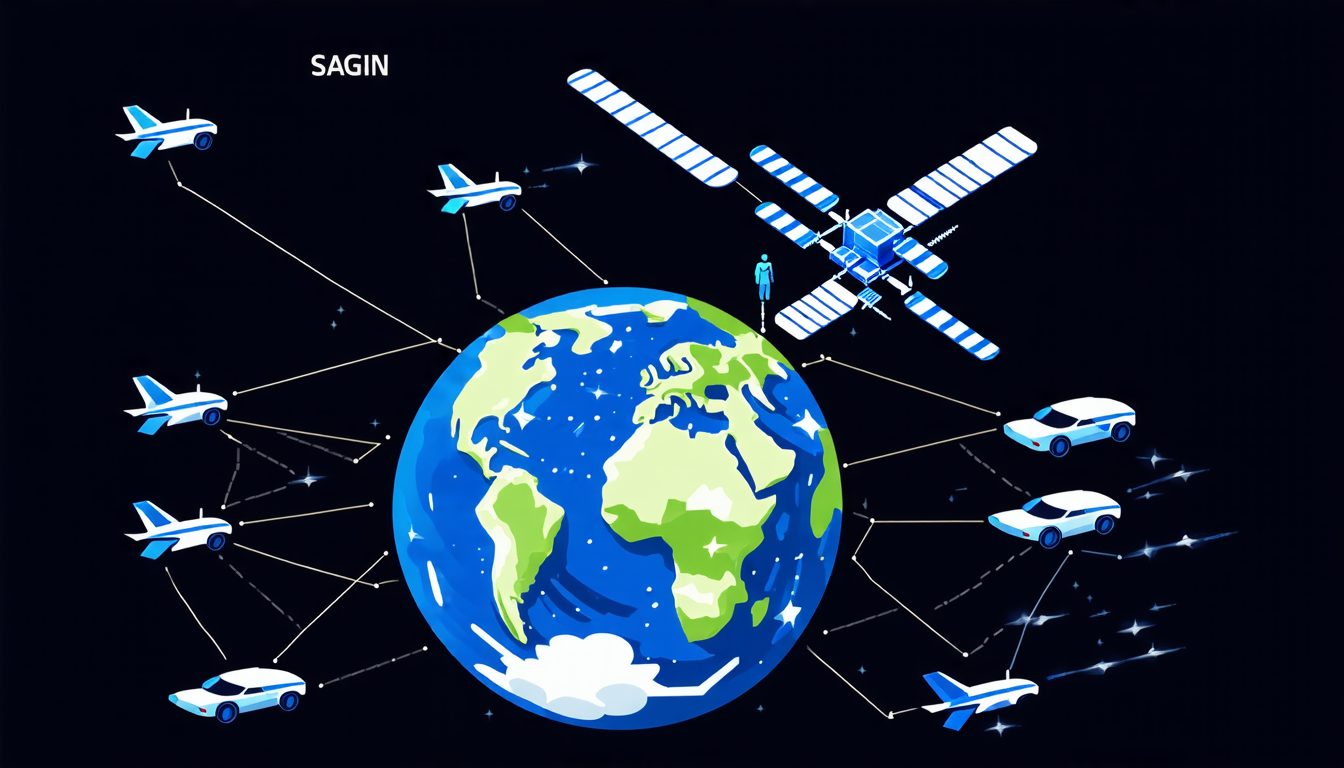
The quest for seamless connectivity in the sixth generation of wireless networks has led researchers to explore innovative solutions. One such approach involves integrating satellites, air vehicles, and ground stations into a single network, known as Space-Air-Ground Integrated Network (SAGIN). This futuristic concept aims to provide ubiquitous coverage and high-speed data transmission.
To make SAGIN a reality, scientists have developed a framework that enables the efficient deployment of virtual network functions (VNFs) in this complex environment. VNFs are software-based components that can be dynamically provisioned and orchestrated across various nodes within the network. By leveraging artificial intelligence and machine learning techniques, researchers have designed an algorithm that optimizes the allocation of resources to ensure seamless service provisioning.
The key challenge lies in addressing the dynamic nature of SAGIN, where nodes may fail or become unavailable due to satellite malfunctions, air vehicle crashes, or ground station outages. To tackle this problem, the researchers developed a matching game-based approach that efficiently recovers from failures by reallocating resources and reconfiguring network topology.
The proposed algorithm, known as FRMG-SAGIN, is designed to minimize the total time required to complete all service function chain deployments in the face of resource failures. Service function chains are critical components of SAGIN, enabling the provisioning of various services such as data processing, storage, and transmission.
Simulation results demonstrate that FRMG-SAGIN outperforms other benchmark algorithms, reducing the total time consumption by approximately 25%. This innovative approach not only enhances network resilience but also improves overall performance, making it an attractive solution for future wireless networks.
The integration of satellites, air vehicles, and ground stations into a single network presents numerous opportunities for innovative applications. SAGIN has the potential to revolutionize various industries, such as environmental monitoring, emergency response, and logistics management, by providing real-time data transmission and processing capabilities.
As researchers continue to push the boundaries of wireless networking technology, the development of efficient and resilient resource allocation algorithms like FRMG-SAGIN will play a crucial role in realizing the full potential of SAGIN. This breakthrough has far-reaching implications for the future of connectivity, enabling seamless communication and data transfer across various domains and industries.
Cite this article: “Seamless Connectivity in Space-Air-Ground Integrated Networks: A Breakthrough Algorithm for Efficient Resource Allocation”, The Science Archive, 2025.
Wireless Networks, Satellite Communication, Air Vehicles, Ground Stations, Space-Air-Ground Integrated Network, Virtual Network Functions, Artificial Intelligence, Machine Learning, Resource Allocation, Fault Tolerance.





