

Sunday 06 April 2025
As we continue to push the boundaries of what is possible with robotics and artificial intelligence, researchers have made a significant breakthrough in the field of aerial manipulation. For years, scientists have been working on developing systems that can manipulate objects using cables suspended from flying robots, but this latest innovation takes it to a whole new level.
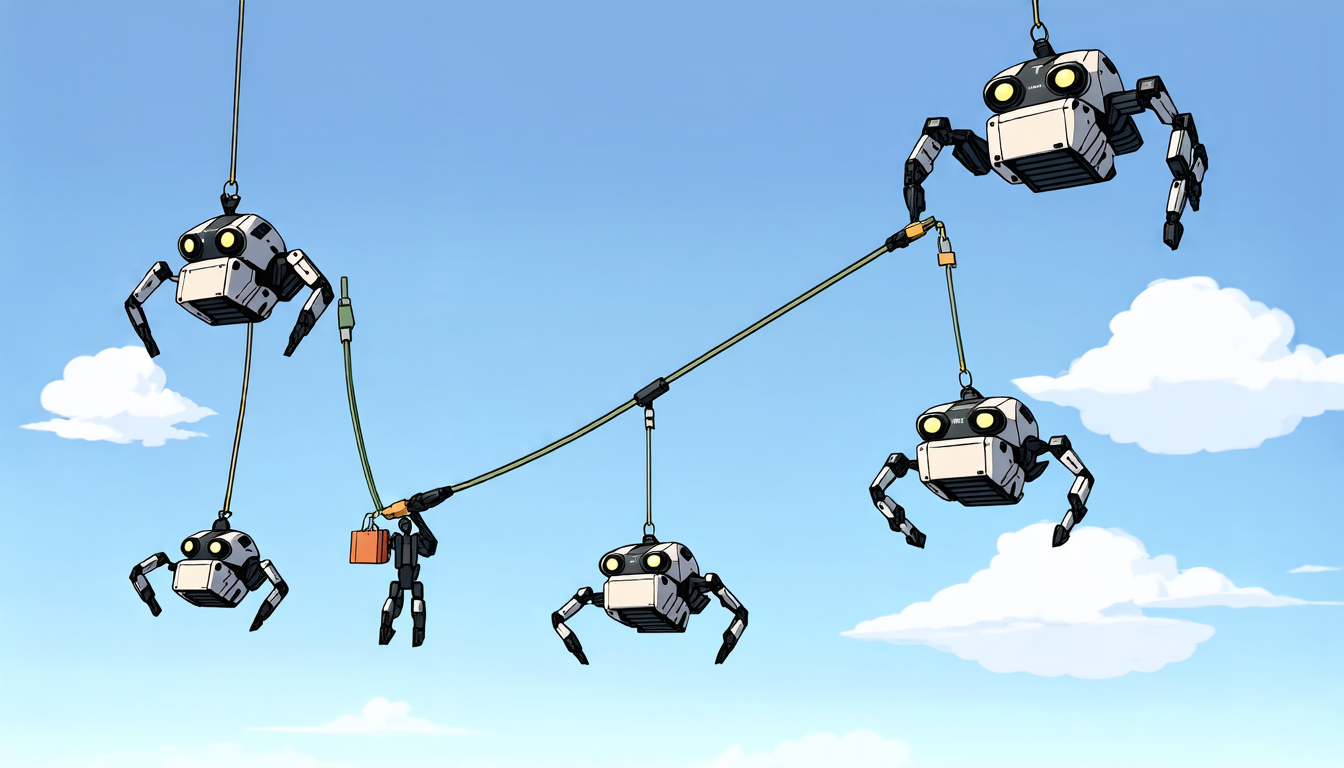
The key to this achievement lies in the concept of non-stop carrier flights, where multiple flying robots work together to maintain a constant pose for a suspended load. This is no easy feat, as the robots need to be able to adjust their movements and forces to ensure that the load remains stable and stationary.
To achieve this, researchers have developed an algorithm that can generate coordinated trajectories for the flying robots, allowing them to work together seamlessly to manipulate the load. The algorithm takes into account various factors such as the positions and velocities of the robots, the tension in the cables, and the weight of the load itself.
One of the most impressive aspects of this technology is its ability to adapt to changing circumstances. For example, if a robot were to encounter an obstacle or experience a malfunction, the algorithm can quickly adjust the movements of the other robots to ensure that the load remains stable.
This innovation has significant implications for a range of industries, from manufacturing and construction to search and rescue operations and environmental monitoring. Imagine being able to use flying robots to transport heavy equipment or supplies to remote locations without having to worry about the logistics of getting them there.
But this technology is not limited to just transporting objects. It also has the potential to revolutionize the way we think about aerial manipulation, allowing us to perform complex tasks such as lifting and placing heavy objects or even manipulating delicate materials.
The researchers behind this breakthrough are now working on refining their algorithm and testing its capabilities in real-world scenarios. As they continue to push the boundaries of what is possible with aerial manipulation, it will be exciting to see where this technology takes us.
In recent years, we have seen a surge in the development of flying robots, from drones designed for recreational use to more advanced systems being used for search and rescue operations and environmental monitoring. This latest innovation takes that technology to the next level, allowing us to harness the power of multiple flying robots working together to manipulate objects suspended from cables.
This breakthrough has significant implications for a range of industries, from manufacturing and construction to environmental monitoring and disaster response.
Cite this article: “Unstoppable Aerial Manipulation: Flying Carriers Keep Payloads Stationary Despite Non-Stop Flight”, The Science Archive, 2025.
Flying Robots, Aerial Manipulation, Robotics, Artificial Intelligence, Cable Suspension, Non-Stop Carrier Flights, Coordinated Trajectories, Algorithm, Object Manipulation, Industrial Applications





