

Tuesday 08 April 2025
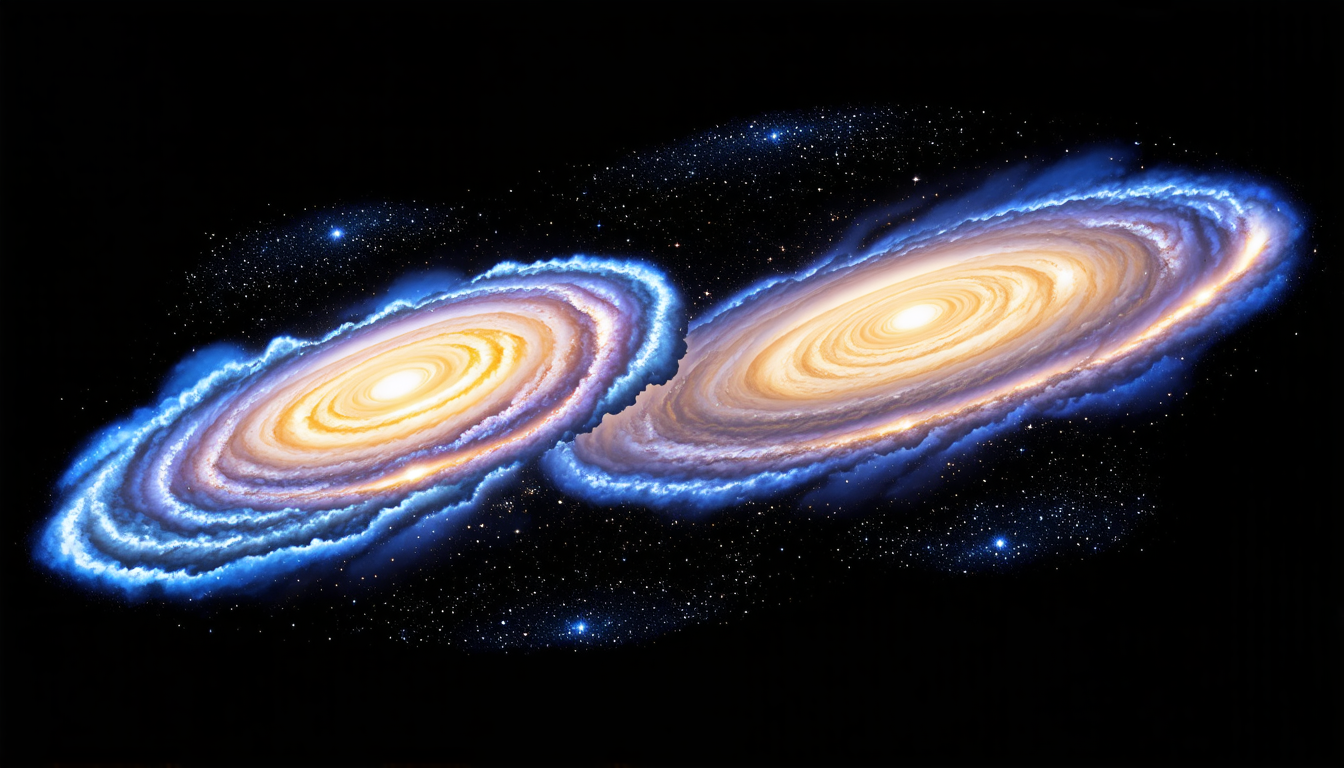
A recent study has shed new light on the mysterious phenomenon of Hi deficiency in Hickson Compact Groups (HCGs), a type of galaxy cluster that is thought to be one of the most intense and dynamic environments in the universe.
For decades, astronomers have been puzzled by the fact that some galaxies within these clusters show significant deficiencies in their neutral hydrogen gas content. This deficiency is particularly striking when compared to surrounding galaxies outside of the cluster. To understand what’s going on, scientists have been studying the properties of HCGs and the relationships between their constituent galaxies.
One key finding has been the identification of different phases of galaxy evolution within these clusters. The research suggests that galaxies in Phase 2 are characterized by a significant loss of Hi gas due to interactions with other cluster members. In contrast, galaxies in Phase 3 have already experienced this depletion and now show a marked increase in their neutral hydrogen content.
But what drives these differences? To answer this question, scientists have been analyzing the properties of the galaxy cores and outskirts within each phase. They’ve found that the core galaxies in Phase 2 are generally more massive and have higher star formation rates than those in Phase 3. The outskirts galaxies, on the other hand, show a reverse trend.
These findings hint at a complex interplay between gas stripping, star formation, and galaxy mergers within HCGs. It’s thought that the core galaxies in Phase 2 are still undergoing intense interactions with their neighbors, which leads to the stripping of their neutral hydrogen gas. As these interactions cease, the galaxies enter Phase 3 and begin to replenish their Hi supplies through other mechanisms.
The study also highlights the importance of considering the morphological properties of HCGs when analyzing Hi deficiency. The researchers found that different galaxy types – such as elliptical or spiral galaxies – exhibit distinct patterns of Hi depletion. This suggests that the evolution of these clusters is shaped by a variety of factors, including the initial conditions and interactions between their constituent galaxies.
These findings have significant implications for our understanding of galaxy evolution within HCGs. By studying these complex systems, scientists can gain valuable insights into the processes that shape the formation and demise of galaxies over billions of years. The results also underscore the importance of considering the full range of galaxy properties when analyzing Hi deficiency in these environments.
Ultimately, this research highlights the intricate dance between gas, stars, and gravity within HCGs.
Cite this article: “Galactic Neighborhoods: Uncovering the Secrets of Compact Group Evolution”, The Science Archive, 2025.
Galaxy Evolution, Hickson Compact Groups, Neutral Hydrogen Gas, Star Formation Rates, Galaxy Mergers, Gas Stripping, Morphological Properties, Elliptical Galaxies, Spiral Galaxies, Galaxy Clusters





