

Wednesday 16 April 2025
Physicists have long been fascinated by the intricate dance of quantum mechanics and thermodynamics, two fundamental forces that govern our universe. At their intersection lies a phenomenon known as dynamical quantum phase transitions, where the behavior of particles can change dramatically in response to subtle changes in temperature or other environmental factors.
In recent years, researchers have made significant progress in understanding these transitions, which are characterized by the emergence of exotic states such as topological phases and non-equilibrium steady states. However, the study of DQPTs has been limited by the need for large-scale experiments and complex simulations.
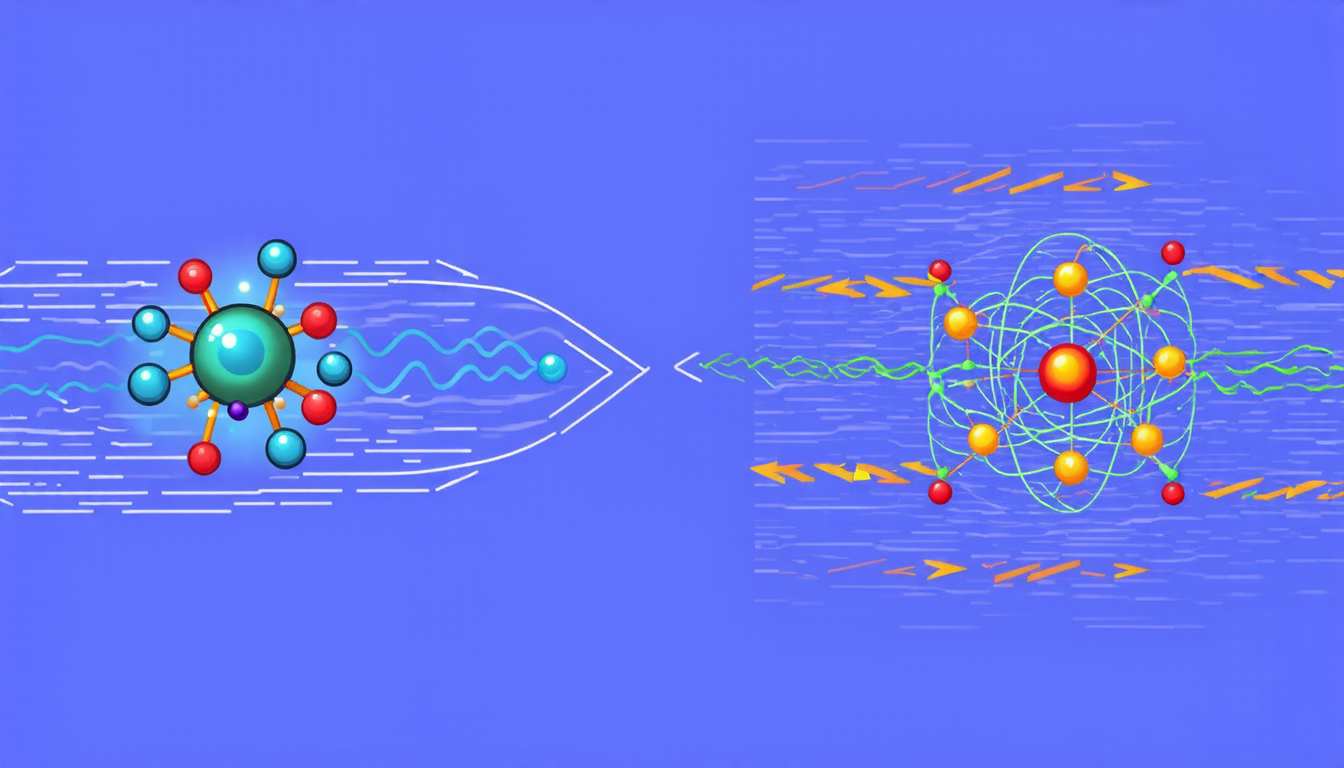
A new paper published in a leading physics journal offers a potential solution to this problem, proposing a novel approach to probing DQPTs in finite-size quantum systems using a two-step quenching protocol. The authors demonstrate that by carefully tuning the rate of change during these quenches, scientists can access exact Loschmidt echo zeros – a hallmark of DQPTs – even in small-scale systems.
The researchers used the transverse Ising model as a testbed for their approach, which is a simplified version of real-world magnetic systems. By applying a two-step quench protocol to this model, they were able to observe the emergence of Loschmidt echo zeros and dynamical topological order parameters, both of which are key indicators of DQPTs.
The significance of this work lies in its potential to enable experiments on DQPTs using currently available technology. In particular, the authors suggest that their approach could be used to study DQPTs in ultracold atomic gases and other quantum simulators, which offer a more controllable environment than traditional solid-state systems.
The implications of this research are far-reaching, with potential applications in fields such as condensed matter physics, materials science, and even quantum computing. By gaining a deeper understanding of the intricate dynamics that govern DQPTs, scientists may be able to design new materials with unique properties or develop more efficient algorithms for quantum simulations.
While the study of DQPTs is still in its early stages, this paper represents an important step forward in our ability to probe and understand these exotic phenomena. As researchers continue to refine their techniques and push the boundaries of what is possible, we may uncover new secrets about the behavior of matter at the quantum level – and potentially unlock new technologies that could revolutionize our understanding of the universe.
Cite this article: “Unlocking the Secrets of Quantum Phase Transitions: A New Framework for Exploring Dynamic Critical Phenomena”, The Science Archive, 2025.
Quantum Mechanics, Thermodynamics, Dynamical Quantum Phase Transitions, Topological Phases, Non-Equilibrium Steady States, Transverse Ising Model, Loschmidt Echo, Ultracold Atomic Gases, Quantum Simulators, Condensed Matter Physics.





